Vietnam, US step up healthcare cooperation, focusing on digital technologies

The meeting also formed part of efforts to implement the Politburo's Resolution No. 59-NQ/TW on international integration in the new context and Resolution No. 57-NQ/TW on breakthroughs in science, technology, innovation and national digital transformation.

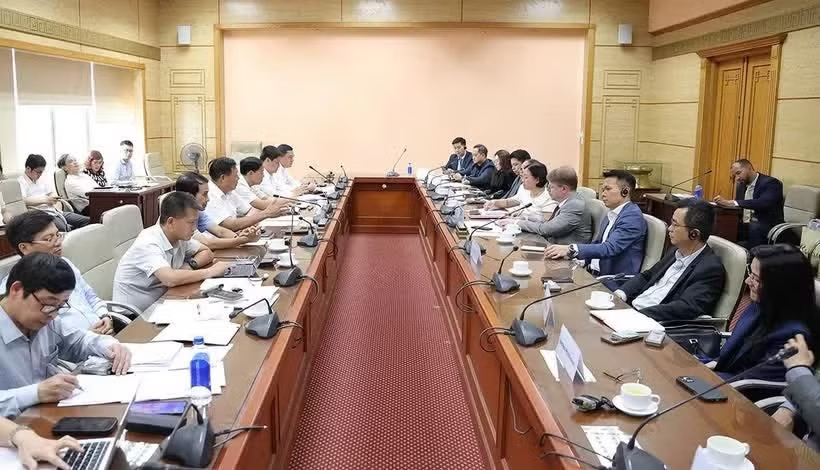
An overview of the meeting (Photo: VietnamPlus)

Hanoi (VNA) – Deputy Minister of Health Do Xuan Tuyen received a US business delegation led by John Goyer, Executive Director for Southeast Asia and Oceania at the US Chamber of Commerce in Hanoi on May 6.

The two sides sought measures to expand cooperation in key areas of health care, including artificial intelligence (AI), digital transformation, pharmaceuticals, and medical devices, to improve service quality and foster innovation.

The discussions focused on regulatory frameworks for AI-powered diagnostic software and digital health solutions, the development of a national breast and cervical cancer screening programme, licensing procedures for new pharmaceuticals and medical devices, updates to the medical device law, opportunities for private-sector cooperation, as well as issues related to the health insurance drug list and food safety.

The meeting also formed part of efforts to implement the Politburo's Resolution No. 59-NQ/TW on international integration in the new context and Resolution No. 57-NQ/TW on breakthroughs in science, technology, innovation and national digital transformation.

Tuyen highlighted the strong healthcare partnership between Vietnam and the US, particularly Washington's support for public health care, disease prevention and control, workforce training, and strengthening the national health system. He expressed hope that bilateral cooperation, including in health care, would continue to deepen for the benefit of both countries.

He noted that Vietnam-US healthcare cooperation has produced significant outcomes in recent years, with the US serving as one of Vietnam's leading partners in strengthening healthcare capacity, combating diseases, advancing scientific research and technology transfer, and developing a high-quality medical workforce.

The official praised the contributions of US companies in pharmaceuticals, medical devices, biotechnology and digital health, saying they have helped improve the quality of healthcare services in Vietnam.

img-6343.jpg
John Goyer, Executive Director for Southeast Asia and Oceania at the US Chamber of Commerce in Hanoi speaks at the meeting (Photo: VNA)

As the world faces mounting challenges ranging from population ageing and non-communicable diseases to public health risks and climate change, healthcare innovation will be key to building a more resilient, adaptive and inclusive health system, he said.

Vietnam's health sector is prioritising three pillars - digital transformation, including electronic health records, telemedicine, and AI applications in diagnosis and disease management; improving grassroots healthcare to ensure equitable access in remote areas; and promoting a sustainable healthcare model, focusing on easing overcrowding, and developing advanced treatment models, including home-based care and preventive medicine.

The ministry sees significant potential for cooperation with US companies in advanced medical technologies, research and development, and resilient healthcare supply chains, Tuyen said, calling on American healthcare firms to continue developing practical and mutually beneficial partnerships with Vietnam.

Goyer and representatives of the participating US companies introduced their respective strengths and shared their interest in Vietnam's healthcare policy and regulatory framework.

In recent years, the Ministry of Health has issued a series of guidelines designed to create a more favourable environment for international investment and cooperation, including with US companies. These reforms have also opened up greater opportunities for Vietnamese businesses to collaborate, adopt cutting-edge technologies, develop domestic products that meet local demand, and gradually expand into export markets.

Tuyen expressed confidence that the exchanges would help translate cooperation into concrete outcomes, delivering tangible benefits for the public./.

VNA

See more

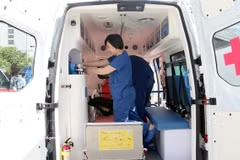
An ambulance from the pre-hospital emergency care service in Phu Quoc special zone in An Giang province. (Photo: VNA)

Pre-hospital emergency care system to be launched nationwide

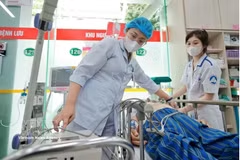
From 2027, the national pre-hospital emergency management platform will be put into operation, connecting data with the 113, 114 and 115 emergency call systems to facilitate rapid emergency dispatch and improve public access to emergency services.

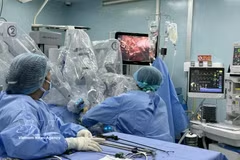
Foreign patients travel to Vietnam for robotic cancer surgery at one-tenth of US costs

Foreign patients travel to Vietnam for robotic cancer surgery at one-tenth of US costs

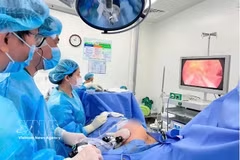
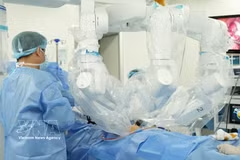
With robot-assisted surgery costing tens of thousands of dollars in the US and Singapore, a growing number of international patients are traveling to Vietnam for robotic cancer surgery, including procedures for prostate, gynecological and gastrointestinal cancers, using the US made da Vinci Xi system at costs starting from just 3,000 USD.

Under a phased rollout beginning in 2026, every resident in Ho Chi Minh City will receive at least one annual health check-up or health screening. (Photo: VNA)

Ho Chi Minh City develops integrated multi-tier healthcare system

Under the new model, healthcare is organised into interconnected levels based on people's needs rather than administrative boundaries. Patients can move seamlessly between levels while their electronic health records and treatment information remain connected through digital platforms, referral systems, telemedicine, electronic medical records, and integrated health databases.

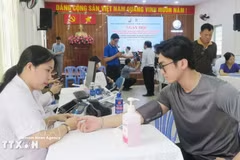
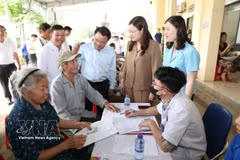
Doctors conduct heart and lung examinations for workers. (Photo: VNA)

Draft policy encourages people to prepare for old age from middle age

A draft circular guiding the implementation of the National Target Programme on Health Care, Population and Development (2026-2035) marks a shift from focusing solely on elderly care to encouraging healthy and independent ageing through early preparation. It covers healthy lifestyles, regular health check-ups, financial planning, suitable employment and home-based elderly care skills.

The meeting between the Vietnam Military Medical University delegation and leaders of the Lao Ministry of National Defence in Vientiane (Photo: VNA)

Vietnam, Laos deepen military medical cooperation

Since 1954, Vietnam Military Medical University has trained 687 Lao military medical personnel, including 322 doctors, 67 master's degree holders, 10 doctorate holders, and dozens of specialist physicians, alongside hundreds of pharmacists and medical technicians.

Vietnam's first penis transplant from a brain-dead donor is successfully performed at Viet Duc University Hospital. (Photo published by VNA)

Vietnam reaches new milestone in reconstructive transplant surgery

As the first operation of its kind in Vietnam, the hospital spent months developing treatment protocols, studying international experience and assembling a multidisciplinary team that included experts in transplantation, andrology, microsurgery, anaesthesia, immunology and pathology.

Dr. Nguyen Thanh Xuan is performing brain surgery on a patient (Photo published by VNA)

National strategy aims to build advanced medical ecosystem

Vietnam's adjusted healthcare network master plan for 2021–2030, with a vision to 2050, also outlines a regional structure covering the country's six socio-economic regions. It envisages 17 provincial general hospitals serving regional functions, at least one highly specialised hospital in each region, and at least one advanced medical facility in every province and city.

Vietnamese Ambassador to Bulgaria Nguyen Thi Minh Nguyet and Prof. Dr. Nguyen Huu Tu, President of Hanoi Medical University, meet with Prof. Boycho Landjov, President of Sofia Medical University. (Photo: VNA)

Vietnam, Bulgaria forge closer medical ties

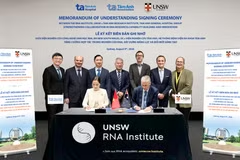
The visit's highlight was the signing of a memorandum of understanding (MoU) between Hanoi Medical University and Sofia Medical University, creating a long-term framework for academic exchanges, scientific research and institutional cooperation between the two countries' leading medical schools.

The Intensive Care Unit at Duc Giang General Hospital has continuously introduced and applied advanced specialised techniques to improve the treatment and survival of critically ill patients. (Photo: VNA)

40 years of renewal: Healthcare quality advanced for new era

Over the past four decades of Doi moi (Renewal), Vietnam’s healthcare sector has made remarkable progress, and is now well positioned to achieve further breakthroughs by harnessing science, technology and innovation to improve public health care in the new era, according to experts from the Vietnam Union of Science and Technology Associations (VUSTA).