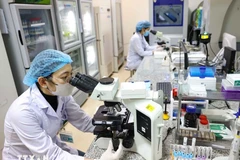
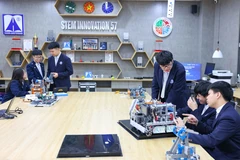
Vietnamese firms accelerate AI applications

Nationwide, around 47,000 businesses, or 13% of Vietnamese businesses, adopted AI solutions in 2024, averaging five every hour. Almost 170,000, or 18%, now use AI, showing a year-on-year growth rate of 39%.

Hanoi (VNA) - In nearly one year, about 170,000 new businesses in Vietnam have adopted artificial intelligence (AI) in their operations and service delivery, according to Amazon Web Services’ (AWS) Unlocking Vietnam’s AI Potential study.

To better understand the scope of AI and where companies of different scales might be headed, AWS collaborated with Strand Partners to conduct the study, which surveyed 1,000 business leaders, and 1,000 nationally representative members of the public.

Nationwide, around 47,000 businesses, or 13% of Vietnamese businesses, adopted AI solutions in 2024, averaging five every hour. Almost 170,000, or 18%, now use AI, showing a year-on-year growth rate of 39%. The productivity and economic potential of AI adoption are promising.

Vietnamese businesses show strong AI innovation adoption, demonstrating significant economic potential, said Eric Yeo, Country General Manager, AWS Vietnam.

The survey shows that 61% of Vietnam’s businesses that have adopted AI reported an increase in revenue, at an average rise of 16%, while 58% expected an average of 20% in cost savings.

eric-yeo-aws.jpg
Eric Yeo, Country General Manager, AWS Vietnam (Photo courtesy of AWS)

The level of AI adoption also shows polarisation among businesses. As many as 55% of start-ups are using AI in some way, of which 35% are building entirely new AI-driven products. In contrast, 41% of large enterprises use AI, but only 11% of these are delivering a new AI-driven product or service, and only 12% have a comprehensive AI strategy. Clearly, start-ups in Vietnam show a much stronger interest and sharper responsiveness in applying and leveraging the strengths of AI, with a pace of adopting advanced technologies that far surpasses many long-established enterprises.

“The nimbler, faster-paced start-ups are also pulling ahead of large enterprises in their speed and depth of innovation. The resulting ‘two-tier’ AI economy could have lasting implications on a country’s future economic development. Celebrating AI adoption numbers alone masks the deeper challenges many businesses face across Vietnam,” said Nick Bonstow, Director at Strand Partners.

Although AI adoption in Vietnam is growing rapidly, most businesses remain at a basic level and have yet to fully tap into the potential of this technology.

About 74% of businesses remain focused primarily on basic AI uses, like driving efficiencies and streamlining processes. Just 17% have advanced to the intermediate stage of AI adoption, and only 9% have reached the most transformative stage of AI integration, where AI is no longer just a tool but a core part of product development, decision-making, and business models.

A lack of skilled personnel is the leading reason that 55% of surveyed firms said is preventing them from adopting or expanding their use of AI. Many reported having the technology and the vision, but are unable to find the people to bring it to life.

Lastly, with 69% saying they are more likely to adopt AI if the government leads, it will be critical to accelerate digital transformation in the public sector, especially in healthcare and education, and use public procurement to drive innovation./.


VNA

See more

Experience virtual reality technology at Nha Trang Center shopping mall (Khanh Hoa). (Photo: VNA)

Experts give ideas to build AI economy from data

According to Nguyen Trung Chinh, Chairman and Executive President of CMC Technology Group, Vietnam’s economic growth over past decades has largely relied on labour expansion, capital accumulation, export promotion and deep global trade integration. However, as the country enters a higher development stage, this model is showing limitations, including declining low-cost labour advantages, slower improvements in capital efficiency, and increasing competition centred on productivity, technology and innovation.

VINASA Vice Chairwoman and Secretary General Nguyen Thi Thu Giang (right) and SEPC General Director Abhay Sinha sign the MoU on cooperation in New Delhi on March 25. (Photo: VNA)

Vietnam, India ink deal to step up IT cooperation

Under the terms of the MoU, the two sides will jointly push trade and investment in IT and services, arrange business delegations and business-to-business meetings, share market and policy information, and help companies access partnership opportunities and expand into new markets.

The Ninh Thuan 1 Nuclear Power Plant project is planned to be built in Khanh Hoa province (Photo: VNA)

Vietnam approves atomic energy development strategy, targeting civil applications

Tran Chi Thanh, Director of the Vietnam Atomic Energy Institute under the Ministry of Science and Technology, underscored that in the coming period, the institute and its affiliated units will continue promoting their strengths to promote the safe and secure application of atomic energy, contributing effectively to socio-economic development goals.

Students at FPT Ha Nam Inter-level High School practice their lessons directly by applying digital technology software (Photo: VNA)

FPT joins top 35 global AI application development service providers

The recognition reflects FPT’s end-to-end AI capabilities, spanning strategic consulting, solution design, application development, and the integration and deployment of AI systems in real-world operations. Notably, the company has developed IvyHub, an integrated agentic AI platform that enables enterprises to design, deploy and manage AI agents at scale.

The High-Frequency Systems and Microchip Laboratory at Ho Chi Minh City University of Technology, Vietnam National University, Ho Chi Minh City. (Photo: VNA)

Ho Chi Minh City sets sights on becoming semiconductor hub

A central component of the plan is expanding cooperation with global technology leaders such as AMD, NVIDIA and Qualcomm. These partnerships are expected to support technology transfer, strengthen chip design capabilities and help the city move further up global semiconductor value chains.

The modern nanotechnology research laboratory of Vietnam National University, Ho Chi Minh City. (Photo: VNA)

Resolution 57 delivers tangible outcomes from local practice

In the course of implementing this resolution, the northern province of Quang Ninh has emerged as one of the early movers in translating strategic orientations into comprehensive development models linked to innovation and digital transformation.

Delegates at the launch of the new version of Ho Chi Minh City technology exchange platform. (Photo: VNA)

Ho Chi Minh City launches upgraded technology exchange platform

The upgraded platform represents a comprehensive shift from a simple information-sharing model to a managed online technology trading system, enabling monitoring and measurement of real transaction outcomes. It is built on three pillars, namely new tradable technology products, a modern digital platform, and an improved operational model.

A Viettel 5G base station provides coverage at the April 16 Square area in Dong Hai ward, Khanh Hoa province. (Photo: VNA)

Conquering 6G networks helps Vietnamese businesses master strategic technologies

The global 6G alliance marks not only a technological milestone but also an opportunity for Vietnamese enterprises to strengthen their position on the global technology landscape. With the involvement of FPT, Viettel and VNG, Vietnam is gradually emerging as an early mover in the development and application of 6G technology.

At the Online Product Safety Summit in Hanoi on March 18. (Photo: dms.gov.vn)

Hanoi summit advances operation of ASEAN product safety portal

The Online Product Safety Summit in Hanoi on March 18 focused on practical enforcement solutions for identifying and removing non-compliant goods from online marketplaces, thereby strengthening consumer protection amid the rapid growth of e-commerce.

Illustrative image (Photo: VNA)

Resolution 57 charts directions for Vietnam’s technology ecosystem

Vietnam's sci-tech sector must evolve from a manufacturing base toward mastering technologies and ultimately developing original products independently, which requires shifting away from outsourcing and assembly models to one where domestic scientists lead in design, development and ownership of core technologies.

Party General Secretary To Lam (centre), Prime Minister Pham Minh Chinh (left), and Chairman of the Party Central Committee’s Commission for Internal Affairs Phan Dinh Trac mark the start of work on a high-tech semiconductor manufacturing plant in Hanoi on January 16, 2026. (Photo: VNA)

Resolution 57 refines technology priorities for new growth phase

The Ministry of Science and Technology is seeking feedback on a draft Prime Minister decision outlining four key categories: priority high technologies for investment, encouraged high-tech products, strategic technologies, and strategic tech products. The move is intended to capture emerging technology trends while strengthening the policy framework for high-tech development.

Professor Geert Angenon of Vrije Universiteit Brussel (Photo: VNA)

European experts highlight potential for AI cooperation with Vietnam

Experts believe that as demand for technological innovation grows and international partnerships expand, Vietnam has big opportunities to deepen cooperation with European partners in high-tech agriculture, healthcare, digital transformation and artificial intelligence.