Vietnam’s diplomacy: Eight decades of dedicated service to the nation

From a small nation once colonised and devastated by war, today, in the eyes of the international community, Vietnam is a developing country with an increasingly important role and position in the region.

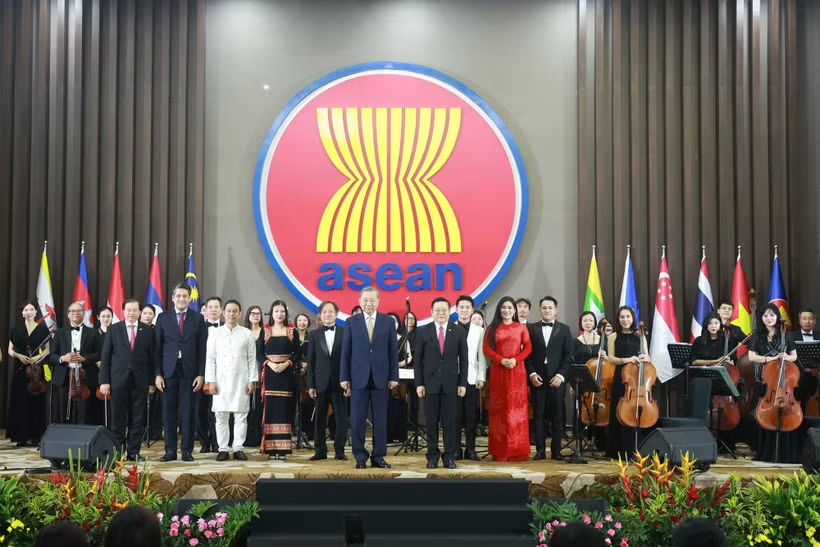
Vietnamese Party General Secretary To Lam (L, 1st row) and ASEAN Secretary-General Kao Kim Hourn on March 10, 2025 pose for a photo with the performing arts troupe at a ceremony marking the 30th anniversary of Vietnam’s accession to ASEAN. (Photo: VNA)

Hanoi (VNA) - From a small nation once colonised and devastated by war, today, in the eyes of the international community, Vietnam is a developing country with an increasingly important role and position in the region.

The red flag with a yellow star flying in front of the United Nations headquarters in the US, the ASEAN Secretariat in Indonesia, the UN peacekeeping mission in the Central African Republic, or at disaster “hotspots” in Türkiye and Myanmar all demonstrates Vietnam’s presence and its increasingly responsible contributions to the global community.

Looking back at Vietnam’s international relations since the country gained independence and established the Democratic Republic of Vietnam in 1945, Deputy Prime Minister and Minister of Foreign Affairs Bui Thanh Son affirmed that Vietnamese diplomacy has always been dedicated to serving the nation and people, making significant contributions to the country’s historic achievements.

From the very early days of nation-building, President Ho Chi Minh used diplomacy as a sharp weapon to gain more friends and reduce enemies, to divide the ranks of opponents, safeguard the young government, and buy more time and resources for the prolonged resistance war. During the struggle for national liberation and reunification, alongside the political and military fronts, diplomacy became an important and strategic front. It contributed to transforming battlefield victories into successes at the negotiation table, ultimately bringing an end to the war.

After the country was reunified, diplomacy played an important role in building peace, breaking through embargoes and blockades, and expanding the foreign affairs landscape. This was accomplished through a foreign policy of independence, self-reliance, multilateralisation and diversification, and for peace, cooperation, and development.

According to Son, the nearly 40-year history of the country's “Doi Moi” (Renewal) has affirmed the extremely important role of diplomacy across the three pillars of the Party’s foreign affairs, State diplomacy, and people-to-people diplomacy.

Diplomacy has contributed to expanding and deepening relationships with partners, and to closely coordinating with defence and security to firmly maintain independence, sovereignty, and territorial integrity of the Fatherland. This has contributed to safeguarding the country and protecting the legitimate rights and interests of the country, people, and businesses, emphasised Son.

In particular, economic diplomacy has become a central task and an important driving force for the country’s development. Vietnam has attracted hundreds of billions of USD in FDI capital, and become one of the top 20 countries with the largest trade volume in the world, and a key link in 17 FTAs with more than 60 major economies worldwide.

Over the course of eight decades, Vietnam has established diplomatic relations with 194 countries, and built a network of strategic and comprehensive partnerships with 37 nations, including all major powers and all five permanent members of the United Nations Security Council. Vietnam is also an active member of more than 70 international and regional organisations. Additionally, the Party has set up relations with 259 political parties in 119 countries.

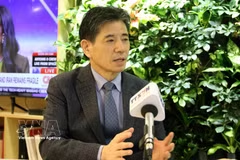
Choi Seung Jin, Director of the Korean Cultural Centre in Vietnam, affirmed Vietnam’s growing prestige and position on the international stage.

According to Choi, Vietnam has been undertaking multiple important roles and continues to further expand its presence and responsibilities globally
diplomacy-2.jpg
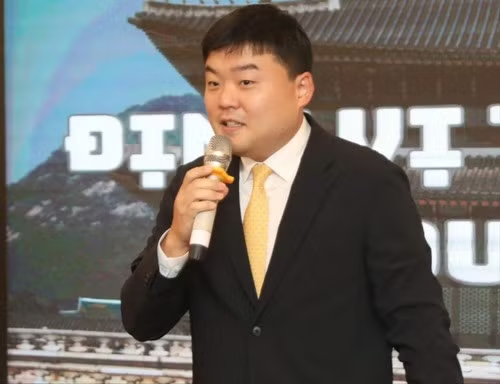
Choi Seung Jin, Director of the Korean Cultural Centre in Vietnam (Photo: VietnamPlus)

He took the country’s successful hosting of the Partnering for Green Growth and the Global Goals 2030 (P4G) Summit in April 2025 as an example. The event, he said, demonstrated its leadership voice in the fields of environmental protection and sustainable development.

The Korean cultural expert proposed a long-term investment strategy to tell Vietnam’s story through the creative industries. He proposed Vietnam and the Republic of Korea cooperate in this field, by co-producing cultural content, thereby enabling both countries to achieve growth in the cultural industry while promoting their national images.
diplomacy-1.jpg
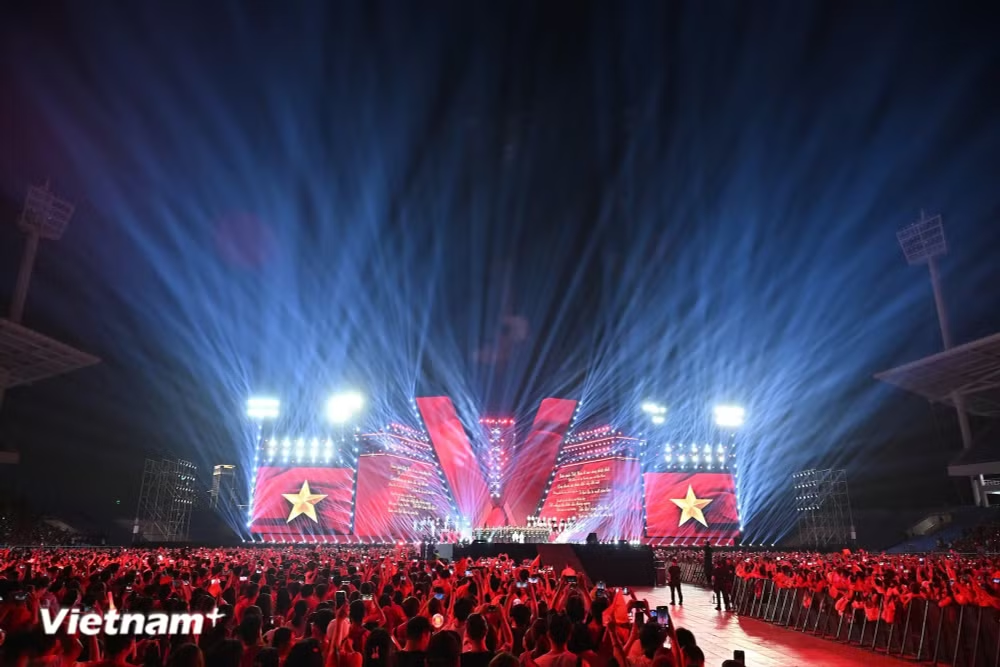
National concert evokes patriotism and national pride through music. (Photo: VietnamPlus)

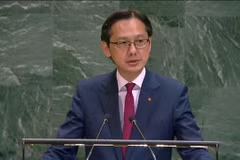
Regarding the direction for Vietnam’s multilateral diplomacy in the coming period, Deputy Minister of Foreign Affairs Do Hung Viet emphasised that multilateral diplomacy must closely coordinate with the country’s other diplomatic branches. It should continue to enhance Vietnam’s participation at multilateral forums, in a manner commensurate with the country’s stature and position./.
VNA

See more

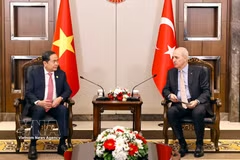
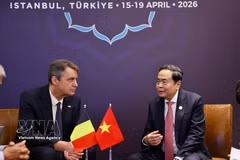
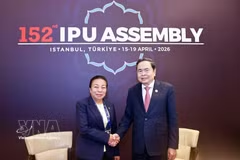
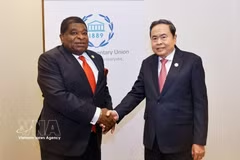
Chairman of the Vietnamese National Assembly Chairman Tran Thanh Man (left) meets with Speaker of the Grand National Assembly of Türkiye Numan Kurtulmus in Istanbul on April 17. (Photo: VNA)

Top legislators of Vietnam, Türkiye meet on sidelines of IPU-152 in Istanbul

The top Vietnamese legislator expressed his admiration for Türkiye’s cultural identity and its friendly, hospitable people, while highly valuing the European country’s growing role and position at multilateral forums and in regional mediation efforts. He affirmed that Vietnam attaches importance to strengthening ties with Türkiye.

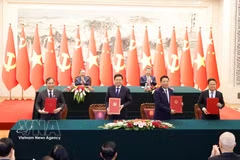
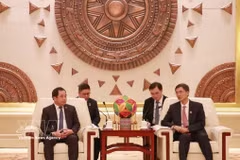
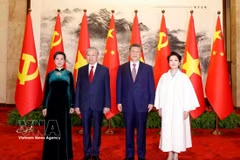
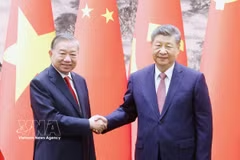
Officials sign cooperation documents in the presence of Party General Secretary and President of Vietnam To Lam, and his Chinese counterpart Xi Jinping on April 15, 2026. (Photo: VNA)

Vietnam, China sign 32 cooperation documents

The documents include a cooperation plan between the Communist Party of Vietnam (CPV) and the Communist Party of China (CPC) for the 2026–2030 period; a memorandum of understanding (MoU) on cooperation between the Organisation Commission of the CPV Central Committee and its Chinese counterpart; and a cooperation agreement between the Ministry of Foreign Affairs of Vietnam and the International Liaison Department of the CPC Central Committee.

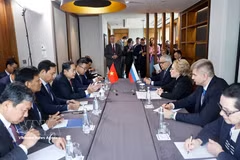
The meeting between Chairman of the Vietnamese National Assembly Tran Thanh Man and Speaker of the Federation Council of Russia’s Federal Assembly Valentina Matviyenko in Istanbul, Türkiye, on April 17 (Photo: VNA)

Parliamentary leaders hail development of Vietnam – Russia ties

The top legislator of Vietnam proposed that both sides deepen political and diplomatic connections, as well as parliamentary cooperation, through delegation exchanges, high-level meetings through various channels, and the successful organisation of a visit to Vietnam by the Speaker of Russia’s Federation Council and a trip to Russia by the NA Chairman to co-chair the 5th session of the Inter-Parliamentary Cooperation Committee in 2026.

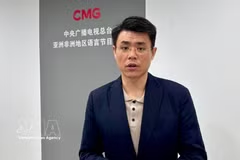
Wei Wei, a researcher on Vietnam and head of the Vietnamese-language service at the China Media Group, grants an interview to the Vietnam News Agency. (Photo: VNA)

Expert highlights new trends in Vietnam – China relations

A Chinese expert has paid attention to General Secretary and President To Lam's visit to the Xiong'an New Area, meeting with youth representatives of both countries together with his Chinese counterpart Xi Jinping, and experience of high-speed rail travel.

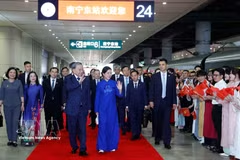
General Secretary of the Communist Party of Vietnam (CPV) Central Committee and State President To Lam and his spouse, together with a high-level Vietnamese delegation, leave Nanning on April 17, successfully concluding their state visit to China from April 14–17 (Photo: VNA)

General Secretary, State President To Lam concludes state visit to China

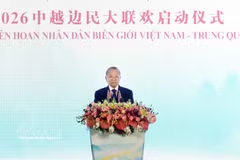
The trip also included meetings with Vietnamese diplomatic staff and the Vietnamese community in China, exchanges with relatives of Chinese generals, experts and others who had supported Vietnam-China friendship, attendance at a Vietnam - China friendship art programme, a visit to the historic Nanning Yucai School, and participation in activities launching a Vietnam–China Border People’s Festival 2026.

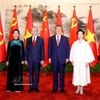
General Secretary of the Communist Party of China (CPC) Central Committee and President Xi Jinping (R) welcomes General Secretary of the Communist Party of Vietnam (CPV) Central Committee and State President To Lam (Photo: VNA)

Vietnam, China issue joint statement on deepening Comprehensive Strategic Cooperative Partnership in new era

The State visit to China by Party General Secretary and State President To Lam was a great success, positively contributing to strengthening the traditional friendship and accelerating the building of the Vietnam–China community with a shared future that carries strategic significance, thus promoting peace, stability, development, and prosperity in the region and the world.