Writing for young readers helps foster reading culture: Mexican author

Having joined anti-war demonstrations in support of Vietnam in the 1970s, Villoro returned to the country more than half a century later as one of Mexico's most celebrated writers, serving as a bridge for cultural exchange between the two nations.

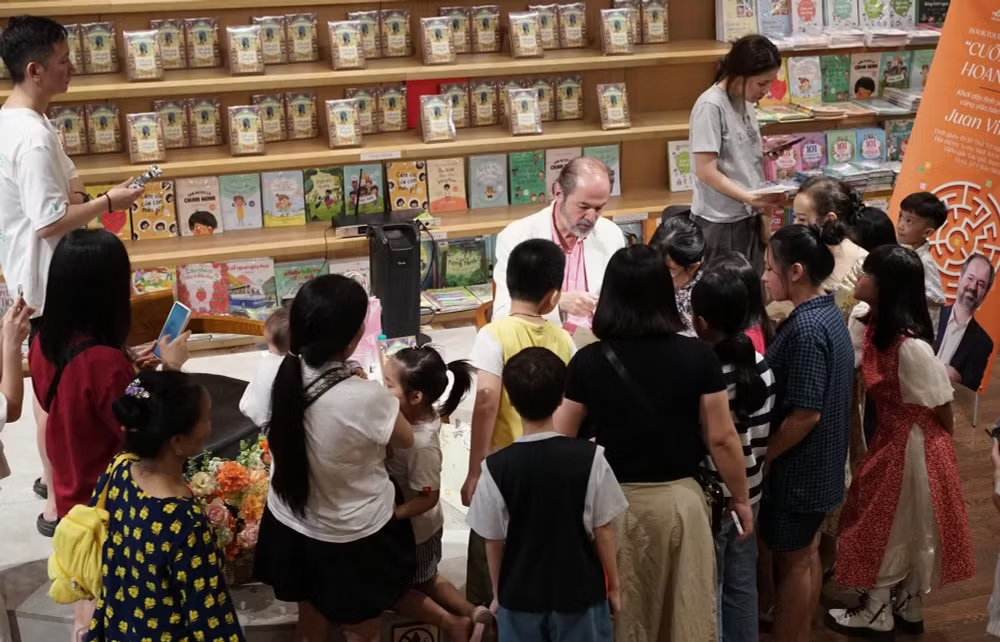
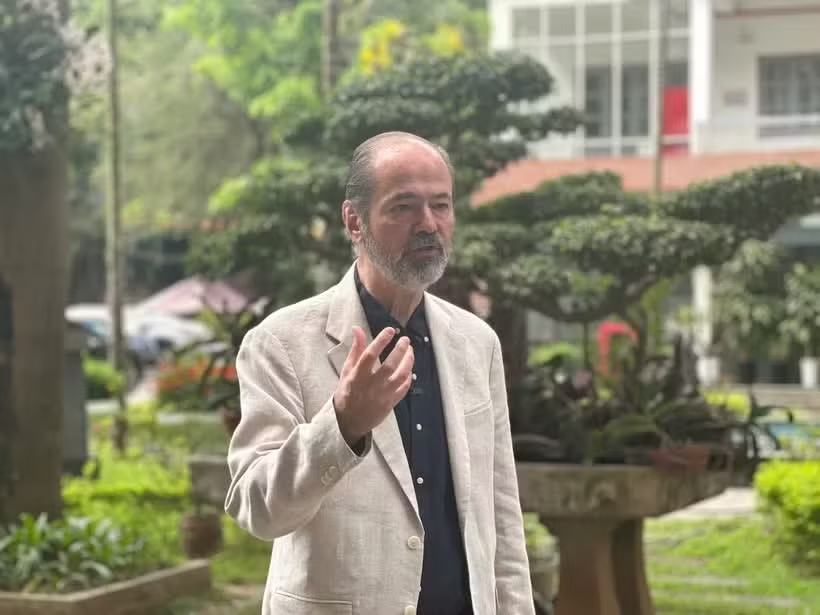
Author of more than 30 novels, short stories, reportage, essays, plays and journalism, Juan Villoro received numerous prestigious international literary awards. (Photo: VietnamPlus)

Hanoi (VNA) – Renowned contemporary Mexican writer Juan Villoro took part in a series of events marking Vietnam Book and Reading Culture Day 2026, helping introduce Latin American literature to Vietnamese readers and promoting the value of reading in the digital age.

Having joined anti-war demonstrations in support of Vietnam in the 1970s, Villoro returned to the country more than half a century later as one of Mexico's most celebrated writers, serving as a bridge for cultural exchange between the two nations.

From April 28 to May 5, he visited Hanoi and Ho Chi Minh City, participating in activities celebrating Vietnam Book and Reading Culture Day 2026 while sharing his views on reading culture and the enduring human value of literature in the digital era.

Vietnam was once a dream destination

Reporter: What are your impressions of Vietnam Book and Reading Culture Day? What does participating in reader exchanges during the event mean to you?

Author Juan Villoro: I am delighted to visit Vietnam for the first time. It is a country I have dreamed of seeing for many years.

When I was young, Vietnam appeared in the news because of the war. In 1970, I joined anti-war demonstrations in support of the Vietnamese people. That is why this visit is especially meaningful to me. It connects memory, literature and reality. For me, Vietnam is a dream that has become real.
dsc02710.jpg
Mexican author Juan Villoro speaks at a discussion and reader exchange at the Hanoi University of Culture during Vietnam Book and Reading Culture Day 2026. (Photo: VietnamPlus)

We are living in a fascinating era, constantly surrounded by digital media, artificial intelligence and technologies that deliver information at incredible speed.

Yet this is precisely why we need to reaffirm the value of reading and books. One of the best ways to inspire a love of reading is to write for children and young adults.

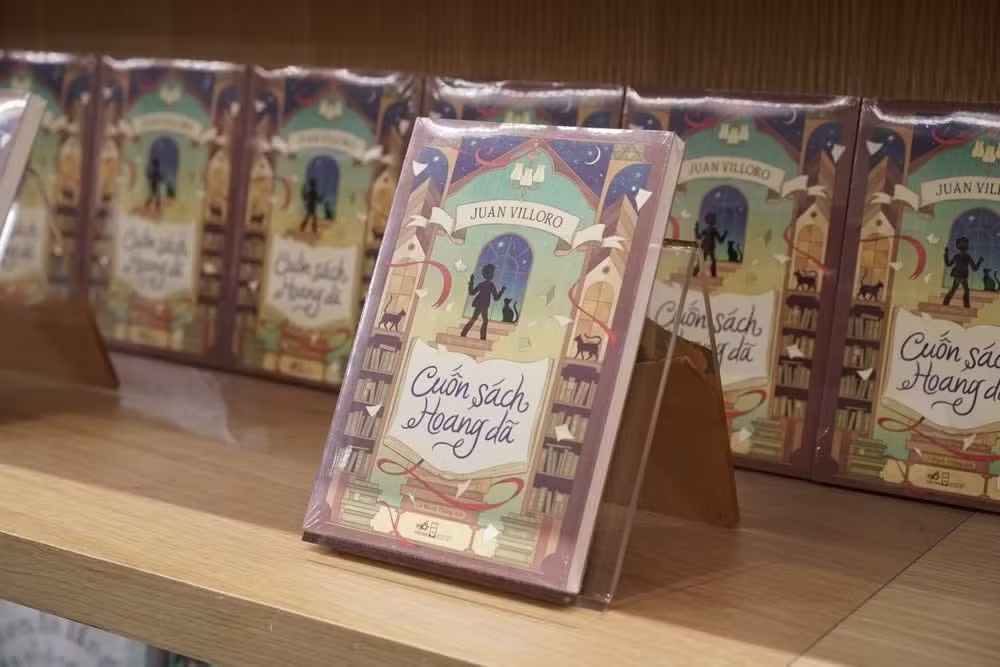
My novel The Wild Book is about the magic of books and the journey of discovering oneself. Through it, I hope to encourage readers to realise that literature is a source of happiness, enjoyment and knowledge, something the digital world alone cannot provide.

Computers, mobile phones and AI are all important, but they can never replace critical thinking or the richness of human emotion that books offer.
dsc02877.jpg
Juan Villoro's The Wild Book, a bestselling children's and young adult novel, has sold nearly two million copies in Mexico, been translated into multiple languages, adapted into Braille for visually impaired readers, and made into a feature film. (Photo: VietnamPlus)

Reporter: More broadly, how do you view reading culture and the publishing industry in Vietnam?

Author Juan Villoro: One of Vietnam's greatest strengths is its openness in publishing. A large number of translated books means readers here have access to literature and ideas from around the world.

Building cultural bridges with other countries is very important. In Mexico, we are pursuing the same goal. I translate works from German and English because I believe connecting with other cultures is deeply enriching.

One of the defining characteristics of Vietnam's publishing industry is this openness. It opens doors for readers to understand what is happening around the world, and I greatly admire that.

Literature: A home for emotions and dreams

Reporter: With artificial intelligence developing rapidly, what role do you think literature plays in shaping people's mind and character?

Author Juan Villoro: AI is an extraordinary tool for processing information, but human beings need something it cannot provide - literature and arts.

Have you noticed that when we visit certain websites, we are asked to prove that we are not robots?

The irony is that we now have to convince machines that we are human, and it is the machines that decide whether we have succeeded.
img-0431.jpg
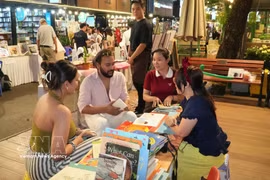
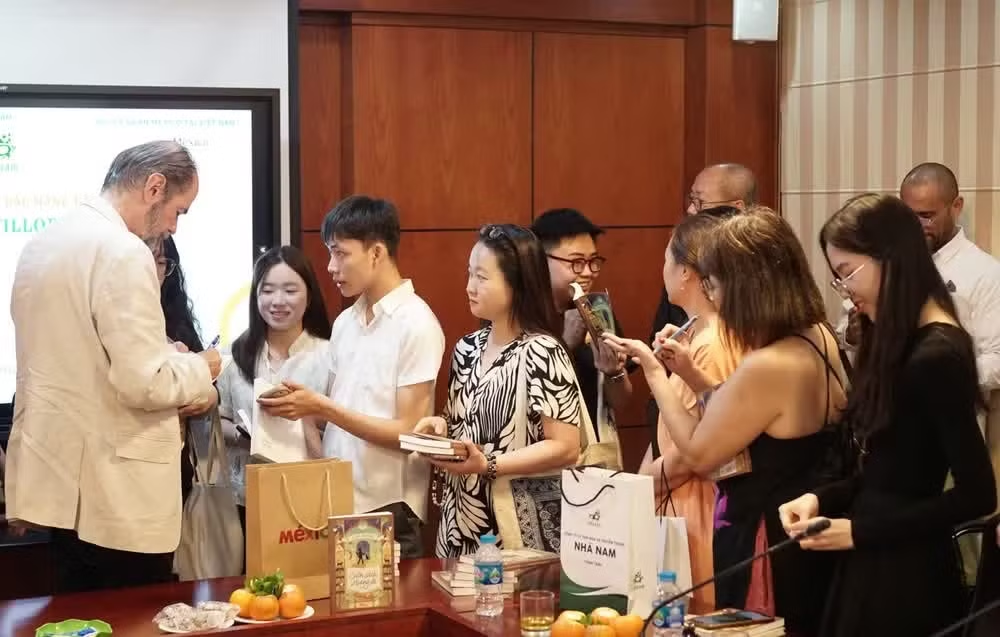
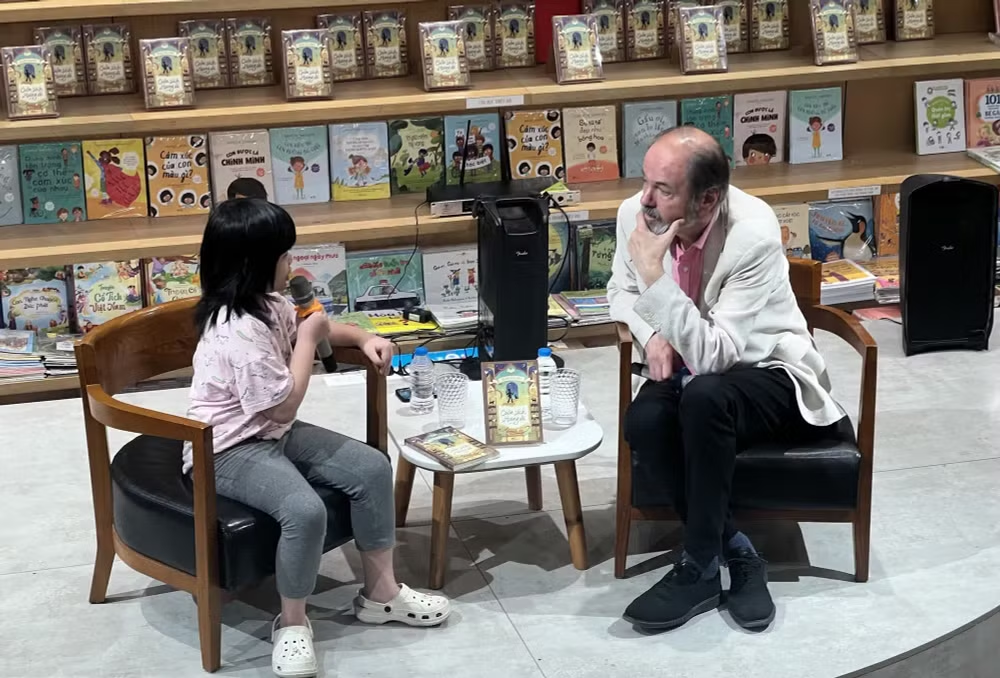
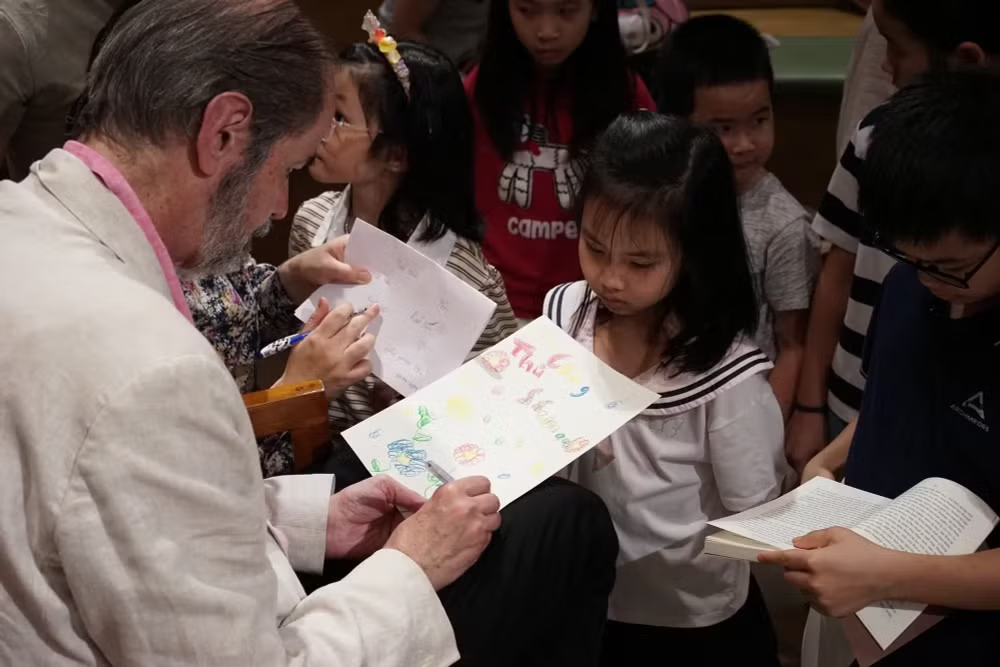
Mexican author Juan Villoro takes part in a series of reader exchanges and book-signing events for Vietnamese children and young adults. (Photo: VietnamPlus)
dsc03136.jpg
Mexican author Juan Villoro takes part in a series of reader exchanges and book-signing events for Vietnamese children and young adults. (Photo: VietnamPlus)
dsc03139.jpg
Mexican author Juan Villoro takes part in a series of reader exchanges and book-signing events for Vietnamese children and young adults. (Photo: VietnamPlus)

That raises a fundamental question: What does it really mean to be human?

People possess qualities that machines do not. We have secrets. We have emotions - the very things we rely on when making the most important decisions in our lives. Emotions define our humanity.

Culture, particularly literature, is where we encounter those emotions and dreams - things that no machine can truly replicate.

Reporter: Unfortunately, many young people today seem more interested in digital entertainment than in literature. In your view, what should be done to promote a stronger reading culture?

Author Juan Villoro: That is true. Today, far fewer people read literature than in the past. In Mexico, we are working to broaden the readership, and one of the most effective ways is to write for children and young adults.

Writing is a journey of exploring reality through endless curiosity. A true writer is someone who constantly asks questions and never takes anything for grant. Literature is therefore inseparable from life. It is an ongoing dialogue between people and the world around them, where imagination helps create new ways of understanding reality.

Reporter: Thank you very much!
VNA

See more

Youth sports strengthen Vietnam-China border friendship

Youth sports strengthen Vietnam-China border friendship

Sports exchanges between Vietnamese and Chinese youth serve as an effective bridge for fostering closer ties and mutual understanding between the two countries’ people. Through football and basketball matches, young people from both sides can improve their fitness and skills while building friendships and promoting solidarity.

A performance staged at the closing ceremony of the Hanoi International Martial Arts Festival 2026 on August 9. (Photo: VNA)

Hanoi Martial Arts Festival 2026 closes, spreading Thang Long spirit

Held under the theme “Thang Long Spirit – Quintessence of Vietnamese Martial Arts,” the festival took place at the Thang Long Imperial Citadel from August 7-9. It was part of Hanoi's efforts to implement Politburo Resolution No. 80-NQ/TW on the development of Vietnamese culture.

The poster of "Glorious Ashes" movie.

Vietnamese cinema returns to Berlin summer film programme

The screening attracted considerable interest from film enthusiasts and the Vietnamese community in the German capital. It marked the fourth time Vietnamese films have been featured in the programme, following "The House of No Man" by Tran Thanh, "Glorious Ashes" by Bui Thac Chuyen, and "My Best Friend's Wedding" by Nguyen Quang Dung and Diep The Vinh in previous years.

Xuan Son comes on in the second half and contributes to Vietnam’s second goal, with his shot forcing a Cambodian defender into an own goal to put Vietnam 2-1 ahead (Photo: VNA)

Vietnam's 22-match unbeaten run draws praise from RoK media

Under the tournament format, the semifinals and final will be played over two legs. Vietnam will travel to Malaysia for the first leg on August 16 before hosting the second leg on August 19. Should Vietnam overcome Malaysia, they will meet the winner of the other semifinal between Thailand and Singapore in the final.

A performance at the Vietnam–Korea Festival 2026 in Da Nang city (Photo: VNA)

Vietnam–Korea Festival 2026 kicks off in Da Nang

Now in its fifth edition, the festival has cemented its place as Da Nang’s signature annual diplomatic event, spotlighting the distinct cultures of both nations, fostering friendship and driving cooperation with Korean localities and partners.

A performance at the opening ceremony of the 2026 Hanoi International Martial Arts Festival on August 7 (Photo: VNA)

Hanoi opens international martial arts festival

The event attracts about 2,000 martial artists of 66 delegations, including seven international delegations from six countries, namely Indonesia, Russia, France, Germany, Switzerland and Morocco.

The statue of Vietnam's King Ly Thai To ( (974 - 1028) in Bonghwa county (Photo: VNA)

RoK to develop K-Vietnam Valley project linked to Ly Dynasty heritage

With the designation in place, Bonghwa will carry out eight specialised projects worth a combined 347.6 billion KRW (245.1 million USD) from 2026 to 2030 – among them the K-Vietnam Valley itself, tourism development around Changpyeong Reservoir, rental smart farms, and a Baekdudaegan healing ‘pet village.’

The organising committee presents awards to outstanding martial artists at the festival. (Photo: VNA)

9th Int’l Festival of Vietnamese Traditional Martial Arts wraps up

The ninth International Festival of Vietnamese Traditional Martial Arts has fostered the martial spirit, strengthened national pride, promoted cultural exchanges and reinforced the aspiration to bring Vietnamese traditional martial arts to a wider international audience.

An appetising bowl of My Quang features a rich combination of ingredients. (Photo: VNA)

Da Nang to host festival honouring Quang Nam-style noodle soup

My Quang is not only a signature dish of the Quang region but also reflects the history, culture and daily life of communities in central Vietnam. With its diverse ingredients, preparation methods and distinctive flavours, the noodle soup has become one of Vietnam's best-known culinary specialities, helping strengthen Da Nang's position on the culinary tourism map.