Seoul (VNA) – ASEAN member states, together with Japan, China, and the Republic of Korea (ASEAN+3), have recently exchanged assessments and discussed economic response measures amid rising uncertainty driven by the Middle East conflict as multiple international organisations warn of mounting downside risks to the global economy.
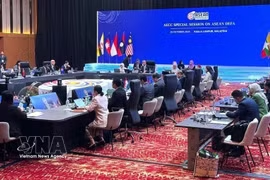
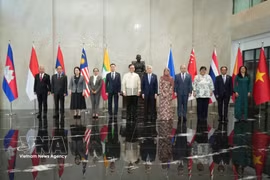
Their discussions came during the ASEAN+3 Finance and Central Bank Deputies' Meeting, held virtually on April 8.
During the meeting, major economic organisations such as the International Monetary Fund (IMF) and the Asian Development Bank (ADB) warned that the global economy faces significant downside risks due to rising geopolitical tensions in the Middle East.
They also called for swift and targeted fiscal support to address growing uncertainties and assist vulnerable groups, along with monetary policy responses and efforts to strengthen economic resilience.
The participating countries shared such an assessment and exchanged views on the economic impact and their respective policy responses.
Participants also discussed ways to further develop the Chiang Mai Initiative Multilateralisation (CMIM), a 240 billion USD currency-swap arrangement established in 2010 as a regional financial safety net.
The outcomes of the meeting are expected to be finalised at the upcoming ASEAN+3 Finance Ministers and Central Bank Governors' Meeting, scheduled for May./.
ASEAN+3 better positioned to weather energy shocks: report
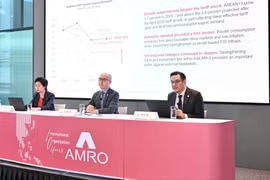
In its ASEAN+3 Regional Economic Outlook (AREO) 2026, AMRO projected regional growth of 4.0% in both 2026 and 2027.