Can Tho conference pushes youth innovation in green, digital economy

The event featured discussions on digital applications, digital transformation in logistics, circular economy, artificial intelligence in e-commerce, and sustainable agriculture. Students also presented potential startup ideas, showing their aspirations to shape the future.

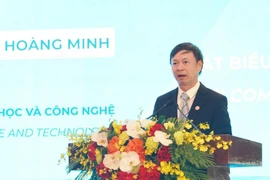
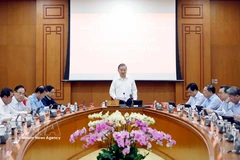
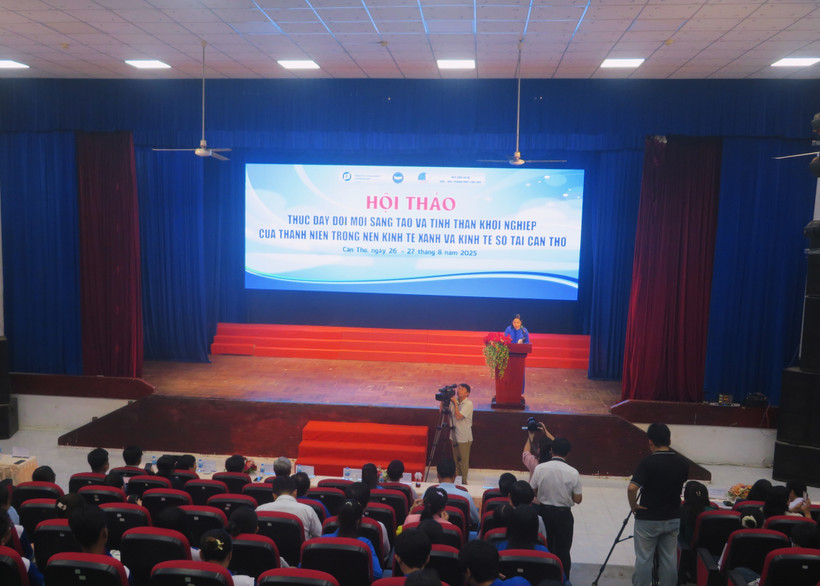
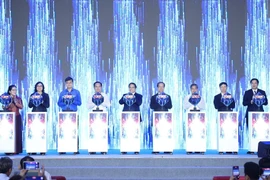
An overview of the conference in Can Tho (Photo: VNA)

Can Tho (VNA) - The Can Tho Union of Friendship Organisations teamed up with Germany’s Friedrich Naumann Foundation for Freedom (FNF) and the Vietnam Youth Federation of Can Tho to hold an international conference on August 26-27, pushing young innovators to take charge in the green and digital economy.

The event featured discussions on digital applications, digital transformation in logistics, circular economy, artificial intelligence in e-commerce, and sustainable agriculture. Students also presented potential startup ideas, showing their aspirations to shape the future.

Assoc. Prof. Dr. Nguyen Chi Ngon, Vice Chairman of Can Tho University Council and Chairman of the municipal Vietnam - Germany Friendship Association, acknowledged Vietnam’s efforts in national digital transformation and startup initiatives, particularly in Can Tho. However, outcomes lag behind the Mekong Delta’s potential and pressing needs. The region, acutely vulnerable to climate change, urgently requires more “green startup” projects to bolster sustainability, he said.

Prof. Dr. Vo Quang Minh, Chairman of the Vietnam-Philippines Friendship Association, said a green economy hinges on low carbon emissions, efficient resource use, and social equity. “The trend is shifting toward a smart economy that integrates green growth, digitalisation, and sustainability,” he said.

To succeed, young entrepreneurs need collaboration among the State, academia, businesses, and communities to foster clearer regulations, stronger links between research and real-world application, corporate funding, and broad public support

The FNF, a Germany-based foundation promoting freedom, democracy, innovation, and sustainable development globally, has focused on empowering Vietnam’s youth, women, and partners in innovation, green economy, and digital economy. It also advocates for a vibrant market economy grounded in fair competition and social responsibility, which it views as critical for innovation and entrepreneurship to thrive./.

VNA

See more

Deputy Prime Minister Ho Quoc Dung speaks at the forum on building a cooperation ecosystem for AI development in Hanoi on July 17, 2026. (Photo: chinhphu.vn)

Deputy PM outlines five strategic pillars for AI development

Deputy PM Ho Quoc Dung said the current priority is to change the mindset. AI should not be developed in isolation by individual agencies or organisations but through an interconnected ecosystem linking the State, universities and research institutes, and businesses.

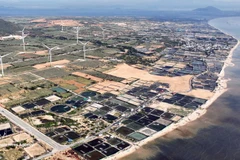
A site for constructing Ninh Thuan 2 Nuclear Power Plant in Thai An village, Vinh Hai commune, Khanh Hoa province. (Photo: VNA)

Vietnam, IAEA expand cooperation in peaceful nuclear applications

Vietnam is implementing 19 cooperation projects with the IAEA in different areas, including agriculture, healthcare, nuclear safety and security, and physical and chemical sciences. The initiatives demonstrate how nuclear technologies can contribute to socio-economic development.

At the BCEC headquarters (Photo: VNA)

Vietnam, RoK deepen startup ecosystem connectivity

Both sides agreed that Vietnam-RoK startup cooperation must pivot from fact-finding tours, trade shows and short-term networking towards a hard-nosed partnership model that delivers concrete market access, business partner matchmaking, product validation, technology piloting and investor connectivity.

Chairman of the National Assembly Tran Thanh Man presents VinFuture awards 2025 to scientists. (Photo: VNA)

VinFuture's global science network delivers lasting value for Vietnam

Via conferences, expert dialogues, networking and inspirational talks, VinFuture has brought many of the world's leading scientists to Vietnam not just to share knowledge, but to co-design research, advise on talent pipelines, and build practical solutions for the country’s most urgent problems.

Plant breeding research at Tra Vinh University (Photo: VNA)

PM orders faster implementation of science, technology, digital transformation agenda

Under Directive No. 29/CT-TTg, the Prime Minister instructed ministers, heads of ministerial-level agencies and provincial and municipal leaders to treat science, technology, innovation and digital transformation as a top political priority, stressing that faster disbursement must go hand in hand with efficiency, transparency and the prevention of waste and corruption.

The conference highlights emerging technologies shaping the future of stroke treatment. (Photo: VNA)

Robot- and AI-driven advances in stroke care introduced at Can Tho conference

Experts are introducing six-dimensional (6D) cerebral vascular imaging for treatment planning, AI-assisted stroke imaging, and robotic intervention and rehabilitation. They are also presenting next-generation neurointerventional devices and personalised treatment strategies to shorten treatment times, improve survival rates, and reduce long-term disability.

A product is showcased at the exhibition area during AI Day 2026. (Photo: VNA)

Vietnam strengthens position in Asia’s AI trade landscape

HSBC (Hongkong and Shanghai Banking Corporation Limited) identifies Vietnam as the economy that has recorded the fastest improvement in its position within the AI supply chain. The country’s share of global trade in AI-related equipment surged from 1.2% in 2015 to 12.4% in 2025, the strongest increase worldwide during the period.

The Nam Dai Duong youth cooperative, based in Nghia Hung commune of Ninh Binh province, uses unmanned aerial vehicles for rice seeding. (Illustrative photo: VNA)

Expert proposes 3 strategies for Vietnam to develop strategic technology products

Dr Ta Anh Phuong, CEO of Seinetime, a French technology start-up specialising in data personalisation and artificial intelligence (AI) solutions, said Vietnam's strategic technology goods should pass a global relevance test and strive to achieve strategic indispensability, making them products that international corporations actively seek to incorporate into their operations.

Deputy Prime Minister Ho Quoc Dung (right) receives Professor Tran Thanh Van, President of the Rencontres du Vietnam Association and Director of the International Centre for Interdisciplinary Science and Education (ICISE), in Hanoi on July 15. (Photo published by VNA)

ICISE urged to strengthen role in advancing Vietnam's science

Deputy Prime Minister Ho Quoc Dung expressed his hope that Professor Tran Thanh Van, the Rencontres du Vietnam Association and ICISE would continue serving as bridges between Vietnam and the international scientific community, attracting leading researchers and making practical contributions to the country's scientific and technological progress.

More than 40 scientists, young researchers and students from seven countries gather in Gia Lai province on July 15 for the 10th Vietnam School on Neutrinos. (Photo: VNA)

Gia Lai province hosts 10th Vietnam School on Neutrinos

During the event, participants receive both fundamental and advanced training in particle physics and neutrino science through lectures covering neutrino physics, the Standard Model, particle and radiation detectors, reactor neutrino experiments, high-energy neutrino astronomy, supernova neutrinos, and major international projects such as Super-Kamiokande, T2K and Hyper-Kamiokande.

A medical worker gives guidance to a mother on how to care for a newborn in Ta Ca commune, Nghe An province. (Photo: VNA)

Top leader unveils people-centred vision for new development model

Vietnam's growth model, long fueled by low-cost labour, resource extraction, contract manufacturing, expanded investment, and capital accumulation, has run out of road. The country now needs a sweeping reform agenda to shift from extensive growth to a model driven by productivity, knowledge, science and technology, innovation, and digital transformation.

Youth union members in Bu Gia Map commune help local residents complete administrative procedures. (Photo: VNA)

Digital governance transforms life in border commune of Dong Nai city

A year after adopting the two-tier local administration model, Bu Gia Map, a remote border commune in the southern city of Dong Nai with a significant ethnic minority community, has experienced notable improvements in public administration, making digital public services more accessible to residents and boosting governance efficiency.