Capital markets, financial hubs key to connecting Vietnam with global capital

As Vietnam strives to achieve double-digit economic growth and become a developed nation by 2045, the country must reduce its reliance on bank credit by developing deeper capital markets and building international financial centres capable of attracting long-term investment from around the world.

Vietnam is accelerating efforts to upgrade its stock market and develop the International Financial Centre in Ho Chi Minh City and Da Nang as part of its strategy to attract global capital and drive long-term economic growth. (Photo: VietnamPlus)

Hanoi (VNA) – As Vietnam strives to achieve double-digit economic growth and become a developed nation by 2045, the country must reduce its reliance on bank credit by developing deeper capital markets and building international financial centres capable of attracting long-term investment from around the world.

The strategy centres on upgrading Vietnam's stock market and establishing the International Financial Centre in Ho Chi Minh City and Da Nang, which are expected to diversify capital sources, strengthen the country's financial resilience and improve its competitiveness in the global economy.

Upgrading the stock market

After more than 25 years of development, Vietnam's stock market has become one of the country's key financial pillars, with market capitalisation reaching about 78% of GDP by the end of 2025.

A significant milestone came when FTSE Russell upgraded Vietnam to Secondary Emerging Market status, effective from September 2026. According to World Bank estimates, the upgrade could attract up to 25 billion USD in foreign investment by 2030, creating new opportunities for businesses seeking long-term capital.

Pham Thi Thuy Linh, head of the Department of Securities Market Development, under the State Securities Commission, said the market upgrade should be viewed not as an end goal but as a catalyst for broader reforms.

She said Vietnam is focusing on improving corporate governance, enhancing information transparency, and attracting more long-term institutional investors. To align the market with international standards, the securities sector is rolling out the new trading system KRX and introducing a central counterparty (CCP) clearing mechanism.

tri7801a.jpg
Currently, only about 8–10% of Vietnam's population participates in the stock market, leaving significant room for market development. (Photo: VietnamPlus)

At the same time, regulators are expanding the range of financial products available to investors, including covered warrants, green bonds and exchange-traded funds (ETFs), helping create a more diversified and mature capital market.

Tran Hieu, head of Business Development at Mirae Asset Vietnam, said Vietnam possesses unique demographic advantages, with more than 60% of its population of working age and a rapidly expanding middle class.

However, only around 8–10% of Vietnamese currently participate in the stock market, compared with more than 30% in regional markets such as Thailand and Malaysia, where stock market capitalisation regularly exceeds 100% of GDP.

He described the gap as enormous growth potential, noting that as incomes rise and the economy expands, more households are likely to shift savings from traditional assets such as gold and bank deposits into stocks, bonds and investment funds.

According to Hieu, the combination of stronger domestic participation and increased foreign investment following the FTSE Russell upgrade could transform Vietnam's stock market into a major source of long-term financing for businesses and strategic infrastructure projects.

Building gateways to global finance

xv71985.jpg
Experts say Vietnam's demographic advantages, combined with stronger foreign capital inflows, could transform the stock market into a major source of long-term financing for the economy. (Photo: VietnamPlus)

For the Vietnam International Financial Centre (VIFC) in Ho Chi Minh City, it is envisioned as an institutional “special zone” with advanced mechanisms designed to attract the world’s leading financial institutions. It will enable Vietnamese businesses to raise capital directly from international markets at competitive costs.

Associate Professor Nguyen Huu Huan, Vice Chairman of the VIFC-HCMC Executive Board, said Vietnam needs a large-scale international financing channel to reduce pressure on the domestic banking system and better meet growing demand for medium- and long-term investment capital.

He said the financial centre would focus on financial technology (fintech), green finance and regulatory sandbox mechanisms that allow innovative financial products and business models to be tested under controlled conditions.
nhan-vien-cat-linh.jpg
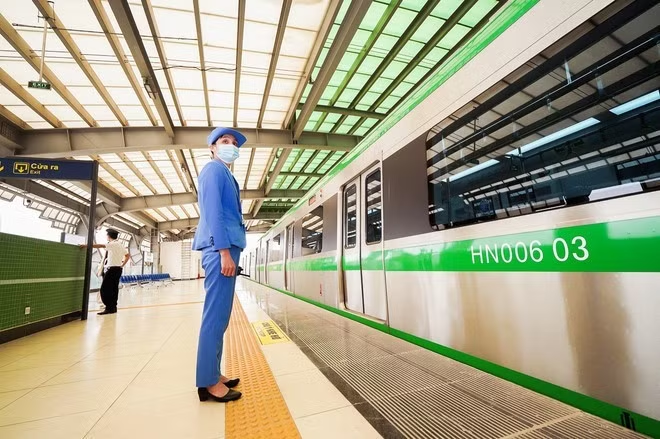
The planned Vietnam International Financial Centre is expected to enable domestic enterprises to raise capital directly from global financial markets at more competitive costs. (Photo: VietnamPlus)

Duong Thanh Tung, Partner at Deloitte Strategy, Risk and Transaction - M&A - Southeast Asia – Vietnam, said the international financial centre would also strengthen investor confidence by providing transparent legal frameworks and internationally recognised dispute resolution mechanisms.

With clearer rules and greater freedom for capital flows, long-term institutional investors and global pension funds would be more likely to view Vietnam as a strategic investment destination rather than merely a short-term trading market, he said.

Diversifying long-term funding sources

Experts also identified public-private partnerships (PPP) as another critical financing channel, particularly as Vietnam requires trillions of Vietnamese dong each year to develop transport, energy, and digital infrastructure.

Doan Viet Nam, Deputy General Director of the Bank for Investment and Development of Vietnam (BIDV), said commercial banks are arranging financing for major PPP projects but called for more comprehensive legal frameworks governing revenue-sharing mechanisms and government guarantees for strategic investments.

He said greater transparency in allocating risks and benefits would encourage stronger private-sector participation in national infrastructure development.

Meanwhile, the development of project bonds and green bonds has been identified as an increasingly important tool for attracting long-term international capital.

As environmental, social and governance (ESG) standards become central to global investment decisions, sustainable financing instruments can help Vietnamese businesses reduce borrowing costs while strengthening their international reputation.

cong-trinh-xanh.jpg
Developing project bonds and green bonds is seen as a key step toward attracting long-term capital from international financial institutions. (Photo: VietnamPlus)

Thai Huong, Chairwoman of TH Group, said high-tech agriculture is among the sectors capable of mobilising capital directly from communities if supported by transparent policies and appropriate financing mechanisms.

She said enabling citizens to invest in sustainable agricultural value chains would not only provide businesses with long-term funding but also generate broader social benefits by promoting organic agriculture, improving food security and advancing social welfare.
cao-toc-dbscnjpg.jpg
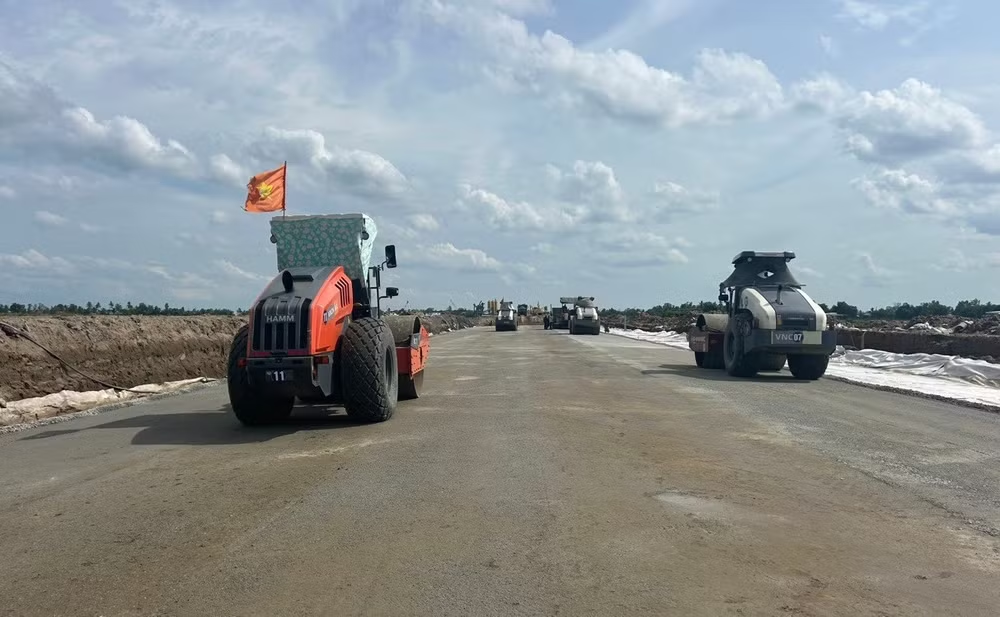
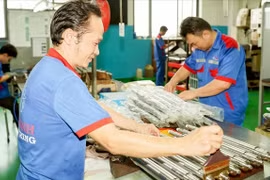
Experts say expanding public-private partnership (PPP) projects is essential to mobilising private investment for Vietnam's strategic infrastructure development. (Photo: VietnamPlus)

According to experts, diversifying funding channels through stronger capital markets, international financial centres, PPPs, and sustainable finance will be crucial to reducing Vietnam's dependence on bank credit. Together, these reforms are expected to create a more resilient financial system, mobilise global capital more effectively and provide the long-term resources needed to support the country's ambition of achieving high-income, developed-country status by 2045./.
VNA

See more

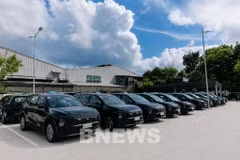
Representatives of C.P. Vietnam, the Ministry of Agriculture and Environment, the Embassy of the Republic of Korea (RoK) in Vietnam and the Animal Husbandry Association of Vietnam attend a ceremony marking the export of the country’s first shipment of processed chicken to the RoK. (Photo: VNA)

Vietnam exports first shipment of processed chicken to RoK

Vietnam and the RoK announced the opening of the Korean market to processed chicken from Vietnam on April 22 this year. C.P. Vietnam became the first company to meet the requirements to ship Vietnam’s first consignment of processed chicken to the market.

A view of Vinh Loc 2 Industrial Park in My Yen commune, Tay Ninh province (Photo: VNA)

FDI surge fuels new real estate demand

According to Savills experts, FDI continues to flow into manufacturing, logistics, technology and digital infrastructure, changing property requirements for investors.

Lien Chieu Port is under construction in central Da Nang city. (Photo: VNA)

Energy infrastructure underpins marine economy development

The integrated investment in energy infrastructure will provide a vital infrastructure foundation for effectively harnessing the marine potential, helping realise the goal of making Vietnam a strong maritime nation and achieving sustainable and prosperous development from the sea./.

The Australia-Vietnam Policy Institute Forum in Ho Chi Minh City on August 25, 2026 discusses how Australian expertise, partnerships and capital can support Vietnam's growth, and how to build stronger connections between the two countries' business communities. (Photo: VNA)

Vietnam, Australia seek new space for economic cooperation

The Australia–Vietnam Policy Institute Forum was held in Ho Chi Minh City on August 25, bringing together policymakers, businesses, and organisations for discussing how the business communities of Australia and Vietnam can build stronger connections.

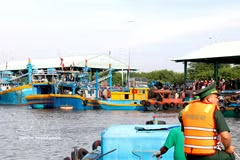
Officers from Thanh Hai Border Guard Station (Phu Thuy ward, Lam Dong province) patrol and monitor fishing vessels entering and leaving the port. (Photo: VNA)

Lam Dong province deploys 10 key measures to combat IUU fishing

The measures target key gaps, including ineligible fishing vessels, port controls, electronic fishing-trip data, seafood traceability and vessel monitoring system (VMS) violations. Authorities will also act against vessels detained by foreign authorities, submit weekly progress reports and draw up specific action plans.

Speakers at the seminar (Photo: VNA)

Legal transparency key to making VIFC more attractive: experts

Dominic Scriven, Chairman and Founder of Dragon Capital, said legal clarity, consistency and predictability are essential to strengthening investor confidence, enabling long-term business planning and encouraging firm capital commitments to Vietnam.

Illustrative photo (Photo: VNA)

Vietnam promotes cooperation to remove barriers to rice trade with Philippines

Vietnam proposed studying a higher-level cooperation framework on rice trade to provide a more stable and long-term foundation for Vietnam-Philippine rice trade while balancing the interests of farmers, businesses and consumers, and providing sustainable livelihoods for rice growers and stable living conditions for Philippine consumers.

An overview of the 11th APEC Food Security Ministerial Meeting in Hangzhou on August 25. (Photo: VNA)

Vietnam proposes four strategic cooperation directions at APEC Food Security Ministerial Meeting

Vietnam’s proposals at the 11th APEC Food Security Ministerial Meeting, which took place in Hangzhou, China received broad support and consensus from participating economies. Several members expressed their desire to work with Vietnam to further build consensus, with a view to ensuring that the APEC Food Security Ministerial Meeting in Vietnam in 2027 will produce a shared vision and a substantive action programme.

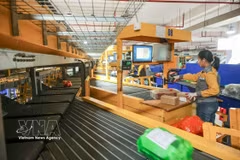
Vietnam Post accelerates the adoption of modern technology, elevates logistics capabilities, and boosts the digital economy. (Photo: VNA)

Breakthrough opportunities for businesses in digital economy

Only when businesses view digital transformation as a fundamental change in their business models, while the State provides an enabling framework, data infrastructure and sufficiently broad markets for innovation, can the digital economy become a substantive growth driver.

A lecturer guides students on how to diagnose diseases in aquatic animals. (Photo: VNA)

Vietnam leans on digital workforce to unlock productivity boom

Vietnam needs a cohesive national strategy linking the State, enterprises, and training establishments. The strategy must prioritise standardising training to international norms and investing in technological infrastructure to boost national productivity.