Conference seeks to boost Vietnam–Cambodia trade, logistics links

Logistics and border trade infrastructure remains a major bottleneck. Congestion at border gates, underdeveloped warehousing, and the lack of multimodal connectivity are significant barriers to supply chain optimisation.

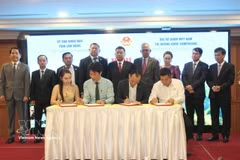
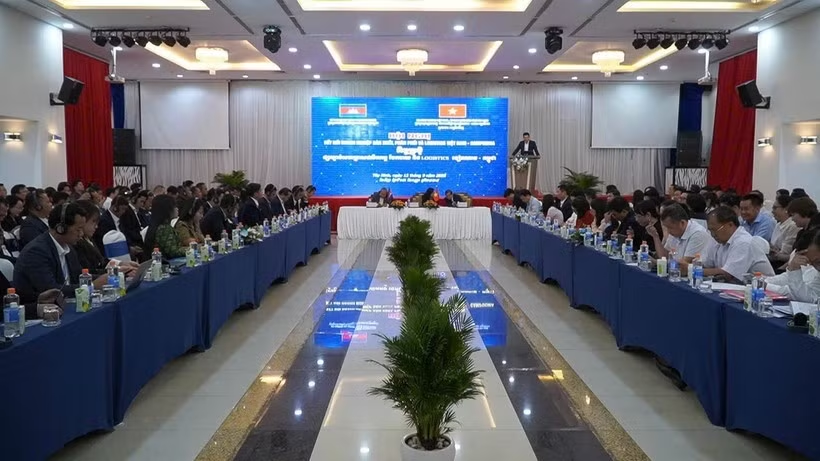
The conference serves as a forum to discuss solutions to remove difficulties for businesses of the two countries (Photo: VietnamPlus)

Tay Ninh (VNA) – A conference aimed at fostering business connections in manufacturing, distribution, and logistics between Vietnam and Cambodia was held in Tay Ninh province on September 13.

Co-organised by Vietnam’s Ministry of Industry and Trade (MoIT), Cambodia’s Ministry of Commerce, and the Tay Ninh provincial People’s Committee, the forum discussed solutions to remove bottlenecks, unlock cooperation potential, and shape the future of sustainable connectivity.

cambodia2.jpg
Phan Thi Thang, Deputy Minister of Industry and Trade of Vietnam (centre), Under Secretary of State of the Cambodian Ministry of Commerce Tith Rithipol (left) and Nguyen Hong Thanh, Vice Chairman of the Tay Ninh provincial People’s Committee, chair the conference (Photo: VietnamPlus)

Speaking at the event, leaders of the Tay Ninh Department of Industry and Trade underlined the province’s strategic role as a “gateway” with nearly 369km of shared border with three Cambodian provinces and a system of 21 border gates. The province’s total trade turnover exceeded 2 billion USD in the first seven months of this year, up 17% year-on-year, while cross-border trade alone reached nearly 3.83 billion USD.

Key exports included processed industrial goods such as textiles, footwear, and machinery, while imports focused on raw materials for these sectors alongside farm produce like cashew nuts and rubber. This complementary structure highlights a close economic link, with Vietnam serving both as a consumer market and a supplier of materials and processed goods for Cambodia.

However, delegates stressed that logistics and border trade infrastructure remains a major bottleneck. Congestion at border gates, underdeveloped warehousing, and the lack of multimodal connectivity are significant barriers to supply chain optimisation.

To address this, Tay Ninh outlined its 2030 vision to develop key border-gate economic zones, including Moc Bai (21,284 ha) and Xa Mat (34,890 ha), along with 14 logistics centres covering 1,288ha. Priority will be given to “green logistics” and “e-logistics” to cut costs, maximise supply chains, and protect the environment.
cambodia3.jpg
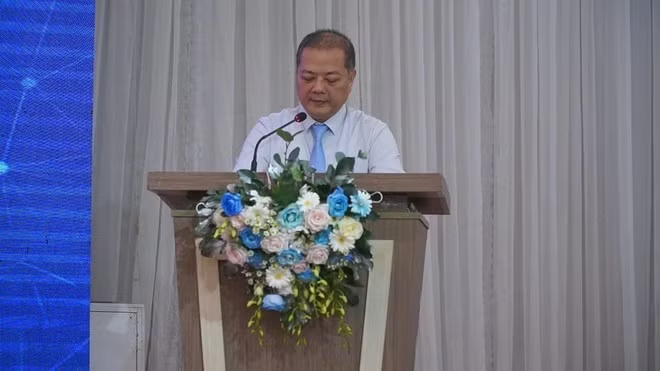
Nguyen Anh Son, Director of the Agency of Foreign Trade under the Ministry of Industry and Trade of Vietnam, speaks at the conference (Photo: VietnamPlus)

Logistics companies such as Logsun Global Logistics shared insights into opportunities and challenges in developing supporting export sevices, emphasising the need for digitalisation and standardised processes.

Analysts noted that synchronising legal frameworks with infrastructure investment is essential. Key documents, including the Prime Minister’s Decision 259/QD-TTg on border trade infrastructure, the Vietnam–Cambodia border trade agreement (2022), the Vietnam–Laos border trade agreement (2015), and bilateral MoUs, have created a solid foundation. The challenge now is how to effectively implement them.

Discussions with with participation of enterprises such as Tu Son supermarket chain, Green & Green Agriculture, and D&T Express brought practical perspectives on customs procedures, distribution networks, agricultural consumption, and port development. These exchanges underscored the importance of linking production, distribution, and logistics to form a complete value chain.

To realise its goals, the provincial Department of Industry and Trade made specific recommendations to the MoIT. They included adding Long An International Port to the list of ports under the Vietnam–Cambodia waterway consultation framework, upgrading the My Quy Tay main border gate, and reviewing border markets for investment in infrastructure development to better serve the trading needs of residents on both sides of the border.

cambodia4.jpg
A Cambodian rice enterprise representative shares views at the conference (Photo: VietnamPlus)

Speaking to VietnamPlus, Leng Bopha, CEO of Kon Khmer Rice Mill of Cambodia, said her company joined the event to seek partners in Vietnam.

To boost exports, the two countries should consider preferential tariff mechanisms, especially within the bilateral trade agreement, she said. Reduced or exempted import tariffs on certain specialty rice varieties would make Cambodian rice more competitive and accessible for Vietnamese consumers, she suggested.

She added that stable supply chains with optimised transport and storage costs would allow Cambodian rice to maintain affordable prices without compromising quality./.

VNA

See more

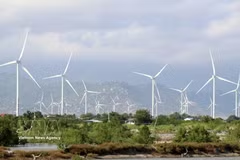
The southern area of Khanh Hoa province holds significant potential for developing wind power projects. (Photo: VNA)

Vietnam tested by rising global energy risks

Energy security today extends beyond supply stability to include adaptability and technological self-reliance in clean energy. With proactive integration and sustained investment in renewables, Vietnam is well positioned to turn external pressures into an opportunity to drive a greener, more resilient economic transformation

Online shopping is a common habit among office workers. (Photo: VNA)

E-commerce boom shadowed by surge in counterfeit goods

What appears to be a convenient digital marketplace is, in many cases, riddled with sophisticated traps. With a single click, trust can quickly be exchanged for fake or substandard products, online newspaper vietnamplus.vn reported.

Border Guard officers in Dong Thap inspect and verify fishing vessels before they depart from port. (Photo: VNA)

Dong Thap steps up digital vessel management, strengthens traceability

The Mekong Delta province of Dong Thap has rolled out a plan to implement recommendations from the European Commission on tackling illegal, unreported and unregulated (IUU) fishing, aiming to fully fix shortcomings and contribute to the removal of the “yellow card” warning in 2026.

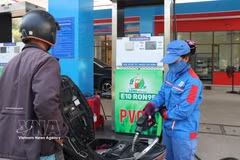
Tran Phu petrol station in Nghia Lo ward, Quang Ngai supplies E10 petrol to local residents. (Photo: VNA)

Dung Quat biofuel plant set for full-capacity operations in April

BSR-BF Director Pham Van Vuong said the company is looking to expand into new areas such as biodiesel, sustainable aviation fuel (SAF), microalgae, and afforestation, opening up broader growth prospects and strengthening its position in the green energy value chain.

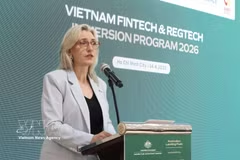
Emma McDonald, Australian Senior Trade and Investment Commissioner, speaks at the conference on April 14. (Photo: VNA)

Vietnam, Australia boost cooperation in fintech

Australian companies have strengths in regtech, data governance, cybersecurity, payment infrastructure, and digital assets—areas that align with Vietnam’s priorities. Their experience in highly regulated environments could help Vietnam address challenges such as financial fraud, cybercrime, and security risks.

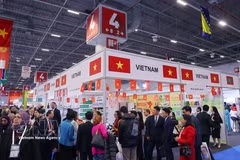
Booths of Vietnamese cooperatives and enterprises at the Halal Expo 2025 exhibition in Türkiye. (Photo: VNA)

Türkiye seen as promising market for Vietnam’s Halal products

With a large Muslim population, Türkiye serves as both a major consumer market and a well-developed processing hub for such products. Meanwhile, Vietnam is gradually establishing its capacity to supply Halal goods, particularly in processed foods, agricultural produce, beverages, tourism services and logistics.

A view of Da Nang city (Photo: VNA)

Da Nang charts mega merger for global eco-city vision

Da Nang has set a target of having at least five financial technology (FinTech) businesses with revenues of over 1 trillion VND (40 million USD) yearly, while the Free Trade Zone would contribute 17.9% to the city’s gross regional domestic product (GRDP).

A VinFast electric motorbike showroom. (Photo: vinfastecoxe.vn)

Fuel hikes push electric motorbike sales

Electric motorcycle sales by Honda Vietnam, Yamaha Motor Vietnam, Piaggio Vietnam, SYM Vietnam and Suzuki Vietnam, rose by 8.3% year-on-year to 729,121 units.