Culture, innovation key to defining Vietnam’s brand identity in new era

Vietnamese brands wanting to compete globally must now be anchored in digital transformation, innovation, green growth, and national cultural identity

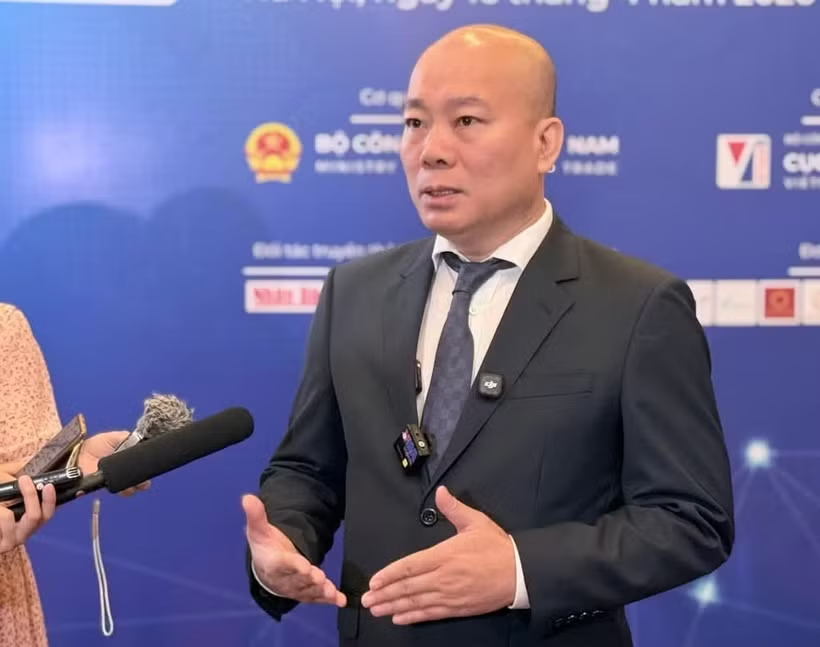
Vu Ba Phu, Director of the MoIT's Vietnam Trade Promotion Agency (Photo: VietnamPlus)

Hanoi (VNA) - As the world accelerates its shift toward green growth and digital transformation, Vietnam's National Brand Programme is becoming a launchpad to shove domestic firms out of low-margin contract manufacturing and into brand-driven innovative ownership.

The Vietnam National Brand Week 2026 is designed to boost public recognition of the programme, and deliver a new message on brand development as it enters a phase of rapid and sustainable growth.

Vu Ba Phu, Director General of the Vietnam Trade Promotion Agency under the Ministry of Industry and Trade (MoIT), made clear that Vietnamese brands wanting to compete globally must now be anchored in digital transformation, innovation, green growth, and national cultural identity, in an interview with the press.

Keeping pace with changing times

- What are the key goals of this year's Vietnam National Brand Week?

Vu Ba Phu: The National Brand Week is built to spread and raise awareness of the programme’s significance and role. It is also a stage to exhibit the sharp climb in Vietnam's national brand value on the global scoreboard in recent years.

- Why did the organising board choose the theme "Vietnam National Brand in a New Era" this year?

Vu Ba Phu: The theme mirrors both domestic and global realities. Global growth is now wired through digital transformation, sci-tech, and innovation.

Vietnam's strategic trajectory after the 14th National Party Congress lays out a vision of fast, sustainable development powered by the same engines.

Keeping up with these global trends, the National Brand Programme has locked in this theme to tether business activity to Vietnam's 2026–2035 development strategy and its outlook to 2045.

This demonstrates the MoIT's commitment to supporting firms. We want to underscore that Vietnamese products and corporate brands must evolve in lockstep with digital transformation, innovation, scientific and technological advance, and, critically, green transition and social responsibility.

Breaking the "made for others" mold

- After more than two decades, Vietnam's national brand value has risen steadily. But against the tougher demands of green transition and digital transformation, what will the ministry do to push Vietnamese brands higher?

Vu Ba Phu: Vietnam's national brand value has indeed posted rapid, attention-grabbing gains. But alongside that momentum, the cracks are visible. The growth is not yet durable, nor is it sufficiently rooted in innovation.

That is why the Vietnam National Brand Strategy, now being drafted by the MoIT, will put innovation, digital transformation, and green growth at the centre of its efforts to lift the value of national brand products in the coming years.

The strategy's sharp end will be to force a switch away from contract manufacturing for foreign labels and toward designing, producing, and marketing products and services under a company's own name.

Under the Politburo’s Resolution 80, Vietnamese cultural identity will receive particular focus. The plan is to fuse cultural values into brand development and establish culture as a defining feature of the value proposition of Vietnamese products and services going forward.

- To support the Politburo's double-digit economic growth goal, how should National Brand enterprises gear up for this new era?

Vu Ba Phu: As I have said, Vietnamese enterprises must leverage digital transformation and innovation to pack more value-added content into their products and services. They should treat these factors as key growth levers, enabling them to sharpen the competitiveness of Vietnamese goods and services in international markets and thrive in the new era.

- Thank you for your time!
VNA

See more

Vietnamese Ambassador to Brazil Bui Van Nghi speaks at the seminar. (Photo: VNA)

Vietnam, Brazil seek ways to promote trade, investment cooperation

Vietnamese Ambassador to Brazil Bui Van Nghi informed that two-way trade reached 4.22 billion USD in the first six months of 2026, up 16.8% year-on-year. Brazil's exports to Vietnam exceeded 2 billion USD, rising 16.6%, while its imports from Vietnam totalled about 2.11 billion USD, an increase of 17%.

Wave Alpha, Honda Vietnam’s best-selling manual motorcycle model each month. (Photo: Bnews/VNA)

Honda Vietnam posts strong car sales growth, leads motorcycle market

The company sold 172,299 motorcycles in June, up 4.7% from the same month last year, highlighting steady consumer demand even as the market gradually shifts towards greener transport options. For the first six months of 2026, motorcycle sales reached 515,743 units, up 0.6% year-on-year.

Rice harvest in Xuan Giang commune, Ninh Binh province. (Photo: VNA)

Plan issued to develop agricultural logistics system

A key target is that by 2030, all concentrated agricultural, forestry and fisheries production areas will have access to essential services, including product traceability, quarantine, testing, quality certification, processing and market development. The move reflects growing international demand for stricter food safety, quality and traceability standards, which have become increasingly important for agricultural exports.

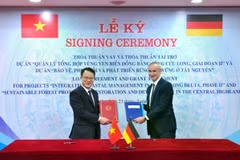
Delegates at the signing ceremony (Photo: VNA)

Vietnam, RoK boost micro-business cooperation

Vietnam's young population, dynamic market, and big growth potential are a perfect fit for the strengths that Korean micro-businesses bring in K-brands, technology, and service expertise, said KFME President Song Chi Young.

Cars at a public parking lot in Hai Phong city. (Photo: VNA)

Vietnam's auto sales rise 15%, hybrid, imported vehicles continue to outperform

With auto loan interest rates remaining competitive, stable vehicle supply, and an increasingly diverse product range, Vietnam's automotive market is expected to maintain its growth momentum through the remainder of 2026. SUVs, MPVs, and hybrid vehicles are likely to remain the main drivers of overall market sales.

The MoU signing ceremony between Becamex VSIP Binh Dinh and PV Gas CNG in Gia Lai province on June 26, 2026 (Photo: nhandan.vn)

Gia Lai positions itself as magnet for sustainable investment

Vice Chairman of the provincial People's Committee Nguyen Huu Que said ESG is no longer a communications message or a cost burden, but an essential requirement for accessing global capital. Gia Lai has chosen ESG as a pillar for building new competitive advantages and achieving sustainable development.

Chairman of the Tay Ninh provincial People's Committee Le Van Han delivers remarks at the inauguration ceremony. (Photo: VNA)

Suntory PepsiCo inaugurates 300-million-USD plant in southern Tay Ninh province

Built on nearly 20 hectares at Huu Thanh Industrial Park, the facility is the company's largest and most advanced plant in Vietnam and the biggest production site in Suntory PepsiCo's Asian manufacturing network. The factory has a designed annual production capacity of over 1.24 billion litres and is equipped with highly automated production, filling and warehousing systems.

Ho Chi Minh City inaugurates a UAV postal route linking Can Gio commune and Vung Tau ward on February 12, 2026. (Photo: VNA)

Ho Chi Minh City promotes UAV applications to develop low-altitude economy

With its enlarged development space, Ho Chi Minh City now combines strengths in urban development, industry and services with high-tech agriculture, the marine economy, logistics and diverse ecological areas. These conditions provide an ideal testing ground for UAV applications in urban management, land administration, environmental monitoring, disaster prevention and response, agriculture, logistics and public services.