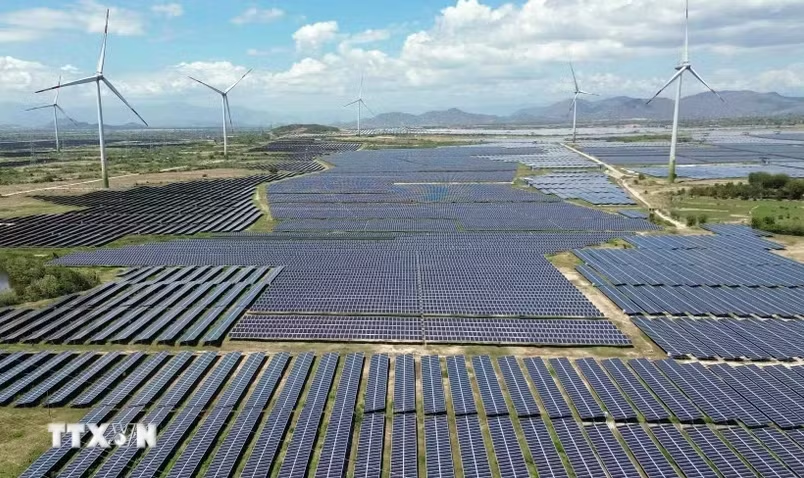
Hanoi (VNA) - As Vietnam enters a new development phase with goals of achieving double-digit economic growth, ensuring energy security, particularly a stable electricity supply, has become a decisive factor underpinning this goal, said insiders.
With rising power demand driven by rapid industrialisation, urbanisation, and economic restructuring, the energy sector is increasingly seen as both a bottleneck and a key growth engine.
The revised Electricity Law, along with Resolution No. 253/2025/QH15, is helping to remove institutional barriers, paving the way for greater investment inflows and technology transfer while advancing the dual objectives of energy security and net-zero emissions.
According to Dr Can Van Luc, Chief Economist at BIDV and member of the Prime Minister's Policy Advisory Council, Vietnam’s electricity demand is expected to grow sharply in the coming years. Power consumption rose by about 8% annually during 2021–2025, but is projected to surge to 10–12% per year in 2026–2030 before stabilising at 7–7.5% in the following period.
Such double-digit growth in electricity demand presents significant challenges, he said, noting that investors, particularly FDI firms, are increasingly focused on two decisive factors: whether Vietnam can ensure sufficient electricity to sustain double-digit growth, and whether power prices are competitive enough to ensure production efficiency.
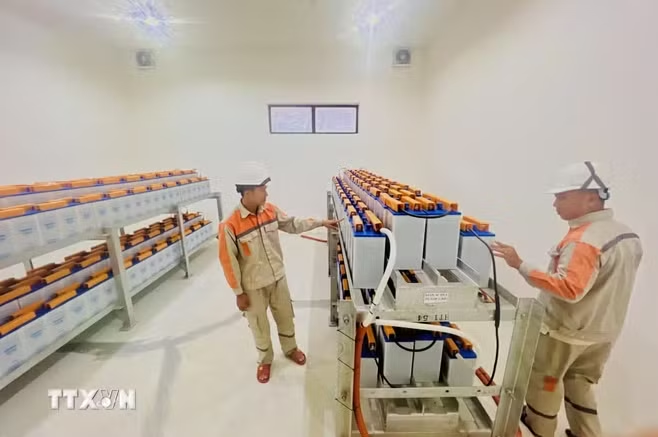
Amid these pressures, ensuring energy security has been reaffirmed as a consistent strategic priority of the Party and State.
Tran Hoai Trang, Deputy Director General of the Electricity Authority under the Ministry of Industry and Trade (MoIT), stressed that energy security is not only a cornerstone of socio-economic development but also an integral part of national security.
Citing Resolution No. 70-NQ/TW on national energy security through 2030 with a vision to 2045, Trang underscored that energy development must be prioritised to support sustained economic expansion of over 10% in the coming decades.
“Energy planning must be implemented in a coordinated, unified, and effective manner to meet development goals,” he said.
While the Electricity Law provides the legal foundation, Resolution No.253/2025/QH15 is widely seen as a breakthrough policy instrument that directly addresses longstanding technical bottlenecks that have constrained the sector for years.
Doan Ngoc Duong, Vice President of the Institute of Energy under the MoIT, highlighted that the resolution’s most significant impact lies in streamlining administrative procedures, decentralising authority, and introducing more flexible planning mechanisms.
Previously, any adjustment to power projects had to wait for periodic planning revisions, often conducted every five years, creating delays and inefficiencies.
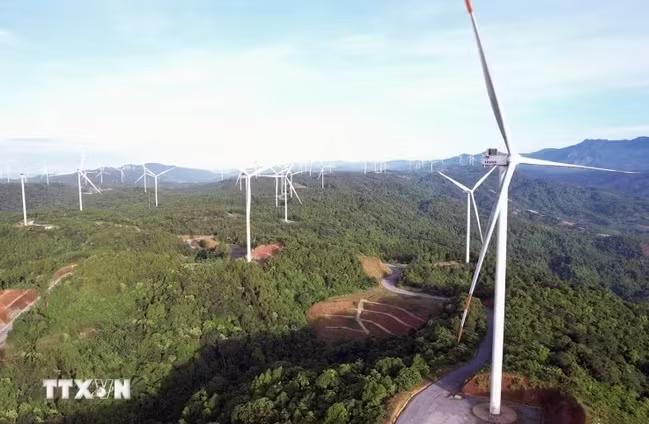
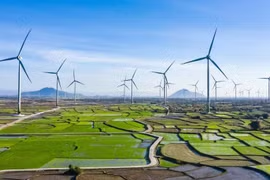
One of the sectors set to benefit most from the new approach under Resolution No. 253 is offshore wind power, often described as Vietnam’s “energy treasure”, which has yet to be fully developed.
According to Bui Vinh Thang, Vietnam Country Manager of the Global Wind Energy Council, the new mechanisms in the resolution reflect a strong commitment to institutional breakthroughs.
Notably, offshore wind projects will be directly assigned rather than subject to competitive bidding. During 2026–2030, projects will be allocated by the Prime Minister, with further decentralisation to local authorities planned for the subsequent period.
This approach is expected to shorten approval timelines and accelerate project deployment, Thang noted.
Growth pressures, combined with the synergy of strong political determination, a solid legal foundation, and flexible implementation mechanisms, are forming a robust “three-pillar” framework.
Despite ongoing challenges in financing and technology, Vietnam is making significant strides toward achieving sustainable development and long-term prosperity, anchored in a secure and resilient energy system./.