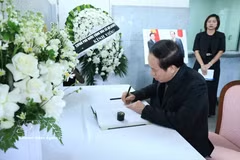
Students visit an exhibition on Hoang Sa and Truong Sa held in Quang Tri province. (Photo: VNA)
Vietnam’s sea area covers about 1million sq.km, three times larger than the mainland area and making up nearly30% of the area of the East Sea. It is home to thousands of islands of allsizes that scatter rather evenly along the coastline and in the outpostarchipelagoes of Hoang Sa and Truong Sa.
Historical and legal evidence testifying to Vietnam’s sovereignty over thesetwo archipelagoes have been recognised by many countries, theinternational community, and many scientists who have affirmed that the Stateof Vietnam was the first in history to possess and exercise sovereignty overthe islands.
Vietnam’s possession and exercise of sovereignty over Hoang Sa and Truong Saare clear, uninterrupted, peaceful, and in accordance with the existing principleof acquisition of territory – the principle of actual possession – of publicinternational law.
Maps dating back to the 17th century feature Hoang Sa and Truong Sa as a single strip which was initially called“Bai Cat Vang” by Vietnamese people, as seen in “Toan tap Thien Nam tu chi lodo thu” (Route Map from the Capital to the FourDirections) – a map compiled by geographer Do Ba and completed in1686.
In the first half of the 17th century, the Nguyen Lords establishedthe “Hoang Sa flotilla”, which gathered people from An Vinh commune of Binh Sondistrict, Quang Nghia (now Quang Ngai province) to collect objects fromstranded ships and catch rare seafood in Hoang Sa. The lords also set up the “BacHai flotilla”, whose members were residents of Tu Chinh hamlet or Canh Duongcommune of Binh Thuan, to perform similar duties in Truong Sa.
Throughout three centuries – from the17th to the late 19th century, despite differentdynasties, the monarchical state of Vietnam established, practiced management,and exercised the country’s sovereignty over Hoang Sa and Truong Sa withoutencountering any dispute or objection.
This fact was proved in many old documents, books, and legal documents of theState, along with the maps showing Vietnam’s exercise of its sovereignty overthe two archipelagoes, kept in Vietnam and many countries, including “Toan tapThien Nam tu chi lo do thu” by Do Ba, “Phu bien tap luc“ (Miscellany on the Government of the Marches, 1776)by Le Quy Don, “Lich trieu hien chuong loaichi” (Regulations of Successive Dynasties by Subject-Matter, 1821) by Phan HuyChu, “Hoang Viet dia du chi” (Geographical Treatise of Imperial Vietnam, 1833),“Dai Nam thuc luc tien bien” (Veritable Records of the GreatSouth, Prequel Records, 1844 - 1848), and “Dai Nam thuc luc chinh bien” (Veritable Records of the Great South, Principal Records, 1844 - 1848).
In particular, the World Atlas by PhilippeVandermaelen, published in Belgium in 1827, clearly drew anddepicted Hoang Sa as part of the territory of the Kingdom of An Nam, an oldname of Vietnam.
 Boats in a ritual of the Feast and Commemoration Festival for Hoang Sa Soldiers. (Photo: VNA)
In 1975, together with the complete liberation of the South and the nationalreunification, the Vietnam People’s Navy also liberated the islands kept by theSaigon troops such as Truong Sa, Son Ca, Nam Yet, Song Tu Tay, Sinh Ton, and AnBang, which are part of the Truong Sa archipelago. The then ProvisionalRevolutionary Government of the Republic of South Vietnam also issued astatement affirming Vietnam’s sovereignty over Hoang Sa and Truong Sa.
On July 2, 1976, at its firstsession, the 6th-tenure National Assembly (NA) (1976 - 1981) –the parliament of the reunified Vietnam that was elected on April 25, 1976 –decided to rename the country the Socialist Republic of Vietnam. The State ofthe Socialist Republic of Vietnam has continued to manage and protect thecountry’s sovereignty over Hoang Sa and Truong Sa via a number of activitiesthat ensure the sufficiency of and adherence to procedures during the legalstruggle while at the same time consolidating and maintaining the presence ofVietnamese soldiers and people on the geographical entities currently managedby the State of the Socialist Republic of Vietnam.
Particular, in 1982, Vietnam established the districts of Hoang Sa and TruongSa, with Hoang Sa district now being part of Da Nang city and Truong Sa district being partof Khanh Hoa province.
Given this, Vietnam owns sufficient historical evidence with legal value totestify to and protect its sovereignty over these two archipelagoes throughouthistory.
It is noteworthy that the Resolution of the United Nations General Assembly,dated October 24, 1970, stated: “The territory of a State shall not be theobject of military occupation resulting from the use of force in contraventionof the provisions of the Charter. The territory of a State shall not be theobject of acquisition by another State resulting from the threat or use offorce. No territorial acquisition resulting from the threat or use of forceshall be recognised as legal.”
Therefore, China’s use of force to occupy Hoang Sa, an integral part of Vietnam’sterritory, on January 19, 1974 ran counter to international law and was unableto generate a legal right towards this archipelago for China.
Hoang Sa is forever a territorialpart of Vietnam!/.
VNA