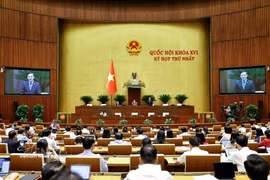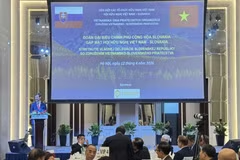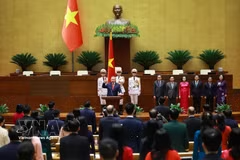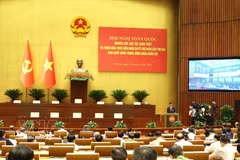
Hanoi (VNA) - The five-year plan for socio-economic development, national finance, public debt management, and medium-term public investment for the 2026–2030 period was highlighted at a national conference held on April 13 to study, disseminate and implement the resolutions of the second meeting of the 14th Party Central Committee.
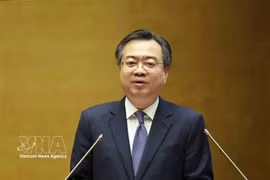
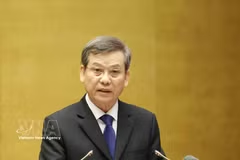
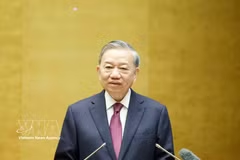
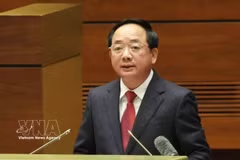
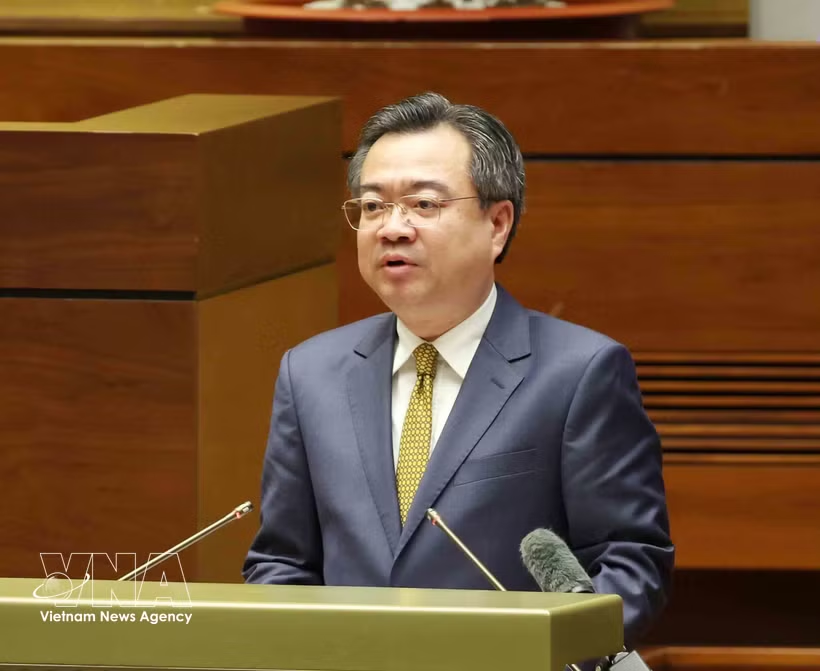
Addressing the conference, Politburo member, Secretary of the Party Central Committee, and Chairman of its Commission for Policies and Strategies Nguyen Thanh Nghi presented key contents of the 14th Party Central Committee's Conclusion No. 18-KL/TW, issued on April 2, on the plan. The conclusion outlines major orientations aligned with the goal of achieving double-digit economic growth in the coming period.
He noted that the 2021–2025 period unfolded amid a complex global environment marked by intertwined opportunities and challenges, with difficulties prevailing. However, under the Party’s close leadership, the coordinated oversight of the National Assembly, and the decisive, flexible governance of the Government and the Prime Minister, Vietnam achieved important and comprehensive results. The country met or exceeded 22 out of 26 key socio-economic targets, including all social indicators.
Macroeconomic stability was basically maintained, major economic balances were ensured, and growth rebounded strongly. The country's gross domestic product (GDP) expanded by 8.02% in 2025, with an average growth rate of 6.2% over the five-year period. The size of the economy increased from 346 billion USD in 2020 to 514 billion USD in 2025, ranking 32nd globally. GDP per capita reached 5,026 USD, placing Vietnam among upper middle-income economies. Inflation, budget deficits, and public debt indicators remained under control.
Significant progress was also recorded in implementing strategic breakthroughs, resolving long-standing inefficiencies in investment projects and weak financial institutions, and advancing infrastructure development. Human resources development, science and technology, innovation, and digital transformation made positive strides. Social welfare was ensured, living standards were improved, and national defence, security, and foreign affairs were enhanced.
However, Nghi acknowledged that macroeconomic foundations are not yet truly solid, while productivity, competitiveness, and resilience of the economy are still limited. Contributions from science, technology, innovation, and digital transformation to growth remain modest. Institutional frameworks to effectively mobilise private and foreign investments are yet to be fully developed. Public investment planning has not consistently prioritised comprehensive socio-economic efficiency, and environmental challenges persist. Implementation capacity at various levels has not fully kept pace with development requirements.
Looking ahead to the 2026–2030 period, the global situation is forecast to become increasingly complex and unpredictable, including ongoing conflicts in the Middle East that disrupt supply chains and drive up energy and transport costs. These factors pose direct challenges to Vietnam’s development objectives.
On the basis of a comprehensive assessment, the Party Central Committee has agreed on key targets aimed at achieving double-digit growth, contributing to the realisation of the country’s long-term strategic goals of becoming a developing country with modern industry, upper middle-income status and securing a position among the world’s top 30 economies by 2030.
To this end, the conclusion sets out 51 key indicators and identifies four overarching groups of tasks and solutions, covering socio-economic development, national finance, public debt management, and medium-term public investment.
For socio-economic development, priority measures include strengthening unity in mindset, awareness, aspiration and action, improving governance and implementation, advancing institutional reform, and transitioning to a growth model driven by science, technology, innovation, and digital transformation. Efforts will also focus on restructuring industries, developing new economic models, ensuring macroeconomic stability, diversifying supply chains and capital flows, enhancing education and human resources, promoting cultural development, and modernising infrastructure.
In terms of national finance, the strategy emphasises effective budget management, the development of a transparent and modern tax system, and the mobilisation of diverse financial resources. The efficient use of public assets and cost-saving measures in administrative infrastructure are also highlighted.
Public debt management is identified as a long-term, cross-cutting priority to ensure national financial security. Measures include strengthening risk management, enhancing transparency, and adopting flexible borrowing strategies aligned with fiscal management.
Medium-term public investment is described as a critical driver of growth. The plan calls for more focused allocation of resources to key national projects, a reduction of at least 30% in the number of projects compared to the previous period, and stronger public-private partnerships. Improving investment efficiency and preventing wastefulness and corruption are also key objectives.
Nghi also stressed that the effective implementation of Conclusion No. 18 will require proactive, flexible, and results-oriented actions, alongside the active participation of the business community and the public, in order to drive rapid and sustainable socio-economic development in the years ahead./.
See more
Vietnam takes part in ASEAN Finance Ministers' meeting
Vietnam reaffirmed its development strategy for 2021–2025 and 2026, based on three pillars - institutional reform, infrastructure development, and human resources, with infrastructure as a top priority to drive new growth.
Guangxi eyes boundless cooperation with Vietnam
Vietnam has remained Guangxi’s largest trading partner for 27 consecutive years. In 2025, bilateral trade exceeded 300 billion CNY (43.4 billion USD) for the first time, ranking third among China’s provincial-level localities.
☕ Afternoon briefing on April 13
The following is a brief review of the day’s events as reported by the Vietnam News Agency.
PMs discuss measures for advancing Vietnam – Slovakia relations
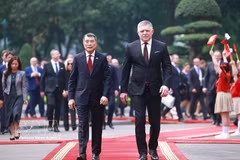
PM Le Minh Hung reaffirmed that Vietnam consistently prioritises strengthening ties with traditional friends, including Slovakia, which it considers a leading priority partner in Central and Eastern Europe.
IPU-152 attendance showcases Vietnam’s dual-track diplomatic priorities: diplomat
The upcoming participation of National Assembly Chairman Tran Thanh Man and his spouse in the 152nd Assembly of the Inter-Parliamentary Union (IPU-152) in Istanbul, along with several bilateral activities in Türkiye, highlights Vietnam’s priorities in both multilateral and bilateral diplomacy, a Vietnamese diplomat said.
Top Vietnamese leader’s China visit to boost political trust, strategic ties
Yu described the Vietnamese leader’s visit as an important step in deepening political trust between the two countries, which, as neighbouring socialist nations, regard each other as a priority in their foreign policies.
Party steps up anti-corruption drive in new phase
Anti-corruption efforts have achieved significant and breakthrough results, contributing to the Party and political system building, political stability, socio-economic development and stronger public trust in the Party, the State and the regime.
Vietnam–China relations entering unprecedented historic opportunity: ACC official
Under the strategic guidance of top leaders of the two Parties and countries, political exchanges have reached a new height. Senior leaders maintain regular, close contacts, enabling timely discussions on strategic orientations for bilateral relations.
Vietnam reinforces proactive, responsible role in Inter-Parliamentary Union
Through the IPU platform, Vietnam has advanced parliamentary diplomacy to protect national interests, deepen ties with other legislatures, and elevate its global profile while contributing initiatives in areas such as sustainable development, climate change, gender equality, child protection, and digital transformation.
Vietnam–China partnership advances towards deeper trust and connectivity: Chinese scholar
On the visit’s key agenda, Professor Qu Qiang of the Minzu University of China highlighted the need to effectively implement common perceptions and overarching directions reached by senior leaders, particularly the “six major orientations” guiding bilateral ties, including more substantive cooperation, stronger security, closer coordination, and higher political trust.
People-to-people ties between Vietnam and Slovakia strengthened
A meeting was held in Hanoi on April 12 between a delegation of the Slovak Government and representatives of Vietnamese people who have strong affection for Slovakia, on the occasion of the official visit to Vietnam by the Slovak Prime Minister and a government delegation.
Top Vietnamese leader’s China visit hoped to advance bilateral ties to new stage of development
The trip will mark the first state visit by To Lam in his capacity as the top leader of the Party and the State of Vietnam, coming exactly one year after the Chinese leader’s state visit to Vietnam and representing the third trip between the two top leaders within less than two years.
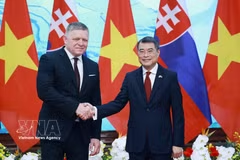
Vietnamese, Slovak PMs witness exchange of documents, chair joint press briefing
In an atmosphere of sincerity, mutual trust and understanding, the PMs held highly successful talks and reached broad consensus in aspects. They adopted a joint statement on upgrading Vietnam–Slovakia relations to a Strategic Partnership.
Top leader demands stronger governance, strategic planning to drive sustainable development
The Party and State leader underscored the necessity for decisive, coordinated and effective actions to translate the Party’s resolutions into concrete results throughout the political system and society.
New regulation on political, ideological work in Party highlighted at national conference
The regulation, adopted at the second plenum of the 14th Party Central Committee and issued as Regulation No. 19-QD/TW on April 8, 2026, marks the first comprehensive and systematic framework governing political and ideological work in the Party. It reflects a new step in theoretical mindset and strong political resolve to enhance Party building as well as the Party's leadership and combat capacity.
Vietnamese Prime Minister chairs official welcome ceremony for Slovak counterpart
Over the past 76 years since the establishment of diplomatic relations, Vietnam and Slovakia have maintained and nurtured their traditional friendship, with both sides attaching importance to strengthening ties. High-level visits and exchanges, as well as regular contacts at all levels, have been sustained.
Party conference spotlights key reforms in inspection, disciplinary work
Resolution 05 introduces a number of breakthrough viewpoints, positioning inspection and supervision as one of the Party’s most critical leadership functions. It is defined as a mechanism for self-correction and self-improvement, a key tool to control power and uphold Party discipline and order, ensuring that the Party’s guidelines are implemented rigorously and effectively in practice.
Regulation on Party Statutes enforcement disseminated to Party members nationwide
The new regulation was developed in line with key principles, including strict adherence to the Party Statutes, selective amendments and supplements to certain provisions, and the addition of new and important contents reflecting both directions set during the 13th tenure and emerging practical requirements.
📝OP-ED: Personnel consolidation – A lever to elevate national governance, development
The personnel consolidation at all levels has been carried out in a methodical and rigorous manner, choosing personnel with firm political mettle, strong ethical qualities, and outstanding capabilities who have been tested through practical experience and are well-equipped to meet the requirements of the new context.
National conference disseminates resolution of 14th Party Central Committee’s 2nd session
The hybrid event was connected with 36,323 venues nationwide, drawing nearly 2.2 million participants.