Vietnam–China partnership advances towards deeper trust and connectivity: Chinese scholar

On the visit’s key agenda, Professor Qu Qiang of the Minzu University of China highlighted the need to effectively implement common perceptions and overarching directions reached by senior leaders, particularly the “six major orientations” guiding bilateral ties, including more substantive cooperation, stronger security, closer coordination, and higher political trust.

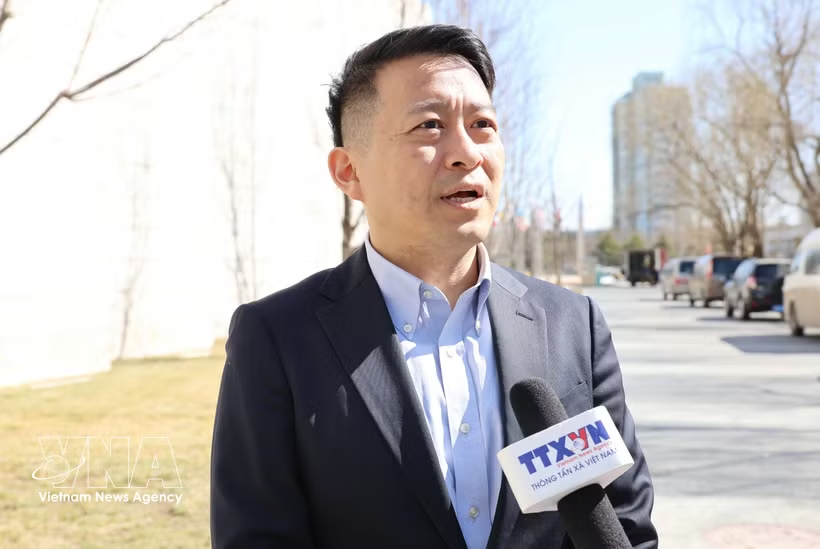
Professor Qu Qiang of the Minzu University of China grants an interview to the Vietnam News Agency. (Photo: VNA)

Beijing (VNA) – The forthcoming visit to China by Party General Secretary and State President To Lam is expected to inject fresh momentum into the Vietnam – China Comprehensive Strategic Cooperative Partnership and advance efforts to build a a community with a shared future that carries strategic significance, a Chinese scholar has said.

In an interview with Vietnam News Agency (VNA) correspondents in Beijing ahead of the trip, Professor Qu Qiang of the Minzu University of China noted that ties between the two Parties and countries have entered a new stage, characterised by more frequent high-level exchanges, deeper cooperation, and improved engagement quality. This, he said, both reinforces the long-standing “comrades and brothers” bond and provides a renewed framing for bilateral relations.

On the visit’s key agenda, Qu highlighted the need to effectively implement common perceptions and overarching directions reached by senior leaders, particularly the “six major orientations” guiding bilateral ties, including more substantive cooperation, stronger security, closer coordination, and higher political trust. He stressed that these priorities should be carried through at all levels, from central agencies to localities, academia, businesses, and people-to-people exchanges.

Economic cooperation continues to take centre stage. Qu pointed out that Vietnam’s ambitious growth targets in the years ahead, including a GDP growth goal exceeding 10% and long-term development plans towards 2030, call for expanded economic engagement with China. Priority areas include boosting bilateral trade, enhancing technology exchange, and accelerating connectivity projects such as the Lao Cai – Hanoi – Hai Phong railway linked to China’s network, alongside cooperation in power and energy.

He also identified cooperation under the Belt and Road Initiative and the China – ASEAN framework as key drivers of regional economic integration and supply chain resilience. Amid ongoing global uncertainties, the two countries are expected to step up coordination to mitigate external shocks while fostering more stable and sustainable trade and supply chains.

On foreign policy, Qu underscored Vietnam’s consistent pursuit of an independent, self-reliant approach centred on national interests. In a complex global landscape, stronger coordination between Vietnam and China on regional and international issues would help safeguard their interests while contributing to broader peace, stability, and development.

Emphasising the role of regular high-level exchanges, Qu said such engagements not only help shape strategic direction but also strengthen political trust, facilitate the management of differences, and drive practical cooperation. He added that both countries share similarities in political systems and serve as key nodes in the China – ASEAN supply chain, supporting global supply chain stability.

Citing recent trade figures, Qu noted that China’s import-export turnover has surpassed global expectations, with imports rising by around 19% and exports by about 20%. These gains, he said, reflect not only China’s own efforts but also close cooperation with ASEAN partners, particularly Vietnam. At the same time, Vietnam has sustained solid economic growth despite global headwinds, pointing to considerable scope for further bilateral collaboration.

From a regional standpoint, Qu noted that Vietnam and China have effectively worked together to bolster political trust, manage differences, and maintain stability, helping make the China – ASEAN region one of the few globally to sustain both robust growth and political-security stability.

With political trust strengthening, practical cooperation expanding, and shared interests deepening, bilateral relations are well positioned to continue on a stable and sustainable trajectory, contributing to peace, stability, and development in the region and beyond, he added./.
VNA

See more

Party General Secretary and State President To Lam, head of the Central Steering Committee for Prevention and Control of Corruption, Wastefulness, and Negative Phenomena, chairs a meeting of the committee's Standing Board on March 18, 2026. (Photo: VNA)

📝OP-ED: Controlling power, preventing corruption at roots

As the country enters a new development phase, the anti-corruption focus is shifting from strict punishment alone to prevention at the roots, while also protecting officials who dare to think innovatively and act decisively for the common good.

Vietnamese Ambassador to Ireland Pham Toan Thang (right) presents a souvenir to Deputy Lord Mayor of Cork Margaret McDonnell (Photo: VNA)

Vietnam, Ireland seek to expand all-around cooperation

Vietnamese Ambassador to Ireland Pham Toan Thang expressed hope that academic cooperation will continue to expand into areas where Vietnam has growing demand, including high-tech agriculture, biomedical technology, artificial intelligence and computer science.

General Secretary of the Communist Party of Vietnam Central Committee and State President To Lam (L) and Indian Prime Minister Narendra Modi witness the exchange of cooperation documents between the two countries. (Photo: VNA)

Vietnam-India relations enter new phase of development: Indian expert

The elevation of bilateral ties to an Enhanced Comprehensive Strategic Partnership reflects the increasingly deep convergence of geopolitical, economic, maritime and civilisational interests between the two countries, former Indian Deputy National Security Adviser S.D. Pradhan told Vietnam News Agency correspondents in New Delhi.

At the meeting between Vietnam's Politburo member Nguyen Thanh Nghi and General Secretary of the Communist Party of Sri Lanka G. Weerasinghe and General Secretary of the Sri Lanka-Vietnam Solidarity Association Sudasinghe Sugathapala. (Photo: VNA)

Vietnamese Party official meets leaders of Sri Lankan political parties

Nguyen Thanh Nghi, Politburo member, Secretary of the CPV Central Committee and Chairman of its Commission for Policies and Strategies, held meetings in Colombo, Sri Lanka, on May 8 with leaders of the Janatha Vimukthi Peramuna (JVP - People's Liberation Front), the Communist Party of Sri Lanka and the Sri Lanka-Vietnam Solidarity Association.

Speaker of the Turkish Grand National Assembly Numan Kurtulmuş (R) receives Vietnamese Ambassador to Türkiye Dang Thi Thu Ha (Photo: VNA)

Vietnam, Türkiye strengthen parliamentary cooperation

Speaker of the Turkish Grand National Assembly Numan Kurtulmuş affirmed that Türkiye considers Vietnam an important partner in Southeast Asia, emphasising that similarities in historical depth, cultural identity, foreign policy orientations and family values provide a strong foundation for elevating bilateral ties to a new level.

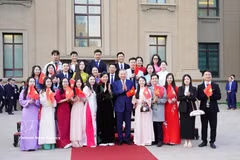
Participants pose for a group photo at the ceremony in Hanoi on the evening of May 8,2026, to celebrate Europe Day (May 9). (Photo: VNA)

Europe Day 2026 marked in Hanoi

EU Ambassador to Vietnam Julien Guerrier reaffirmed the bloc's commitment to accompanying Vietnam in achieving its goals of becoming a developed economy by 2045 and reaching net-zero emissions by 2050, while ensuring energy security amid global uncertainties.

General Secretary of the Communist Party of Vietnam Central Committee and State President To Lam (L) and Indian Prime Minister Narendra Modi meet the press to announce the outcomes of their talks. The two sides issued a joint statement on the Enhanced Comprehensive Strategic Partnership between Vietnam and India. (Photo: VNA)

Top leader’s visits opening new phase of deeper, more effective ties with India, Sri Lanka: FM

Minister of Foreign Affairs Le Hoai Trung described the visits as particularly important and historic, taking place at a meaningful moment as Vietnam and India mark the 10th anniversary of their Comprehensive Strategic Partnership and just one month after the top leader of Vietnam assumed his new position. For Sri Lanka, this was the highest-level visit by a Vietnamese leader since the two countries established diplomatic relations.

Prime Minister Le Minh Hung attends the plenary session of the 48th ASEAN Summit in Cebu, the Philippines. (Photo: VNA)

PM’s presence in ASEAN Summit spreads message of dynamic, strongly rising Vietnam: official

Deputy Foreign Minister Dang Hoang Giang said that the Vietnamese delegation made important contributions to the summit’s success, reflecting the foreign policy orientation set out by the 14th National Congress of the Communist Party of Vietnam, which continues to place ASEAN at the centre of Vietnam’s regional engagement, as well as its commitment to proactive, positive and responsible contributions to ASEAN Community-building process.

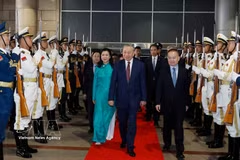
General Secretary of the Communist Party of Vietnam Central Committee and State President To Lam reviews the honor guard. Photo: VNA

Vietnam’s top leader concludes successful state visit to Sri Lanka

Vietnam and Sri Lanka agreed to elevate political trust and comprehensively develop the traditional friendship and multifaceted cooperation as well as expand high-level and all-level exchanges and contacts, regularly implement bilateral cooperation mechanisms across various fields.

General Secretary of the Communist Party of Vietnam Central Committee and President of Vietnam To Lam (R) meets with Prime Minister of Sri Lanka Harini Amarasuriya in Colombo on the afternoon of May 8. (Photo: VNA)

Top Vietnamese leader meets with Sri Lankan PM in Colombo

The two leaders agreed that their countries will work together to turn the good intentions and aspirations for bilateral relations into tangible outcomes so that in the future, they could look back with pride on the achievements born from today’s determination.