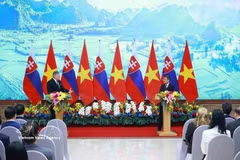
Hanoi (VNA) – The opening days of the 2026–2031 tenure have marked a synchronised and resolute shift in personnel work from the central to local levels. The consolidation of key leadership positions within the Party and the State, alongside the restructuring, reassignment, and appointment of officials across various agencies and localities, not only meets immediate requirements but also lays a critical foundation for a new phase of national development.
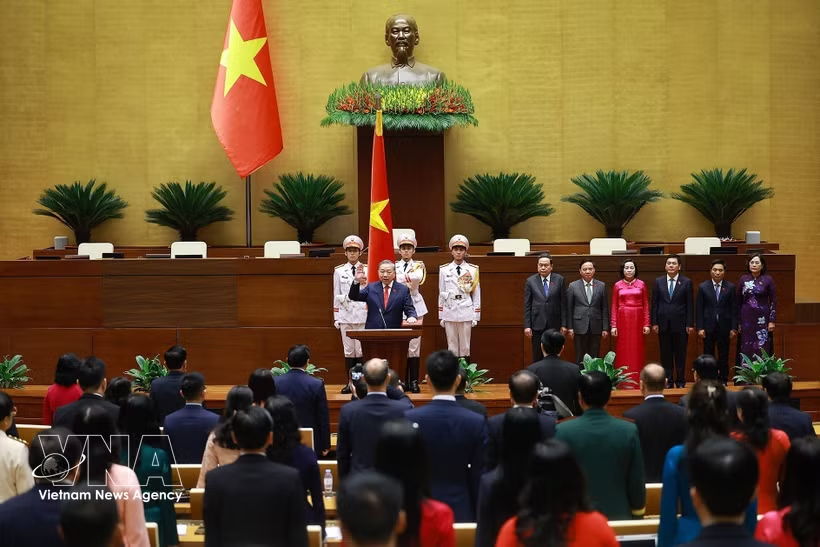
At its first session, the 16th National Assembly elected the State President and the Prime Minister, and approved the Prime Minister’s nominations for Deputy PMs, ministers, and other members of the Government for the 2026–2031 term. Shortly thereafter, appointment decisions were announced, completing the new Government apparatus with 23 members, including the PM, six Deputy PMs, and 16 ministers and heads of ministery-level agencies.
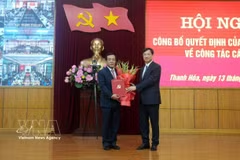
At the same time, the Politburo and the Secretariat have successively issued decisions on the reassignment, designation, and appointment of key officials across a number of important bodies, including the Organisation Commission, the Office, and the Commission for Policies and Strategies of the Party Central Committee. They have also consolidated the Party Committees of the Government and the National Assembly, and appointed leadership of the Supreme People’s Court along with several localities.
The move has been carried out in a methodical and rigorous manner, choosing personnel with firm political mettle, strong ethical qualities, and outstanding capabilities who have been tested through practical experience and are well-equipped to meet the requirements of the new context.
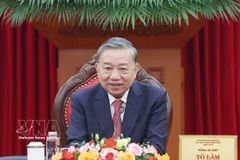
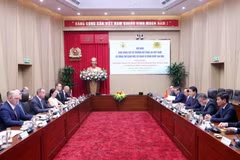
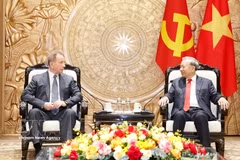
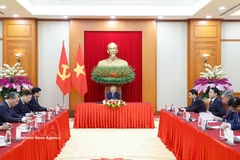
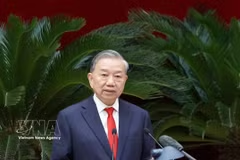
Speaking at conferences announcing the decisions, Party General Secretary and State President To Lam underscored that the 2026–2031 tenure unfolds in a particularly significant context, serving both as the first term to implement the Resolution of the 14th National Party Congress and as a pivotal period determining whether Vietnam can rise to a new level of development.
The country is entering a new development phase with a strengthened foundation, yet facing intertwined challenges. In this context, growth must be of higher quality, driven by productivity, science – technology, and innovation; competitiveness must be markedly enhanced; strategic autonomy must be firmly reinforced; and the effectiveness and efficiency of national governance must be elevated to a more advanced and modern level.
The Party and State leader stressed that this tenure must not merely continue past efforts, but represent a step-up to a higher stage of development, with ultimate success measured by improvements in people’s quality of life and the country’s stature and reputation.
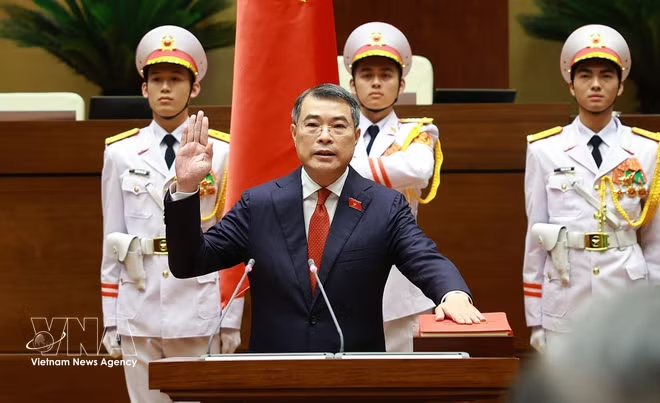
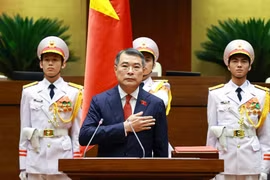
Prime Minister Le Minh Hung takes the oath of office on April 7, 2026. (Photo: VNA)
Outlining key requirements for the Government and the entire administrative system, he emphasised that the foremost task is to create an enabling development environment, expand growth space, generate new growth drivers, and enhance implementation capacity. The Government must place particular focus on maintaining macroeconomic stability, strengthening major economic balances, and effectively managing risks while fostering new engines of growth to achieve high and sustainable growth targets. It is also essential to improve the capacity to implement Party and National Assembly resolutions, as well as State laws, ensuring that they are translated into practice more swiftly, transparently, and consistently. This, in turn, will help build confidence among citizens and businesses to invest, innovate, and engage in legitimate economic activities, with each state management decision serving as a catalyst for development.
The Government must operate in a unified, seamless, disciplined, and effective manner, ensuring that words are matched by actions. Responsibilities must be clearly defined in terms of personnel, tasks, accountability, timelines, and deliverables. Each Government member must shoulder national responsibilities within their respective portfolios. Ministries and sectors must move beyond narrow and sectoral thinking, placing the overarching national interest, the overall efficiency of the economy, and the convenience of citizens and businesses above all else, the top leader noted.
Particularly, science – technology, innovation, and digital transformation must be viewed as the foundation of a new growth model – an overarching orientation that extends beyond the science sector to encompass the entire political system and the economy as a whole.
At the same time, strong efforts are required to improve the investment and business climate, ensuring the protection of the freedom to conduct business, the property rights, fair competition, and equal access to resources and development opportunities in accordance with the law. It is essential to eliminate the “ask – give” mechanism, bureaucratic harassment, and informal costs, thereby fostering trust among citizens and enterprises.
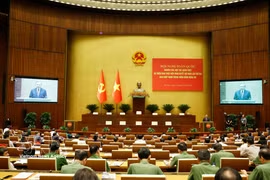
Regarding the personnel consolidation of the NA Party Committee, the Party General Secretary and State President stressed that this is a concrete step to strengthen the Party’s direct and comprehensive leadership over the legislature, ensuring that the NA effectively fulfills its three core functions: legislation, supreme supervision, and decision-making on nationally important issues.
According to him, institutional reform is the foremost priority and the “breakthrough of all breakthroughs”. The quality of the NA Party Committee's operations will directly determine institutional quality, thereby shaping both the pace and quality of national development. The key requirement is to remove all bottlenecks, facilitate development, and transform institutions into a competitive advantage capable of meeting the country’s development needs in the new era, while consistently upholding the principle that “the people are at the root” in all activities.
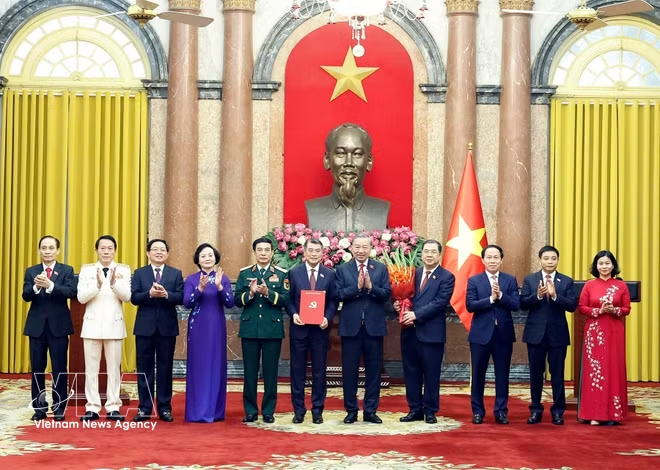
Each National Assembly deputy must proactively engage with real-life issues, listening even to the smallest concerns of citizens and businesses, and translating the people’s voice into legislation, questioning, supervision, and decisions on major national matters. Public trust and tangible improvements in people’s living standards must serve as the highest yardstick for both deputies and the National Assembly as a whole. The leadership methodology of the NA Party Committee must be reformed in a more scientific, transparent, and accountable direction, shifting decisively from process-based to results-based leadership, with substantive outcomes as the ultimate measure.
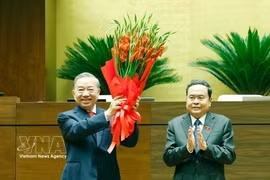
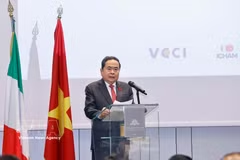
NA Chairman Tran Thanh Man affirmed the determination to build a clean and strong Party Committee of the National Assembly, renewing legislative thinking from a management-oriented approach to one that fosters development, transforming supervision from detection to enforcement promotion, and reforming policymaking from short-term to long-term, from reactive to proactive, and from fragmented to holistic approaches, closely linked with the application of science – technology and digital transformation.
In addition, personnel work within the Party’s strategic advisory bodies, the judicial system, and localities has also been consolidated with a focus on improving quality and effectiveness. The Party General Secretary and State President called for the building of a contingent of officials who are transparent, upright, and disciplined; for heightened individual accountability, especially among leaders; for resolute efforts to prevent and combat corruption and negative practices; and for ensuring that all decisions are objective, impartial, and made in the interest of the common good.
In the judicial sphere, the appointment of judges to the Supreme People’s Court has been identified as an urgent requirement to enhance the quality of adjudication, uphold justice, and meet the growing expectations of the public in a new stage of development.
At the local level, the reassignment and appointment of key officials have been carried out in alignment with the imperative of fast and sustainable development, including taking the lead in renewing growth models, advancing science and technology, accelerating digital transformation, and achieving ambitious growth targets.
Beyond organisational requirements, the current consolidation of personnel at all levels also represents a strategic preparation for the country’s next development phase. As General Secretary and President To Lam emphasised, the people assess performance not by words but by results; they look not to promises but to tangible improvements in daily life. Every state management decision must therefore serve as a driver of development.
With a strengthened foundation and a systematically selected and consolidated cadre contingent, expectations are higher than ever for a tenure defined by action, innovation, and effectiveness – one that will propel the country toward fast and sustainable development and a new level of advancement./.