Regulation on Party Statutes enforcement disseminated to Party members nationwide

The new regulation was developed in line with key principles, including strict adherence to the Party Statutes, selective amendments and supplements to certain provisions, and the addition of new and important contents reflecting both directions set during the 13th tenure and emerging practical requirements.

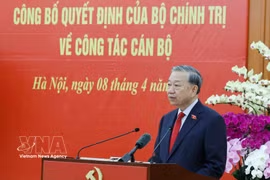
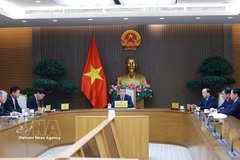
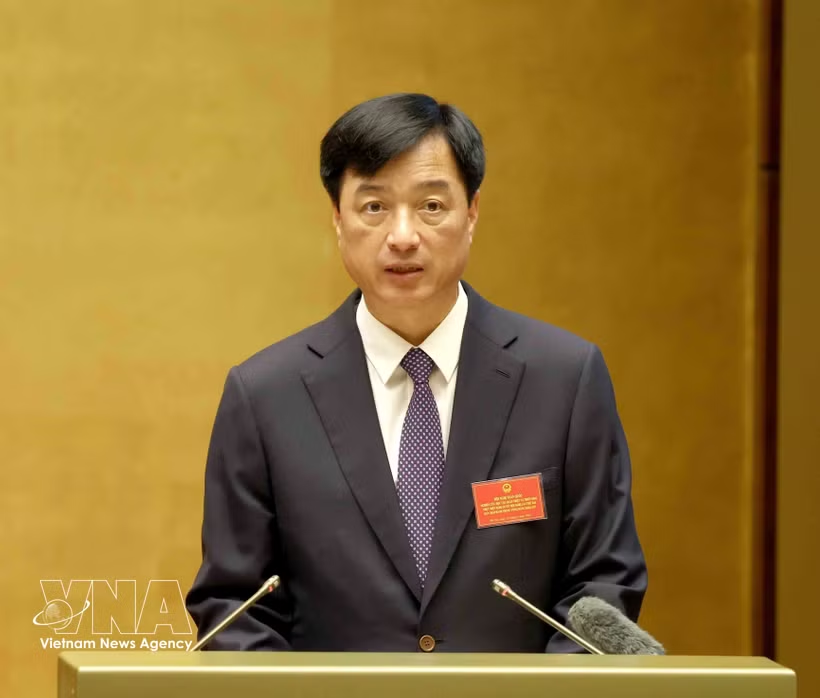
Politburo member, Secretary of the Party Central Committee and Chairman of its Organisation Commission Nguyen Duy Ngoc speaks at the national conference to disseminate and implement the resolution of the second meeting of the 14th Party Central Committee. (Photo: VNA)

Hanoi (VNA) – Politburo member, Secretary of the Party Central Committee and Chairman of its Organisation Commission Nguyen Duy Ngoc presented a thematic report on the regulation on the implementation of the Party Statutes at a national conference held on April 13 to disseminate and implement the resolution of the second meeting of the 14th Party Central Committee.

Ngoc stressed that the new regulation, signed off by Party General Secretary To Lam on behalf of the Party Central Committee on April 8, was developed in line with key principles, including strict adherence to the Party Statutes, selective amendments and supplements to certain provisions, and the addition of new and important contents reflecting both directions set during the 13th tenure and emerging practical requirements.

Comprising 33 items, the regulation retains 12 provisions from the previous version while revising and supplementing a number of areas, including educational requirements for Party membership, timelines for admission ceremonies and recognition of full membership, handling of irregular admissions, management and use of Party membership cards, procedures for exemption from Party activities, settlement of complaints related to removal from Party membership, working regulations of Party committees, and the organisation of Party congresses. It also addresses matters such as the number of standing committee members at each level, the composition of congress presidiums, Party badge awards, and Party finances.

Ngoc highlighted five key new and focal areas of the regulation. First, regarding the Party’s organisational system, the Party Central Committee has introduced pilot mechanisms to better align with the evolving structure of the political system. These include piloting the establishment of Party organisations in clusters of non-state enterprises at the grassroots level, with a view to reducing administrative burdens on commune-level Party committees and enhancing leadership effectiveness.

Second, the regulation creates a foundation for accelerating digital transformation within the Party. New provisions address the digitisation and electronic management of Party member records, the development and operation of Party member data, and the conduct of Party activities in the digital environment.

These measures aim to modernise Party member management, improve transparency and efficiency, and facilitate data connectivity across different levels.

Third, adjustments have been made to regulations on the appointment and designation of Party committee members to ensure continuity in leadership and enhance operational efficiency and effectiveness. Pilot provisions have also been introduced to streamline procedures when assigning personnel to multiple concurrent positions, thereby reducing administrative steps and improving timeliness.

Fourth, the regulation promotes stronger decentralisation and delegation of authority, particularly to standing bodies of Party committees, enabling more timely and flexible decision-making in response to increasing workloads and complex governance demands.

Fifth, it standardises the five-year term for grassroots Party cells beginning with the 2025–2030 tenure, ensuring alignment across the Party system and facilitating long-term planning linked to socio-economic development goals.
vnanet-duyngoc2.jpg
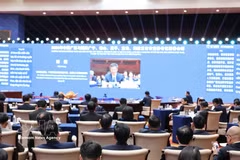
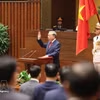
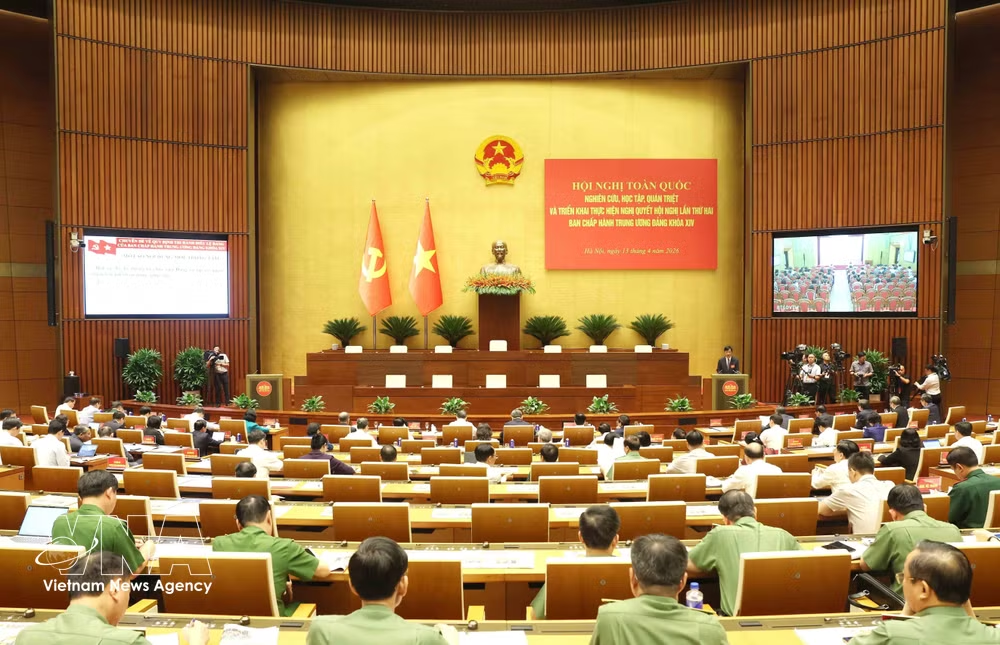
The national conference to disseminate and implement the resolution of the second meeting of the 14th Party Central Committee at the NA House. (Photo: VNA)

Ngoc emphasised that the implementation of the regulation requires serious study and consistent application across all levels. The Secretariat and relevant central bodies will issue detailed guidance to ensure uniform implementation.

Party committees and organisations were tasked with strengthening inspection and supervision, promptly addressing emerging issues, and reporting issues beyond their authority to the Party Central Committee.

Central advisory bodies and Party committees at all levels were urged to complete the institutionalisation and concretisation of the regulation into specific rules and guidelines within the second quarter of 2026. Priority areas include personnel work, organisational models, delegation mechanisms, and digital transformation processes, ensuring clarity in responsibilities, authority, and accountability while maintaining strict control over the exercise of power.

The official noted that the promulgation of the regulation represents a significant preparatory step for the comprehensive review and potential amendment of the Party Statutes and the Political Platform for national construction in the transitional period toward socialism at the 15th National Party Congress on the occasion of the Party’s centenary in 2030./.
VNA

See more

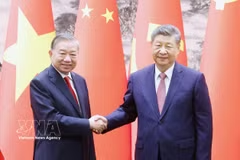
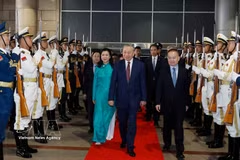
General Secretary of the Communist Party of China (CPC) Central Committee and President Xi Jinping (R) welcomes General Secretary of the Communist Party of Vietnam (CPV) Central Committee and State President To Lam (Photo: VNA)

Vietnam, China issue joint statement on deepening Comprehensive Strategic Cooperative Partnership in new era

The State visit to China by Party General Secretary and State President To Lam was a great success, positively contributing to strengthening the traditional friendship and accelerating the building of the Vietnam–China community with a shared future that carries strategic significance, thus promoting peace, stability, development, and prosperity in the region and the world.

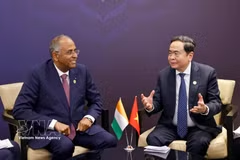
Chairman of the National Assembly Tran Thanh Man (R) meets President of the National Assembly of Côte d’Ivoire Patrick Achi on the sidelines of the 152nd Assembly of the Inter-Parliamentary Union (IPU-152) in Istanbul, Türkiye, on April 16. (Photo: VNA)

Vietnam, Côte d'Ivoire strengthen parliamentary, economic ties

On parliamentary cooperation, the top Vietnamese legislator called for increased the exchange of high-level delegations and closer collaboration between the two legislatures, including sharing legislative experience and strengthening ties between their respective committees.

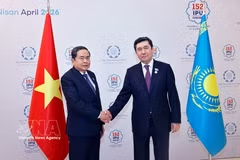
National Assembly Chairman Tran Thanh Man (left) and Yerlan Koshanov, Speaker of the Mazhilis - the lower house of Kazakhstan’s parliament, during their in Istanbul, Türkiye, on April 16 (Photo: VNA)

NA Chairman meets with Kazakhstan’s lower house speaker in Türkiye

The two sides also consented to continue close coordination at multilateral parliamentary forums, particularly the IPU, promoting the role of legislatures in advancing multilateralism and respect for international law, and contributing to peace, stability, cooperation and development regionally and globally.

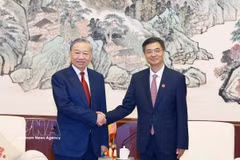
General Secretary of the Communist Party of Vietnam Central Committee and State President To Lam (L) receives Chen Gang, member of the Communist Party of China Central Committee, Secretary of the CPC Committee and Chairman of the Standing Committee of the People’s Congress of the Guangxi Zhuang Autonomous Region (Photo: VNA)

Top Vietnamese leader receives Secretary of Guangxi’s Party Committee

Vietnam is a close neighbour, trusted friend and one of Guangxi’s most important partners. The Party organisation and authorities of China's autonomous region attach great importance to friendship and cooperation with Vietnamese localities; and will continue to take the lead in thoroughly implementing the important common perceptions reached by the two top leaders, thereby deepening cooperation and friendship between China and Vietnam.

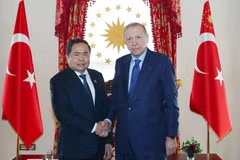
Vietnam’s National Assembly Chairman Tran Thanh Man (L) and Turkish President Recep Tayyip Erdogan at their meeting in Istanbul on April 16, 2026. (Photo: VNA)

Vietnamese NA Chairman meets Turkish President

Vietnam’s National Assembly Chairman Tran Thanh Man and Turkish President Recep Tayyip Erdogan emphasised that economic, trade, and investment ties should serve as key pillars of the relationship. They agreed to create favourable conditions to raise bilateral trade turnover to 4 billion USD, while continuing to encourage Turkish enterprises to invest in Vietnam and contribute to its economic development.

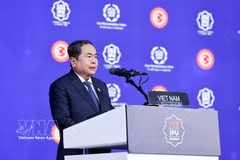
Chairman of the Vietnamese National Assembly Tran Thanh Man speaks at the general debate of the 152nd Assembly of the Inter-Parliamentary Union (IPU-152) in Türkiye on April 16, 2026. (Photo: VNA)

Vietnam's top legislator addresses general debate at 152nd IPU Assembly

Vietnam is striving with confidence and self-strengthening to enter a new stage of development, aiming to become a developing country with modern industry and upper-middle income by 2030, and a high-income developed country by 2045, said NA Chairman Tran Thanh Man at the general debate of the 152nd Assembly of the Inter-Parliamentary Union (IPU-152).

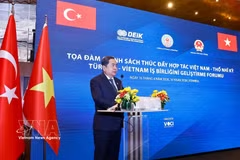
Chairman of the Vietnamese National Assembly Tran Thanh Man speaks at the policy dialogue aimed at promoting Vietnam–Türkiye cooperation (Photo: VNA)

NA Chairman attends policy dialogue promoting Vietnam–Türkiye cooperation

Türkiye is one of Vietnam’s key partners in the region, serving as a strategic bridge between Asia and Europe. Conversely, Vietnam, with its dynamic and fast-growing economy, is an important gateway for Türkiye to access Southeast Asian and Asia-Pacific markets. These complementary advantages provide a solid foundation for the two countries to further deepen their cooperation in the coming period.

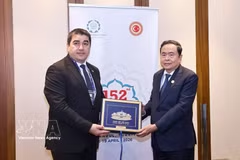
Chairman of the Vietnamese National Assembly Tran Thanh Man (R) presents a commemorative gift to Chairman of the Georgian Parliament Shalva Papuashvili during their meeting in Istanbul on April 16, 2026. (Photo: VNA)

NA Chairman meets Georgian parliament speaker on IPU-152 sidelines

NA Chairman Tran Thanh Man underlined that there remains ample room to further expand cooperation between Vietnam and Georgia in areas where both sides have strengths and potential, including education and training, culture, tourism, sports, logistics and transport, particularly rail transport.

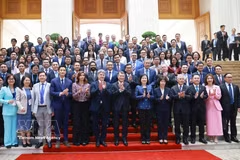
Prime Minister Le Minh Hung (C, first row) and representatives from 52 leading US enterprises (Photo: VNA)

Prime Minister meets delegation of leading US businesses

At the meeting, representatives of USABC, the US Embassy in Vietnam and participating businesses commended Vietnam’s socio-economic achievements and improving investment climate, as well as its strategic development orientation toward rapid and sustainable growth driven by science, technology, innovation and digital transformation.

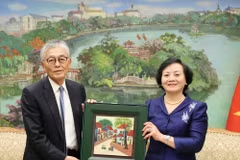
Deputy Prime Minister Pham Thi Thanh Tra (R) receives President and CEO of Japan’s erex Co., Ltd. Honna Hitoshi (Photo: VGP)

Deputy PM hails cooperation in personnel training with Japan

Deputy Prime Minister Pham Thi Thanh Tra highly valued the training programme jointly implemented since 2022 by Vietnam’s Ministry of Home Affairs and Japan’s erex Co., Ltd, which focuses on enhancing public administration capacity, particularly for grassroots officials, young civil servants and female cadres. Through the initiative, nearly 300 local-level officials and leaders from Vietnam have been sent to Japan for training and professional development.

☕ Afternoon briefing on April 16

☕ Afternoon briefing on April 16

Vietnamese PM Le Minh Hung's phone talks with his Singaporean counterpart Lawrence Wong, NA Chairman Tran Thanh Man's attendance at the opening of the IPU-152, and the presentation of the 20th Devotion Awards are among news highlights on April 16.

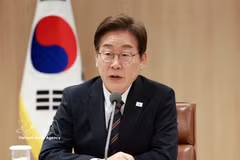
President of the Republic of Korea (RoK) Lee Jae Myung (Photo: Yonhap)

RoK President to pay state visit to Vietnam

President of the Republic of Korea (RoK) Lee Jae Myung and his spouse will pay a state visit to Vietnam from April 21 – 24 at the invitation of General Secretary of the Communist Party of Vietnam Central Committee and State President To Lam and his wife./.

Prime Minister Le Minh Hung holds phone talks with his Singaporean counterpart Lawrence Wong on April 16. (Photo: VNA)

Vietnamese Prime Minister holds phone talks with Singaporean counterpart

PM Hung noted that Vietnam is preparing new policies to attract greater foreign investment, including from Singapore. He called Singapore’s support in developing international financial centres in Vietnam, as well as expanding and upgrading next-generation Vietnam–Singapore Industrial Parks (VSIP) in tandem with high technology transfer.