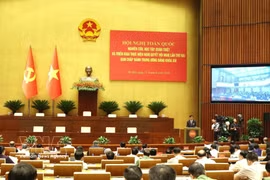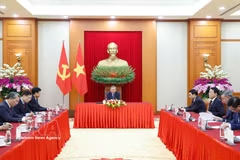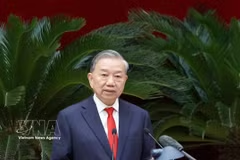
Hanoi (VNA) - A national conference to disseminate and implement the outcomes of the 14th Party Central Committee’s second plenum on April 13 highlighted key new and core contents of Resolution No. 05-NQ/TW and Regulation No. 21-QD/TW, which aimed at reforming and enhancing the effectiveness of Party inspection, supervision and discipline.
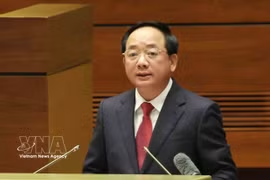
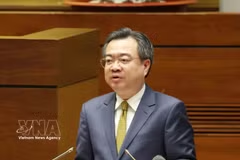
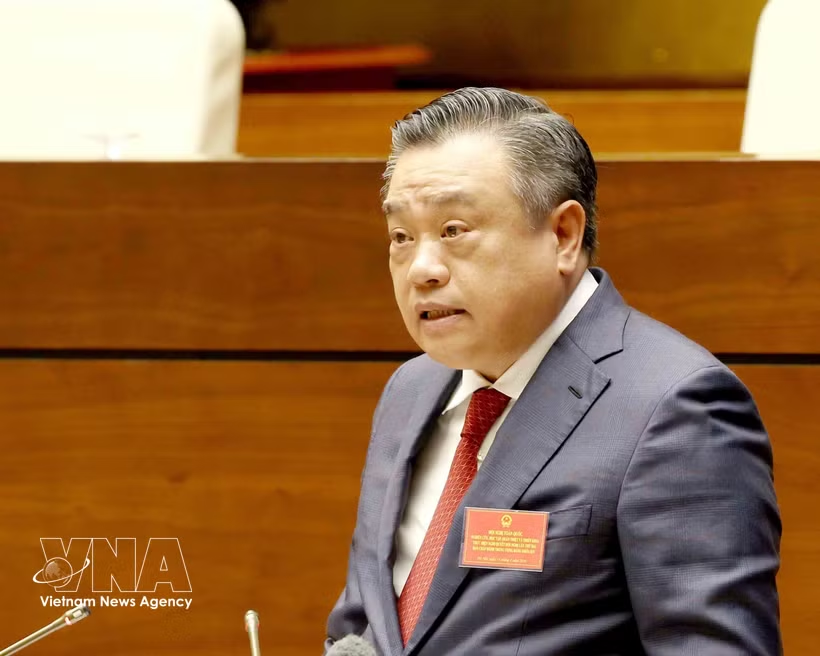
Presenting the thematic report, Politburo member, Secretary of the Party Central Committee, and Chairman of the Party Central Committee's Inspection Commission Tran Sy Thanh underscored the significance of the two documents in redefining the role of inspection, supervision, and discipline within the Party’s leadership.
Resolution 05 introduces a number of breakthrough viewpoints, positioning inspection and supervision as one of the Party’s most critical leadership functions. It is defined as a mechanism for self-correction and self-improvement, a key tool to control power and uphold Party discipline and order, ensuring that the Party’s guidelines are implemented rigorously and effectively in practice. Besides, inspection and supervision are identified as regular and continuous tasks of the Party, of every Party committee, organisation and inspection commissions at all levels, with primary and direct responsibility resting first and foremost with the heads of Party committees.
The Resolution sets out the overarching goal of improving the quality, effectiveness, and efficiency of inspection and supervision in tandem with stronger power control. It aims to curb corruption, wastefulness, negative practices, and “group interests,” while preventing political, moral, and lifestyle degradation as well as “self-evolution” and “self-transformation” within the Party. Ultimately, it seeks to uphold discipline and order, contribute to building and rectifying a clean and strong Party and political system; strengthen the Party’s leadership capacity, combativeness, unity and cohesion within the Party, as well as the effectiveness of national management and governance for the country’s development.
To achieve these goals, six key groups of tasks and solutions have been identified in the Resolution, including raising awareness and accountability among Party committees, organisations, and members for Party inspection, supervision and discipline; enhancing the quality of theoretical research and the review of practical experience; improving the Party’s system of regulations on inspection, supervision and discipline; and renewing the mindset and methods of Party inspection and supervision, closely linking them with mechanisms for power control to ensure strict Party discipline and order.
According to Thanh, attention should be paid to enhancing self-inspection and self-supervision within Party organisations and among Party members; proactively promoting the role of grassroots Party cells; and upholding the responsibility of Party members in overseeing Party organisations, in line with the principle that “inspection and supervision are the responsibility of the entire Party.”
“Party cells form the foundation of the Party and must serve as the closest and most regular supervisory level. Early detection of violations at this level will prevent them from escalating,” Thanh stressed.
Regarding the Regulation on Party inspection, supervision and discipline, Thanh said that reviewing and revising the document to update and supplement new viewpoints, contents and provisions, and to replace Regulation No. 296-QD/TW dated May 30, 2025, is necessary.
The new regulation comprises seven chapters and 35 articles, retaining core elements of the previous version while introducing five notable updates. These include clearer responsibilities for Party committees in coordinating with inspection bodies, police, military, auditing, prosecution, and judicial agencies; additional provisions on the organisation, tasks, and authority of inspection commissions; and expanded decentralisation and authority for the Party Central Committee's Inspection Commission in disciplining Party members.
It also refines principles and procedures for handling complaints and denunciations, aligning them more closely with practical requirements. Notably, the regulation further clarifies the authority levels responsible for resolving disciplinary appeals, promoting decentralisation while ensuring accountability.
Thanh called on Party committees and inspection bodies at all levels to promptly study, disseminate, and implement the new Resolution and Regulation down to each Party cell and member. Inspection and supervision, he stressed, must be defined as a routine task of the entire Party rather than delegated solely to inspection agencies.
He said action plans must be developed with clear priorities, timelines, responsibilities, resources, and measurable outcomes, tailored to the specific conditions of each locality and unit. Implementation results should be linked to performance evaluations of Party organisations, authorities, and their leaders.
Thanh also urged continued review and refinement of regulations and procedures to ensure alignment with the new framework, alongside stronger coordination with relevant agencies.
The focus of inspection and supervision should shift toward early prevention and proactive risk detection, integrating oversight into the operation of power, while promptly addressing violations and promoting positive practices, he noted.
With strong political determination and coordinated implementation, the Party inspection, supervision, and discipline are expected to become more effective, serving as a “watchful eye” and a sharp tool to uphold discipline, strengthen public trust, and ensure the Party’s policies are rigorously enforced, Thanh affirmed./.