Malaysia applies technology to immigration management

Designed to replace the Malaysian Immigration System (MyIMMs) after 20 years of operation, the new system is expected to mark a major breakthrough in enhancing immigration control efficiency while easing congestion at airports during peak hours.

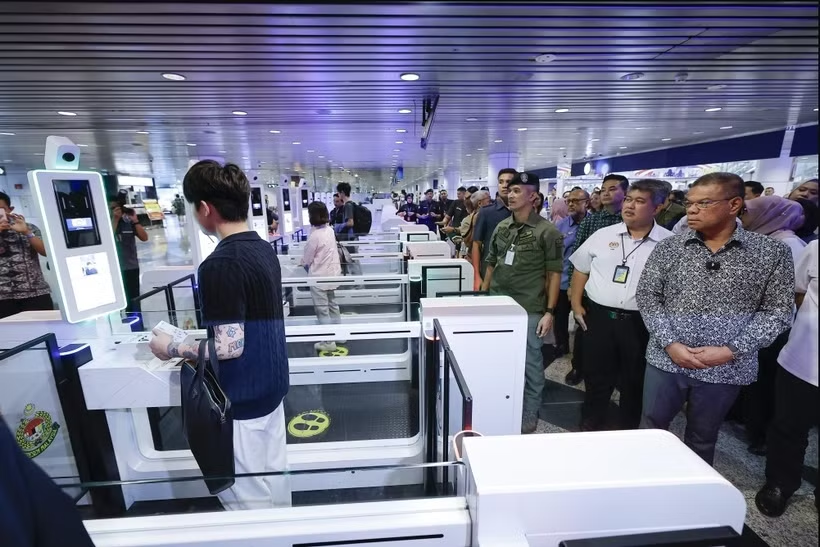
The National Integrated Immigration System (MyNIISe) is set to be fully implemented this June, in line with enhancements to the security features of the MyKad, as part of efforts to strengthen the country’s identity system and improve service delivery to the public. (Photo: Bernama)

Kuala Lumpur (VNA) – Malaysia is expected to launch its National Integrated Immigration System (MyNIISe) at entry points nationwide this September, aiming to reduce passenger inspection times to between four and five seconds.

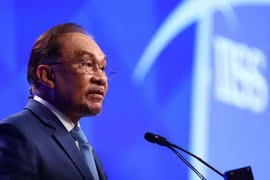
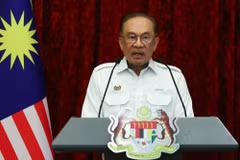
Malaysian Home Minister Saifuddin Nasution Ismail announced the plan following a routine inspection at the main terminal of Kuala Lumpur International Airport on May 5. The total investment for the MyNIISe system is estimated at around 1 billion MYR, equivalent to over 250 million USD.

Designed to replace the Malaysian Immigration System (MyIMMs) after 20 years of operation, the new system is expected to mark a major breakthrough in enhancing immigration control efficiency while easing congestion at airports during peak hours.

Unlike the previous system, which required passport scanning before biometric verification through fingerprints and facial recognition, MyNIISe enables verification using facial recognition technology, QR codes and passports.

Alongside technological upgrades, Malaysia’s Home Ministry also plans to strengthen manpower for the Malaysian Border Guards (MBG). The ministry is expected to expand recruitment to include military veterans in 2027, depending on the performance of the first intake.

The Home Minister expressed confidence that integrating the MBG into the Border Control and Protection Agency (AKPS) would help enhance the country’s border security capabilities.

Currently, the Malaysian Home Ministry is recruiting 200 MBG personnel for AKPS this year. The first phase has already been completed with 50 personnel recruited. The new force is expected to be deployed at key entry points such as Kuala Lumpur International Airport and Port Klang./.


VNA

See more

Aftermath of the fatal collision between a passenger bus and a tanker truck in the Trans-Sumatra Road in North Musi Rawas district, South Sumatra, Indonesia, on May 6, 2026. (Photo: ANTARA)

Indonesia: Bus–tanker collision leaves multiple dead

The North Musi Rawas Regional Disaster Mitigation Agency (BPBD) rescue officers are coordinating with traffic police to carry out evacuation efforts, focusing on clearing the accident site and assisting the victims.

ASEAN Secretary-General Kao Kim Hourn (Photo: VNA)

ASEAN chief spotlights Vietnam’s role in shaping bloc’s future

Vietnam is expected to maintain active contributions across ASEAN’s three pillars - the political-security community, the economic community, and the socio-cultural community; while further enhancing regional connectivity through infrastructure projects and stronger economic linkages.

Representatives of the Vietnamese community in India welcome Party General Secretary and State President To Lam in New Delhi on May 5, 2026. (Photo: VNA)

India media hails Vietnamese leader’s visit as catalyst for stronger strategic partnership

Indian news outlets noted that Vietnam is currently one of India’s most important partners in Southeast Asia, particularly as the two sides share strategic interests in the Indo-Pacific region. Priority areas for cooperation include defence and security, trade and investment, digital transformation, high technology, supply chain connectivity, and maritime collaboration.

Thailand: BOT warns SMEs and vulnerable groups face hardest economic shock (Photo: The Nation)

Thailand faces economic shock from Middle East tensions

Bank of Thailand Governor Vitai Ratanakorn said the economy was likely to slow as many parties had assessed. The clear impact was higher inflation, affecting both businesses and households, which were beginning to face more pressure from rising costs, as well as effects on debt and liquidity.

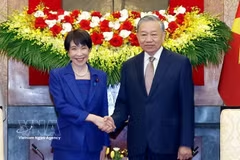
Party General Secretary and State President To Lam (R) receives Japanese Prime Minister Sanae Takaichi in Hanoi on May 2 (Photo: VNA)

Japanese PM highlights outcomes of visits to Vietnam, Australia

Speaking to the press in Canberra on May 4, the Japanese PM stressed that during her visits to Vietnam and Australia, in addition to deepening personal trust among leaders, she and the leaders were able to reach agreement on advancing concrete cooperation toward their shared objective of enhancing national resilience and autonomy, and becoming stronger and more prosperous together as a region.

Foreign investment in Thailand surges in Q1

Foreign investment in Thailand surges in Q1

According to Thailand's Board of Investment (BOI), the combined value of the 624 project applications submitted during the January-March period was roughly 2.4 times the value recorded in the same period last year, reflecting strong foreign interest despite global economic volatility.