Malaysia intensifies efforts to strengthen rice supply, production

Malaysia’s physical rice stocks remain stable and sufficient to meet domestic demand for at least six months, providing a buffer against potential geopolitical tensions in the Middle East.

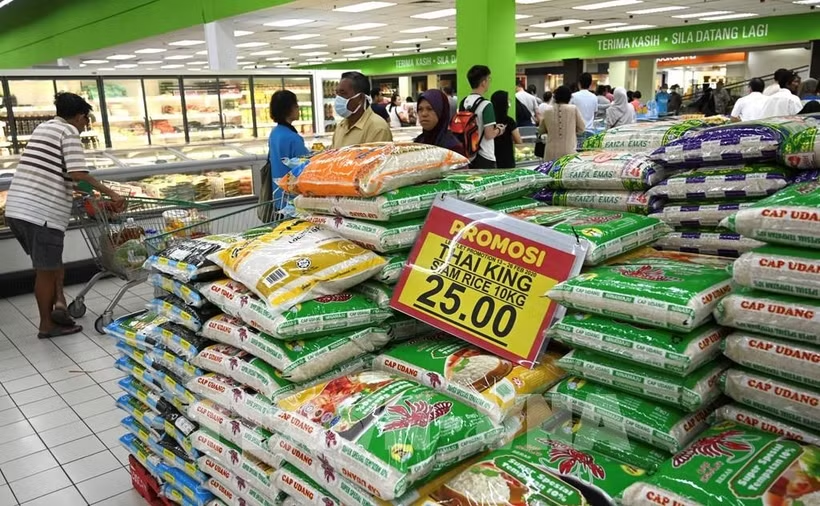
Rice bags sold at a supermarket in Penang, Malaysia (Illustrative photo: AFP/VNA)

Kuala Lumpur (VNA) – Malaysian Deputy Minister of Agriculture and Food Security Chan Foong Hin said on August 4 that the country would continue to ensure a stable rice reserve while stepping up a range of support measures for domestic rice farmers.

As reported by the country’s national news agency Bernama, Malaysia’s physical rice stocks remain stable and sufficient to meet domestic demand for at least six months, providing a buffer against potential geopolitical tensions in the Middle East.

According to the deputy minister, the current inventory stood at 1.237 million tonnes, comprising 200,000 tonnes in national buffer stock and 1.037 million tonnes in commercial reserves.

"We maintain a physical rice buffer stock managed by Padiberas Nasional Bhd, as well as commercial stocks, that can last at least six months in the event of a global supply crisis," he said as quoted by Bernama.

Chan added that the supply control mechanism was supported by government subsidies to regulate local white rice prices.

On achieving an 80% self-sufficiency ratio for rice by 2030, he said the Agriculture and Food Security Ministry was expanding the use of drought-resistant padi varieties to counter climate threats like El Nino.

The official said the ministry was also executing a five-season rice cultivation project over two years across areas under the Muda Agricultural Development Authority, alongside irrigation system upgrades./.

VNA

See more

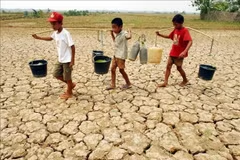
Drought-hit farmland in Cibarusa, Bekasi, Indonesia. (Photo: AFP/VNA)

Indonesia takes drastic measures to respond to strong El Niño

Under its response plan for agriculture and forestry, Indonesia is stepping up forest and peatland fire prevention and firefighting, deploying weather modification technology, improving irrigation systems, putting boreholes into operation, distributing drought-resistant crop varieties, and expanding agricultural insurance. These measures aim to mitigate the impact of drought on rice, palm oil and coffee production.

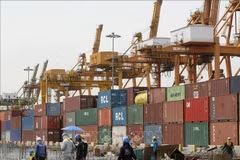
Goods are loaded at a port in Bangkok, Thailand. (Photo: AFP/VNA)

Thailand's exports to US, Europe surge in fiscal 2026

Data from the Thailand Customs Department show that the country's total international trade reached approximately 21.4 trillion THB (660 billion USD) during the period, approaching the 22 trillion THB recorded for the whole of the previous fiscal year.

Malaysia, Thailand step up efforts to restore seafood trade

Malaysia, Thailand step up efforts to restore seafood trade

The inspections focus on biosecurity measures at farms, production systems, and related documentation, including laboratory analyses of chemical residues and the use of prohibited substances. Authorities are also assessing farms, hatcheries, laboratories and border inspection facilities in both countries.

Indonesia steps up response to forest fires

Indonesia steps up response to forest fires

Indonesia's National Disaster Mitigation Agency (BNPB) is preparing to deploy two water-bombing helicopters to accelerate firefighting efforts in the Mount Bromo area. Ground crews are continuing to battle the flames, although many fire hotspots remain in steep, hard-to-reach locations.

ASEAN urged to place children at centre of policymaking

ASEAN urged to place children at centre of policymaking

Citing data from the United Nations Children’s Fund (UNICEF), she said the Asia-Pacific is home to around 1.12 billion children, the largest in the world. ASEAN alone records around 200 million people aged below 18, or nearly 30% of its population.

A corner of Bangkok, Thailand (Illustrative photo: VNA)

Thailand steps up business cooperation with Indonesia

Thailand and Indonesia should connect the “mainland and archipelago” by using Thailand as a manufacturing hub and Indonesia as a large market and maritime economic gateway, said Thai Prime Minister Anutin Charnvirakul.

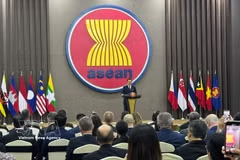
Thai Prime Minister Anutin Charnvirakul delivers the policy speech at the ASEAN Secretariat in Jakarta on August 4. (Photo: VNA)

Thai PM outlines three priorities for ASEAN’s future

To strengthen resilience, ASEAN should deepen integration, build reliable supply chains, bolster energy security, advance digital connectivity and enhance technological capacity, said Thai Prime Minister Anutin Charnvirakul.