Indonesia, Thailand target 20 bln USD in two-way trade by 2030

Indonesia and Thailand aim to increase bilateral trade to 20 billion USD by 2030 under an expanded strategic partnership covering the economic, energy and agricultural sectors, Indonesian President Prabowo Subianto announced on August 3.

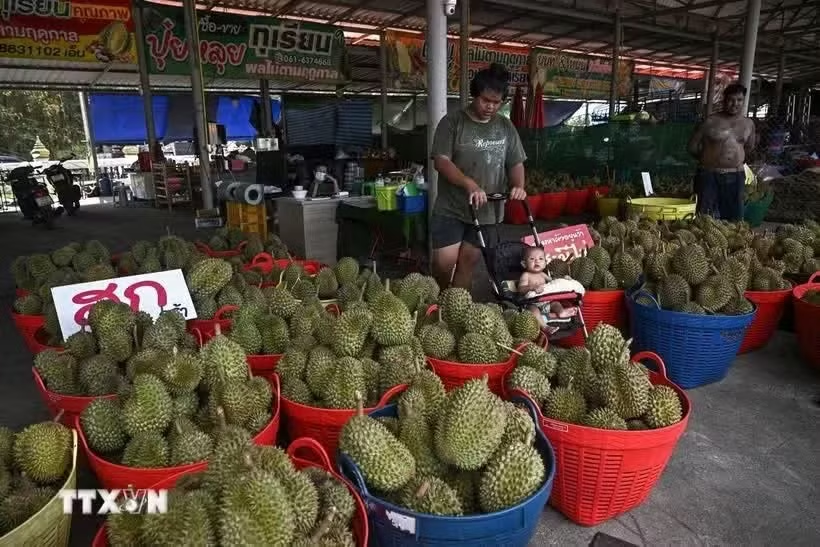
Durian is one of Thailand's key export commodities. (Photo: AFP/VNA)

Jakarta (VNA) – Indonesia and Thailand have set a target of raising bilateral trade to 20 billion USD by 2030 through strengthened strategic partnerships across the economic, energy, and agricultural sectors.

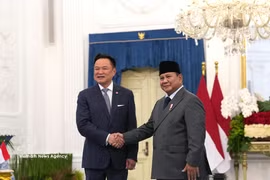
The goal was announced by Indonesian President Prabowo Subianto during a joint press statement with Thai Prime Minister Anutin Charnvirakul in Jakarta on August 3, Indonesia's Antara news agency reported.

Earlier, during their talks, the two leaders officially adopted the Indonesia-Thailand Strategic Partnership Roadmap 2026–2030, providing a framework to expand market access, promote bilateral investment, and remove trade barriers.

As part of the roadmap, the two countries will establish a Joint Trade Commission, the first bilateral trade mechanism between Indonesia and Thailand, to address trade barriers and unlock new business opportunities.

In agriculture and food security, the two countries agreed to strengthen cooperation in the application of agricultural technologies, enhance supply chain resilience, and develop interconnected logistics networks.

They also pledged to leverage their strengths in the halal food industry to build integrated value chains targeting regional and global markets.

Besides, cooperation in energy security and the digital economy are identified as priority areas of the bilateral cooperation. The planned establishment of the Indonesia–Thailand Energy Forum is expected to support the transition towards sustainable energy and strengthen the resilience of regional power systems.

The two sides are also seeking to expand Local Currency Transaction (LCT) frameworks, a move aimed at reducing exchange-rate volatility and improving efficiency in cross-border trade transactions.

Anutin said that with a combined population of around 350 million and vast economic potential, Indonesia and Thailand have ample room to expand economic cooperation. As two of Southeast Asia's largest economies, the countries enjoy complementary strengths and play key roles in advancing ASEAN's economic integration./.
VNA

See more

Cambodia urges strict enforcement of ban on electronic waste imports

Cambodia urges strict enforcement of ban on electronic waste imports

The prohibited items include used air conditioners, refrigerators, freezers, washing machines, clothes dryers, televisions, desktop computers, laptops, mobile phones and tablets. They are classified as hazardous waste because they contain toxic substances, including mercury, cadmium, nickel, chromium, arsenic and lead.

Indonesian officials introduce the national Carbon Unit Registry System (SRUK) at a press conference in Jakarta on July 30. (Photo: VNA)

Indonesia strengthens carbon market governance to attract green investment

Indonesia needs around 470 billion USD to meet its climate commitments, in addition to about 100 billion USD for a programme to develop 100 GW of solar power. As public funding alone will not be sufficient, the carbon market is expected to become an important source of finance for clean energy, forest conservation and emissions reduction projects.

NHK World's official X account reports on five Vietnamese workers who bravely rescued people during the earthquake in Japan's Kumamoto prefecture (Screenshot photo)

Japanese media hail Vietnamese workers for earthquake rescue

Major Japanese media outlets have highlighted the bravery of five Vietnamese workers who rescued a 90-year-old woman from a collapsed house following the Kumamoto earthquake, praising their quick action and the solidarity shown by the Vietnamese community in Japan.

Malaysia targets moving up global semiconductor value chain

Malaysia targets moving up global semiconductor value chain

Malaysia is currently ranked sixth globally in the semiconductor industry, especially in assembly, testing, and packaging, but the country aims to strengthen its position by expanding into higher value activities such as IC design.

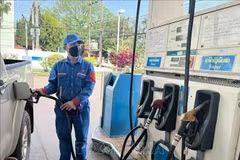
At a gas station in Vientiane, Laos (Photo: VNA)

Laos pushes ahead with oil pipeline project linking to Vietnam

The Lao Government, during its regular meeting for July, instructed relevant ministries, sectors and localities to urgently study investment options for an oil pipeline linking Laos and Vietnam, aiming to strengthen national energy security amid growing volatility in the global fuel market.