Cambodia expands cross-border QR payment links with ASEAN countries

Through the NBC's digital payment infrastructure, Cambodian users and international visitors can make instant retail payments in local currencies by scanning national QR codes across partner payment networks in the five ASEAN countries.

Phnom Penh (VNA) – Cambodia is expanding its footprint in digital finance by strengthening bilateral cross-border QR payment connectivity with five fellow members of the Association of Southeast Asian Nations (ASEAN), namely Laos, Malaysia, Singapore, Thailand and Vietnam.

The initiative, led by the National Bank of Cambodia (NBC) through its Bakong digital currency platform and the official national QR code payment standard KHQR, has positioned Cambodia as one of the region's most interconnected digital payment hubs.

Through the NBC's digital payment infrastructure, Cambodian users and international visitors can make instant retail payments in local currencies by scanning national QR codes across partner payment networks in the five ASEAN countries.

With five bilateral QR payment links now operational, Cambodia ranks second only to Thailand in cross-border payment integration within ASEAN, marking a significant step towards a seamless digital economy in Southeast Asia./.

VNA

See more

Cambodia urges strict enforcement of ban on electronic waste imports

Cambodia urges strict enforcement of ban on electronic waste imports

The prohibited items include used air conditioners, refrigerators, freezers, washing machines, clothes dryers, televisions, desktop computers, laptops, mobile phones and tablets. They are classified as hazardous waste because they contain toxic substances, including mercury, cadmium, nickel, chromium, arsenic and lead.

Indonesian officials introduce the national Carbon Unit Registry System (SRUK) at a press conference in Jakarta on July 30. (Photo: VNA)

Indonesia strengthens carbon market governance to attract green investment

Indonesia needs around 470 billion USD to meet its climate commitments, in addition to about 100 billion USD for a programme to develop 100 GW of solar power. As public funding alone will not be sufficient, the carbon market is expected to become an important source of finance for clean energy, forest conservation and emissions reduction projects.

NHK World's official X account reports on five Vietnamese workers who bravely rescued people during the earthquake in Japan's Kumamoto prefecture (Screenshot photo)

Japanese media hail Vietnamese workers for earthquake rescue

Major Japanese media outlets have highlighted the bravery of five Vietnamese workers who rescued a 90-year-old woman from a collapsed house following the Kumamoto earthquake, praising their quick action and the solidarity shown by the Vietnamese community in Japan.

Malaysia targets moving up global semiconductor value chain

Malaysia targets moving up global semiconductor value chain

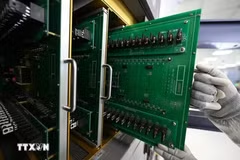
Malaysia is currently ranked sixth globally in the semiconductor industry, especially in assembly, testing, and packaging, but the country aims to strengthen its position by expanding into higher value activities such as IC design.

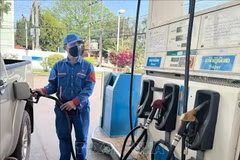
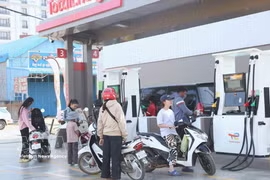
At a gas station in Vientiane, Laos (Photo: VNA)

Laos pushes ahead with oil pipeline project linking to Vietnam

The Lao Government, during its regular meeting for July, instructed relevant ministries, sectors and localities to urgently study investment options for an oil pipeline linking Laos and Vietnam, aiming to strengthen national energy security amid growing volatility in the global fuel market.

Thailand rolls out semiconductor development strategy

Thailand rolls out semiconductor development strategy

Alongside domestic capacity building, Thailand is seeking to strengthen regional semiconductor cooperation. Its proposals include establishing an ASEAN Talent Observatory to forecast workforce demand, expanding the Thailand Skill Bridge platform, promoting joint research and development (R&D) programmes, and incorporating photonics and printed circuit boards into the ASEAN Semiconductor Roadmap.

Malaysia tightens control over e-cigarettes amid rising healthcare costs

Malaysia tightens control over e-cigarettes amid rising healthcare costs

According to a written reply by the Malaysian Ministry of Health (MOH) published on the Dewan Negara (Senate) website on July 29, the health and economic costs associated with vaping-related illnesses significantly outweigh the 354.51 million MYR in excise duty collected from e-cigarette products between 2023 and June 11, 2026.

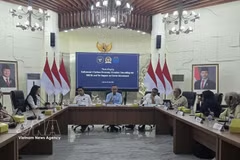
Panelists at the discussion session of the 10th ASEAN Media Forum (AMF 2026). (Photo: VNA)

ASEAN media urged to uphold trust, embrace AI responsibly

AI does not create misinformation but enables false content to be produced and disseminated more quickly and easily. ASEAN should therefore strengthen trusted information sources, improve the public's ability to identify false information and encourage greater accountability among digital platforms.