Cambodia urges strict enforcement of ban on electronic waste imports

The prohibited items include used air conditioners, refrigerators, freezers, washing machines, clothes dryers, televisions, desktop computers, laptops, mobile phones and tablets. They are classified as hazardous waste because they contain toxic substances, including mercury, cadmium, nickel, chromium, arsenic and lead.

Phnom Penh (VNA) - Cambodia’s Ministry of Environment has called on municipal and provincial authorities to enforce a ban on the import of electronic waste, including batteries and used electrical and electronic equipment, warning that such waste poses risks to public health and the environment.

In a letter sent to governors of all capital and provincial administrations, the ministry urged serious enforcement of existing laws prohibiting the import of waste batteries and waste electrical and electronic equipment into the country, reported Khmer Times.

The prohibited items include used air conditioners, refrigerators, freezers, washing machines, clothes dryers, televisions, desktop computers, laptops, mobile phones and tablets. They are classified as hazardous waste because they contain toxic substances, including mercury, cadmium, nickel, chromium, arsenic and lead, Minister of Environment Eang Sophalleth said.

Sophalleth added that battery and electronic equipment recycling projects planning to import hazardous waste from abroad as feedstock could pose serious risks to public health and the environment and should not be approved. He said the enforcement measures are aimed at protecting public health and the environment from toxic substances contained in electronic waste.

Earlier in June, the ministry affirmed that Cambodia will not allow itself to become a dumping ground for electronic waste from abroad, saying the import ban is part of efforts to protect the country’s natural resources and public health./.
VNA

See more

Indonesian officials introduce the national Carbon Unit Registry System (SRUK) at a press conference in Jakarta on July 30. (Photo: VNA)

Indonesia strengthens carbon market governance to attract green investment

Indonesia needs around 470 billion USD to meet its climate commitments, in addition to about 100 billion USD for a programme to develop 100 GW of solar power. As public funding alone will not be sufficient, the carbon market is expected to become an important source of finance for clean energy, forest conservation and emissions reduction projects.

NHK World's official X account reports on five Vietnamese workers who bravely rescued people during the earthquake in Japan's Kumamoto prefecture (Screenshot photo)

Japanese media hail Vietnamese workers for earthquake rescue

Major Japanese media outlets have highlighted the bravery of five Vietnamese workers who rescued a 90-year-old woman from a collapsed house following the Kumamoto earthquake, praising their quick action and the solidarity shown by the Vietnamese community in Japan.

Malaysia targets moving up global semiconductor value chain

Malaysia targets moving up global semiconductor value chain

Malaysia is currently ranked sixth globally in the semiconductor industry, especially in assembly, testing, and packaging, but the country aims to strengthen its position by expanding into higher value activities such as IC design.

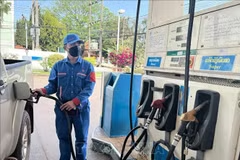
At a gas station in Vientiane, Laos (Photo: VNA)

Laos pushes ahead with oil pipeline project linking to Vietnam

The Lao Government, during its regular meeting for July, instructed relevant ministries, sectors and localities to urgently study investment options for an oil pipeline linking Laos and Vietnam, aiming to strengthen national energy security amid growing volatility in the global fuel market.

Thailand rolls out semiconductor development strategy

Thailand rolls out semiconductor development strategy

Alongside domestic capacity building, Thailand is seeking to strengthen regional semiconductor cooperation. Its proposals include establishing an ASEAN Talent Observatory to forecast workforce demand, expanding the Thailand Skill Bridge platform, promoting joint research and development (R&D) programmes, and incorporating photonics and printed circuit boards into the ASEAN Semiconductor Roadmap.

Malaysia tightens control over e-cigarettes amid rising healthcare costs

Malaysia tightens control over e-cigarettes amid rising healthcare costs

According to a written reply by the Malaysian Ministry of Health (MOH) published on the Dewan Negara (Senate) website on July 29, the health and economic costs associated with vaping-related illnesses significantly outweigh the 354.51 million MYR in excise duty collected from e-cigarette products between 2023 and June 11, 2026.

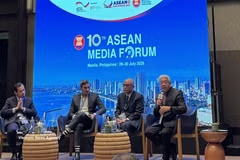
Panelists at the discussion session of the 10th ASEAN Media Forum (AMF 2026). (Photo: VNA)

ASEAN media urged to uphold trust, embrace AI responsibly

AI does not create misinformation but enables false content to be produced and disseminated more quickly and easily. ASEAN should therefore strengthen trusted information sources, improve the public's ability to identify false information and encourage greater accountability among digital platforms.

Bali Island is a popular tourist destination in Indonesia. (Illustrative photo: Xinhua/VNA)

Indonesia aims to become ASEAN’s leading MICE hub

An Indonesian official reaffirmed the country's ambition to strengthen its position as ASEAN's business events hub while promoting high-quality and sustainable tourism that generates greater added value.

Young generation drives Indonesia's digital creative economy

Young generation drives Indonesia's digital creative economy

In a statement released on July 29, Indonesia’s Creative Economy Minister Teuku Riefky Harsya said the creative economy is closely aligned with young people, making partnerships with digital platforms and creative media essential to strengthening the sector's ecosystem.

The 3rd Roundtable on Climate and Water Issues and the 9th Meeting of the Asian Parliamentary Assembly Water Consultative Council (AAWC) in Vientiane on July 28. (Photo: VNA)

Laos advances sustainable water management to address climate challenges

In his opening remarks, Lao NA Vice President Vilayvong Boutdakham highlighted the growing challenges posed by climate change, natural disasters and energy shortages, noting that these issues are having significant impacts on livelihoods and sustainable development across the region.