Indonesia takes drastic measures to respond to strong El Niño

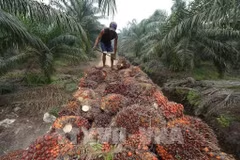
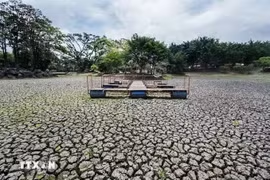
Under its response plan for agriculture and forestry, Indonesia is stepping up forest and peatland fire prevention and firefighting, deploying weather modification technology, improving irrigation systems, putting boreholes into operation, distributing drought-resistant crop varieties, and expanding agricultural insurance. These measures aim to mitigate the impact of drought on rice, palm oil and coffee production.

Jakarta (VNA) – The Indonesian Government has developed a cross-sectoral response framework to prepare for the risk of a strong El Niño in the second half of 2026, focusing on four priority areas: agriculture and forestry; energy and water resources; healthcare; and fisheries and food.

Deputy for Food, Natural Resources, and Environment at the Ministry of National Development Planning Lenardo A.A. Teguh said at a national dialogue on strengthening response against the phenomenon on August 4 that the new policy brief identifies risks, maps the distribution of impacts, and formulates response directions, according to the Indonesian news agency Antara.

Previously, the Meteorology, Climatology, and Geophysics Agency (BMKG) forecast that a strong El Niño could emerge in the second half of 2026, potentially reducing rainfall in some areas to below 20mm per month. The government estimates that without early intervention, economic losses from climate change in priority sectors could exceed 2 quadrillion IDR (111 billion USD).

Under its response plan for agriculture and forestry, Indonesia is stepping up forest and peatland fire prevention and firefighting, deploying weather modification technology, improving irrigation systems, putting boreholes into operation, distributing drought-resistant crop varieties, and expanding agricultural insurance. These measures aim to mitigate the impact of drought on rice, palm oil and coffee production.

In energy and water resources, water storage facilities and river basin conservation infrastructure are being maintained, while weather modification measures are being implemented to help sustain water supplies and minimise impacts on hydropower generation. Meanwhile, reduced cloud cover during the dry season is expected to create favourable conditions for higher solar power generation.

In healthcare, Indonesian authorities are planning to strengthen surveillance of climate-sensitive diseases such as dengue fever and malaria, enhance the preparedness of the healthcare system, ensure access to clean water, and step up risk warnings for communities.

Meanwhile, oceanographic data will be used to develop production plans and apply more efficient aquaculture technologies./.
VNA

See more

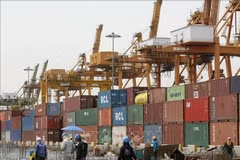
Goods are loaded at a port in Bangkok, Thailand. (Photo: AFP/VNA)

Thailand's exports to US, Europe surge in fiscal 2026

Data from the Thailand Customs Department show that the country's total international trade reached approximately 21.4 trillion THB (660 billion USD) during the period, approaching the 22 trillion THB recorded for the whole of the previous fiscal year.

Malaysia, Thailand step up efforts to restore seafood trade

Malaysia, Thailand step up efforts to restore seafood trade

The inspections focus on biosecurity measures at farms, production systems, and related documentation, including laboratory analyses of chemical residues and the use of prohibited substances. Authorities are also assessing farms, hatcheries, laboratories and border inspection facilities in both countries.

Indonesia steps up response to forest fires

Indonesia steps up response to forest fires

Indonesia's National Disaster Mitigation Agency (BNPB) is preparing to deploy two water-bombing helicopters to accelerate firefighting efforts in the Mount Bromo area. Ground crews are continuing to battle the flames, although many fire hotspots remain in steep, hard-to-reach locations.

ASEAN urged to place children at centre of policymaking

ASEAN urged to place children at centre of policymaking

Citing data from the United Nations Children’s Fund (UNICEF), she said the Asia-Pacific is home to around 1.12 billion children, the largest in the world. ASEAN alone records around 200 million people aged below 18, or nearly 30% of its population.

A corner of Bangkok, Thailand (Illustrative photo: VNA)

Thailand steps up business cooperation with Indonesia

Thailand and Indonesia should connect the “mainland and archipelago” by using Thailand as a manufacturing hub and Indonesia as a large market and maritime economic gateway, said Thai Prime Minister Anutin Charnvirakul.

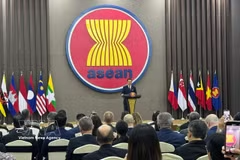
Thai Prime Minister Anutin Charnvirakul delivers the policy speech at the ASEAN Secretariat in Jakarta on August 4. (Photo: VNA)

Thai PM outlines three priorities for ASEAN’s future

To strengthen resilience, ASEAN should deepen integration, build reliable supply chains, bolster energy security, advance digital connectivity and enhance technological capacity, said Thai Prime Minister Anutin Charnvirakul.