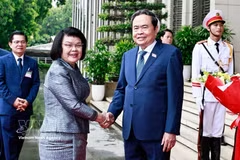
Cambodia seeks to shift toward high-tech industries

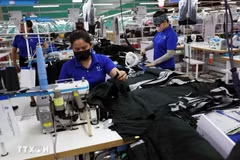
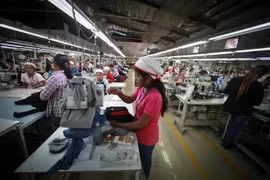
Cambodia is stepping up strategic efforts to transform its industrial sector from a labour-intensive production model towards one driven by skilled workers and advanced technologies.

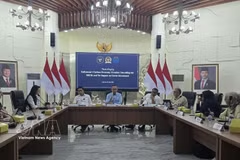
Phnom Penh (VNA) – Cambodia is stepping up strategic efforts to transform its industrial sector from a labour-intensive production model towards one driven by skilled workers and advanced technologies, Deputy Prime Minister and First Vice Chairman of the Council for the Development of Cambodia (CDC) Sun Chanthol said at a meeting on August 4.

The meeting brought together senior CDC officials, representatives from relevant ministries and state agencies, and leaders of companies producing automotive wiring harnesses operating in Cambodia.

Sun Chanthol reaffirmed the Government’s commitment to supporting stakeholders and creating favourable conditions to ensure the sustainable development of the automotive wiring harness manufacturing sector, and further improving the investment environment to attract future investments.

He also instructed relevant agencies to work closely with the private sector and promptly and effectively address proposals raised at the meeting, with a view to strengthening Cambodia’s competitiveness in regional and global markets.

The meeting reviewed overall investment in the sector, with businesses providing updates on their production and business activities.

Representatives of automotive wiring harness manufacturers expressed their appreciation for the Government’s direct dialogue mechanism, saying the platform will help strengthen cooperation and reinforce confidence in Cambodia’s investment climate./.
VNA

See more

Cambodia urges strict enforcement of ban on electronic waste imports

Cambodia urges strict enforcement of ban on electronic waste imports

The prohibited items include used air conditioners, refrigerators, freezers, washing machines, clothes dryers, televisions, desktop computers, laptops, mobile phones and tablets. They are classified as hazardous waste because they contain toxic substances, including mercury, cadmium, nickel, chromium, arsenic and lead.

Indonesian officials introduce the national Carbon Unit Registry System (SRUK) at a press conference in Jakarta on July 30. (Photo: VNA)

Indonesia strengthens carbon market governance to attract green investment

Indonesia needs around 470 billion USD to meet its climate commitments, in addition to about 100 billion USD for a programme to develop 100 GW of solar power. As public funding alone will not be sufficient, the carbon market is expected to become an important source of finance for clean energy, forest conservation and emissions reduction projects.

NHK World's official X account reports on five Vietnamese workers who bravely rescued people during the earthquake in Japan's Kumamoto prefecture (Screenshot photo)

Japanese media hail Vietnamese workers for earthquake rescue

Major Japanese media outlets have highlighted the bravery of five Vietnamese workers who rescued a 90-year-old woman from a collapsed house following the Kumamoto earthquake, praising their quick action and the solidarity shown by the Vietnamese community in Japan.

Malaysia targets moving up global semiconductor value chain

Malaysia targets moving up global semiconductor value chain

Malaysia is currently ranked sixth globally in the semiconductor industry, especially in assembly, testing, and packaging, but the country aims to strengthen its position by expanding into higher value activities such as IC design.