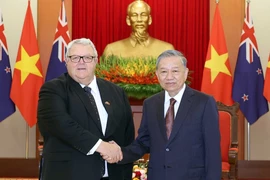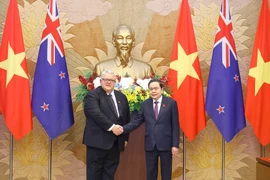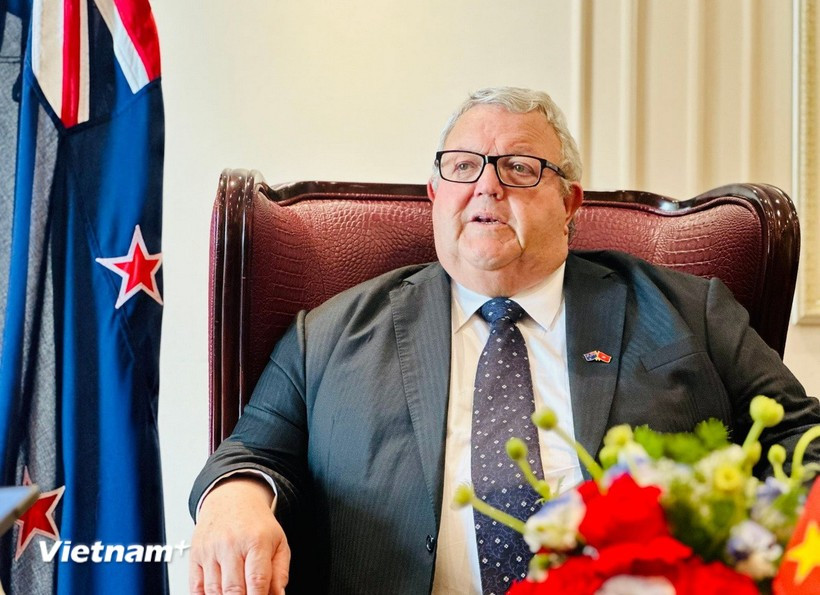
Hanoi (VNA) - New Zealand considers Vietnam a very important partner, especially given Vietnam’s leading role within the Association of Southeast Asian Nations (ASEAN) and its active participation in various multilateral agreements, Speaker of the New Zealand House of Representatives (Parliament) Gerry Brownlee has affirmed.
The Speaker made the statement while talking to the Vietnamese press on the occasion of his ongoing official visit to Vietnam. The Vietnam News Agency (VNA) would like to introduce the full text of the interview.
Reporter: This year, Vietnam and New Zealand celebrate the 50th anniversary of diplomatic relations and also elevated our ties to a Comprehensive Strategic Partnership. From your view, what does this milestone represent, and how do you see it benefiting bilateral cooperation in the years ahead? And which areas of collaboration are the top priorities for both countries right now?
Speaker Gerry Brownlee: New Zealand sees Vietnam as being a very important partner, particularly the leadership role Vietnam takes in ASEAN and various other multilateral agreements that are around this part of the world.
And of course on a broader international stage, countries who have friendly relations tend to have a stronger voice than those who might be a little bit more discouraged. So on a political level we see it as being a very valuable friendship that's grown over those 50 years to a point now where we can say well, how do we take this a bit further? So the comprehensive strategic partnership is built around the idea that on almost every aspect of governance we have some arrangement that recognises a mutual benefit. Further to that of course, both our countries are international traders and we have the very modest goal of improving the two-way trade between our two countries to about 3 billion USD by 2030. We're a country of only 5 million people so we'll do our best to meet the goal. As I say, I think it's modest, I think we can do better. Also, it means that the people-to-people links will be strengthened and enhanced as well.
So we'll look to a range of things that will mean that more people from Vietnam can come to New Zealand for study, education, or for any business activities as well. And Vietnam will do the same for New Zealand. So all in all, it's about the two countries becoming much closer as a result of the trust that's been built up over those 50 years.
Reporter: How do you assess the notable achievements in parliamentary cooperation between the two countries in recent years? What can the two Parliaments do to enhance exchanges and share experiences in legislation and oversight, in order to deepen parliamentary cooperation?
Speaker Gerry Brownlee: Well, parliaments throughout the world are important. It doesn't really matter what sort of political system you have.
Parliament is the place where the voice of the people are heard, and so from that perspective, extremely important. So in New Zealand we have a very open parliament with a large number of political parties represented, so lots of views. But in a population of 105 million, as you've got in Vietnam, there are going to be lots of views about lots of different issues.
So having a parliament where those opinions can be voiced. And also where decisions taken by the government can be ratified or revoiced is extremely important. So processes will be different, but nonetheless we'll look to having whatever levels of cooperation among our bureaucrats of the party, of the parliament, I should say, as we possibly can.
Reporter: Vietnam and New Zealand work closely together through global and regional platforms such as ASEAN+, APEC, and ASEM, and are also members of major trade agreements including ANZFTA, CPTPP, and RCEP. In your opinion, how do these frameworks help advance economic and trade relations while safeguarding our shared strategic interests?
Speaker Gerry Brownlee: Well I think, as I said at the start, Vietnam from New Zealand's perspective has been a very reliable partner in this part of the world when it comes to activities that relate to the multilateral agreements that we have. I think also if you look at the world at the moment, there is, particularly with one of the world's, or the world's biggest economy, reshaping itself through tariffs and other such, that has a flow-on effect to all other countries.
And so having a strong relationship with countries in this part of the world is very important for New Zealand. And we see Vietnam as being strategically quite a leader in the area as well. And you've got very big aspirations here for growth in your economy.
Growth is how you improve, well economic growth is how you improve the wellbeing of people in any country. And so we look to, I suppose in many ways, learn from how you achieve such significant growth rates in a world that is actually quite challenged at the present time.
Reporter: Your visit coincides with the time when Vietnam is preparing to celebrate the 80th anniversary of independence. Looking back over the past 80 years, what do you think are the most outstanding development achievements of Vietnam that impress you?
Speaker Gerry Brownlee: Well, can I first say that being here at a time when you're just a few days away from a celebration is quite an experience.
So it seems to me that just here in the city, and I'm sure it's the case right across the country, the excitement among people to celebrate that independence, to be part of stating that Vietnam is an independent nation that has a lot to offer the world, is quite palpable. You can feel it in the streets, the wonderful way in which the various flags and everything else, the way people are dressing, it's quite an exciting time. And to be here for that, to see that, is a particular privilege for us.
I think if you look at the struggles that Vietnam had post-1945, particularly with the various wars and of course the North-South conflict, etc. Those are things that in my childhood we looked at with Heidegger and Sanders. So to see that end and give this new phenomenon to a peaceful, growing, people-focused Vietnam, I think it's a huge achievement for people here.
All these things take time, so looking back from 1972, what extraordinary change has come over this country and now the very ambitious levels of growth that's happening. You can feel this country being much more on the verge of massively increasing GDP per capita and therefore the well-being of people. And it's that constant drive, I think, over those years that we find most impressive.
Reporter: New Zealand has recently increased the number of scholarships for Vietnamese students by 56%. Looking ahead, what steps will New Zealand take to further attract Vietnamese students and deepen academic exchanges and educational cooperation between our countries?
Speaker Gerry Brownlee: Well first, New Zealand is a peaceful country. We're quite a long way from Vietnam, but we have a Vietnamese population in New Zealand. Small, but very much together representative of the country. And we have universities and politics in New Zealand.
They all rate in the top 2% of the world. So the quality of education that people can get in New Zealand is high. And the desire from New Zealand's point of view to offer those scholarships is to ensure that we have people who are going to be part of the future leadership of this country.
Who have fond memories of their time in New Zealand and have been able to springboard off their education received in New Zealand to do better things, not only for this country, but probably for us as well. On this particular delegation, I'm joined by Lam Pham, who is a Vietnamese by descent and is a member of the New Zealand Parliament. So Vietnam is well represented in New Zealand, given our small population.
And so for an education destination, something that I would encourage people to think about. On the scholarships, if you are serious about promoting your own educational opportunities, then offering scholarships to people who come and have a look and to talk about their experiences is extremely important. And I would expect that as the Comprehensive Strategic Partnership grows in momentum, that there will be a continuation of those scholarships being offered, perhaps at higher levels.
Reporter: Regarding regional and global issues such as peacekeeping, climate change response and sustainable development, in your opinion, how can the two countries cooperate more closely to contribute to promoting peace, stability and prosperity in the region and the world?
Speaker Gerry Brownlee: Well, the commitment by the leadership of Vietnam to an independent foreign policy that doesn't particularly take sides tends to lend itself to the peacekeeping goals that are located around the world. New Zealand has peacekeepers in I think 32 different theatres of conflict around the world. Some of them are very longstanding. We've been in the Sinai Desert since 1972. And we cooperate with a lot of countries in that.
We've got New Zealanders on the Golden Heights, on the border with Syria and Jordan. And that's a longstanding engagement as well. And there are numerous others. We've got people in the Sudan and a lot of places around the world where there has been conflict. And if you look around the world, there's going to be a lot more of those situations, we hope, if there's a peaceful resolution to the Israel-Gaza situation or the Russia-Ukraine situation. There will be roles for peacekeepers in those.
And so I think internationally there will be a search for countries that have that deep commitment to peace. Because unfortunately you can't separate peace from your ability to deter unwanted action and to have high levels of security. So there are a lot of prospects there for Vietnam.
Reporter: Thank you very much!./.
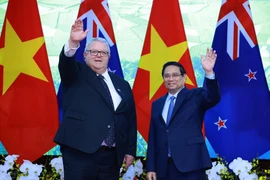
PM meets New Zealand Parliament Speaker in Hanoi
During a reception in Hanoi on August 28 for the New Zealand guest, PM Chinh praised the substantive and comprehensive progress in bilateral ties since the upgrade to a Comprehensive Strategic Partnership during New Zealand PM Christopher Luxon’s official visit to Vietnam in February 2025, saying that it opens up a new chapter in their relations.