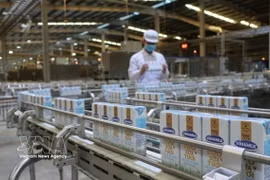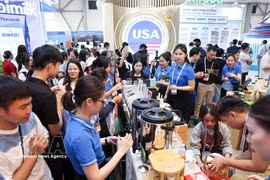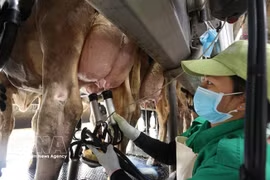
Hanoi (VNA) – Vietnam’s dairy industry plays an important role in ensuring nutritional security and improving public health while supporting agriculture, livestock farming, processing, trade and services; however, amid deeper international economic integration, it faces growing pressure to improve productivity, quality, technological capacity and food safety.
Deputy Minister of Industry and Trade Truong Thanh Hoai said despite positive results in recent years, the industry continues to face major weaknesses. Domestic fresh milk supplies currently meet only about 40% of processing demand, making the sector heavily dependent on imported raw materials.
Nguyen Xuan Duong, Chairman of the Vietnam Animal Husbandry Association, said domestic fresh milk production meets only 38–40% of processing demand, with the remainder relying on imported milk powder. This weakens the domestic dairy farming value chain.
Without timely and strong policy measures, Vietnam will struggle to meet its target of domestic sources supplying 60% of raw milk demand by 2030, Duong warned. The country currently has only about 3.3 dairy cows per 1,000 people, well below Thailand, Japan and the Republic of Korea.
Dairy farming and herd expansion have also stagnated. After growing by 15% between 2010 and 2015, the national dairy herd has expanded by an average of only 0.4% annually since 2020. Vietnam now has around 350,000 dairy cows, producing more than 1.3 million tonnes of milk annually.
Land shortages for growing grass and securing feed supplies remain major obstacles to large-scale farming, while small-scale producers also face difficulties, according to industry representatives.
Without timely support for breeding stock, grass cultivation and by-product processing, they will find it difficult to compete with enterprises operating large-scale, integrated production chains, said Tong Xuan Chinh, Vice Chairman and Secretary General of the Vietnam Dairy Association.
Dr Phung Quang Truong, Deputy Director of the Ba Vi Cattle and Forage Research Centre, noted that fresh milk purchase prices remain at 12,000–14,000 VND (0.47–0.55 USD) per kilogramme, while rising feed costs are squeezing farmers' profits. Farmers also depend heavily on dairy companies for market access, leaving them with limited bargaining power.
Vietnam's dairy market still has considerable growth potential. Annual milk consumption stands at around 24–27 litres per capita, compared with 35 litres in Thailand, 45 litres in Singapore and 80–100 litres in Europe.
The Government has approved the strategy for dairy industry development through 2030, with a vision to 2045, which targets annual industry growth of 12–14% by 2030, domestic raw milk production of 2.6 billion litres per year (meeting 60–65% of demand), and average consumption of 40 litres per capita annually. By 2045, raw milk production is expected to reach 8 billion litres per year (meeting 80–85% of domestic demand), and annual per capita consumption to reach 100 litres.
To achieve these goals, Duong proposed developing high-tech intensive farms run by large businesses alongside professionally managed household farms with 30–50 cows, making better use of rural labour and agricultural by-products.
He also called for stronger links among enterprises, cooperatives and farmers to secure stable supplies, create jobs and raise incomes.
Experts recommended that Vietnam learn from the experiences of the Philippines, Indonesia and China in introducing mandatory minimum proportions of domestically produced fresh milk in dairy processing, alongside preferential capital, credit and tax policies for enterprises purchasing domestic milk beyond prescribed requirements.
Nguyen Viet Tan, Deputy Director of the Ministry of Industry and Trade’s Department for Science Technology and Digital Transformation, said relevant authorities are considering amendments to national technical regulations on liquid milk and encouraging businesses to adopt advanced technologies, cleaner production methods, digital management and traceability systems./.
See more
VIFTA widens room for Vietnamese goods in Israel
Israel is a key Middle East market, with a developed economy, high per-capita income and demand for a diversified import mix. It is a potential outlet for Vietnamese farm produce, food, seafood, apparel, footwear and consumer goods.
Vietnam, European firms seek to boost investment, business links
NA Vice President Nguyen Hong Dien appreciated the European business community's contributions to Vietnam's socio-economic development, particularly in investment, technology transfer, production capacity building and high-quality human resources training.
Drastic measures taken to protect consumer data in cyberspace
Under the Law on Personal Data Protection and the Law on Protection of Consumers' Rights, consumers are entitled to be informed, give or withdraw consent, and request the correction or deletion of their personal data, regardless of where it is processed.
Reference exchange rate maintains downward trend on November 6
With the current trading band of ±5%, the ceiling rate applicable to commercial banks stood at 26,986 VND/USD, while the floor rate was 24,334 VND/USD.
Vietnam’s digital economy to reach 49 billion USD in 2026, fastest-growing in Southeast Asia
The report identifies Vietnam as Southeast Asia's most engaged market for AI. As GenAI moves beyond early adopters into wider workplace use, the country has recorded 45 million users, equivalent to 65% of its workforce, generating 31 billion AI prompts annually.
Trade value handled through Mong Cai border gates rises 19%
Cargo throughput through Mong Cai border gates totalled 2.3 million tonnes during the first 10 months of 2026.
Vietnam’s cross-border QR payments gain traction
Cross-border QR payments are widening Vietnam’s tourism, retail and services links to international markets. But turning cost and technology gains into business results requires a broader acceptance network, transactions tied to sales management and end-to-end operational security.
Can Tho, Germany step up cooperation in green economy, logistics
Can Tho hopes to continue receiving support from the German Ambassador, Consul General and GIZ in connecting it with cooperation programmes, experts and resources of Germany, particularly in sustainable agriculture and fisheries, water resource management, environmental protection, climate change response and circular economy development.
Ho Chi Minh City works to clear the way for RoK investors
The Republic of Korea leads in project count in the city, with more than 3,400, and ranks second by registered capital with more than 15.8 billion USD as of late September.
Da Nang, Vietjet sign comprehensive cooperation agreement for 2026–2030
This collaboration aims to strengthen the relationship between the two parties, leverage their respective strengths and resources, and jointly implement programmes and activities in areas of mutual interest—all in alignment with the city’s development orientation and Vietjet’s operational strategy.
Energy price cuts to help curb inflation, boost growth: experts
The Government's decision to cut the average retail electricity price by 2% and reduce the petrol excise taxes to zero percent from November 1 is expected to ease cost pressures on consumer prices and support economic activity, particularly for businesses facing high input costs.
Fintech firms target Vietnam's household businesses
Vietnam has about 5.2 million household businesses, contributing as much as 30% of gross domestic product and providing jobs for tens of millions of workers, according to the Ministry of Finance.
Improving FDI quality to strengthen growth momentum
Rapid growth in registered capital is encouraging, but unless these commitments are promptly converted into implemented projects and productive capacity, their contribution to economic growth will remain constrained.
Vietnam well-positioned to attract high-quality European investment: insiders
Vietnam has established a considerable manufacturing and export base, giving it an advantage in attracting investment from European corporations. However, amid the restructuring of global supply chains, the key objective is not merely to attract more investment, but also to enhance the quality of investment and the value it generates.
US dollar hits 18-month low at Vietnamese banks
The State Bank of Vietnam (SBV) set the daily reference exchange rate at 25,623 VND/USD on November 5, down 4 VND from the previous session.
Vietnam, AIIB promote cooperation in strategic infrastructure investment
Although cooperation between Vietnam and the Asian Infrastructure Investment Bank has made positive progress, its results remain modest compared with the potential as AIIB is still a relatively new partner for many Vietnamese ministries, agencies and localities
Vietnam Logistics Forum 2026 to seek measures for central region's products to expand global reach
The forum will provide a platform to discuss measures for developing the logistics sector amid changing domestic and international conditions, enhancing economic competitiveness, promoting regional development and improving the institutional framework for national logistics management.
PM pledges optimal conditions for Airbus to expand operations
PM Le Minh Hung suggested that Airbus consider establishing aircraft maintenance and repair centres in Vietnam, particularly in the vicinity of Long Thanh and Gia Binh international airports.
Vietnam, EU shape future of green economy, new value chains
In his remarks Deputy Minister of Industry and Trade Luong Hoang Thai said the ninth edition of the forum serves as an effective channel for regular exchanges between government agencies and business communities on policies, market development, trade connectivity and investment.
Public investment disbursement reaches 74.1% of annual target
As of October 31, total public investment disbursement stood at nearly 708.6 trillion VND (over 27.5 billion USD), rising more than 217.5 trillion VND from a year earlier.