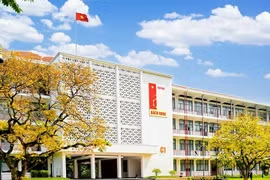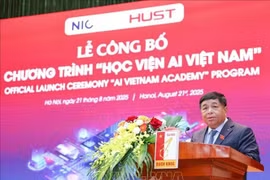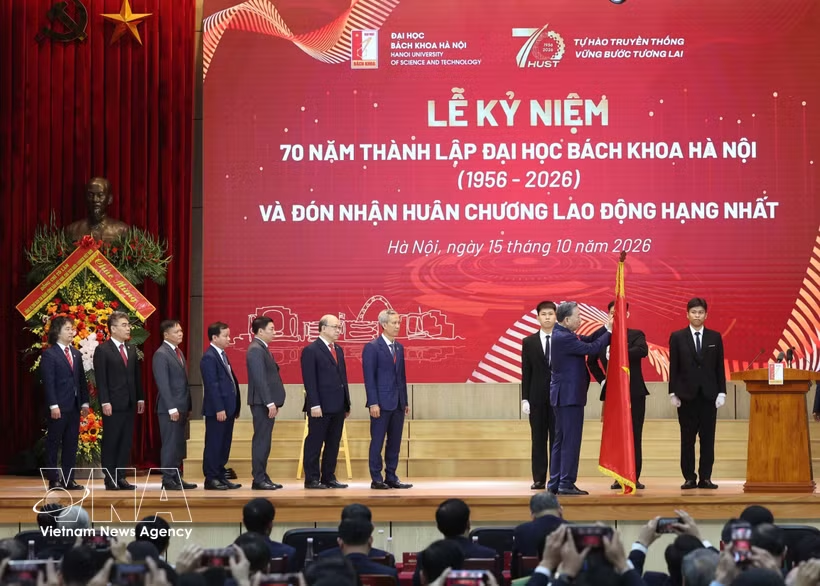
Hanoi (VNA) - General Secretary of the Communist Party of Vietnam Central Committee and President To Lam on October 15 called on the Hanoi University of Science and Technology (HUST) to become an outstanding research university capable of undertaking major national missions, as Vietnam seeks to strengthen its technological capabilities and drive scientific and industrial development.
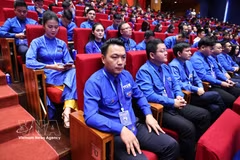
Speaking at a ceremony in Hanoi to mark the university’s 70th anniversary (October 15, 1956–2026) and receive the First-Class Labour Order, the top leader stressed the need to translate the institution’s long-standing reputation and existing capabilities into tangible contributions to the country’s next stage of development.
He said the era of scientific and technological advances, artificial intelligence, technological competition and supply-chain disruptions was presenting new challenges. Vietnam must improve productivity and quality, strengthen self-reliance and pursue effective international cooperation. The country needs the intellectual capacity, determination and creativity of HUST’s academic community more than ever, he said.
Resolutions 57 and 71 of the Politburo set out requirements for breakthroughs in science and technology, innovation, digital transformation, education and training. Government Decision No. 663, dated May 23, 2025, approved a plan to develop HUST into one of Asia’s leading universities and a centre of excellence in education, talent development, research and innovation, serving strategic technology and industrial sectors.
These goals reflect the Party and State’s confidence in the university’s ability to take a leading role, he noted.
He called on HUST to pursue clearly defined programmes, build strong research teams and centres of excellence, and develop shared laboratories to establish itself as an outstanding research university capable of undertaking major national missions.
The target of ranking among Asia’s top 100-150 universities by 2035 must be underpinned by the quality of education and research, academic reputation and contributions to the country, he said. The university should also create an environment in which scientists can pursue valuable ideas and mentor the next generation. Its interdisciplinary strengths should be harnessed to address major national tasks in industry, transport, energy and infrastructure.
According to the General Secretary and President, HUST should identify and nurture talent from an early stage, linking education with research and production while placing greater emphasis on basic sciences, systems thinking and practice.
The university should train engineers capable of mastering design and testing, with a strong sense of professional responsibility, as well as experts able to lead major programmes. In the age of artificial intelligence, it is essential to cultivate innovative thinking, autonomy, independence, verification skills and academic integrity, he said.
He called for research efforts to focus on mastering technologies and solving major national challenges. The university should identify priority areas, define the capabilities it needs to develop, specify the products it aims to deliver and select partners to carry out the work.
HUST should strengthen its design and manufacturing capabilities, help businesses improve production and participate more deeply in supply chains, and identify suitable approaches in the semiconductor sector. Research should also address practical needs in energy, transport, urban development, healthcare, the environment and disaster response.
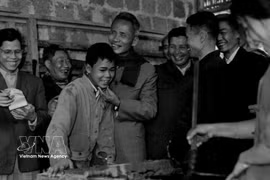
The determination demonstrated by researchers in developing technologies to detect and neutralise magnetic mines during wartime should be carried forward in addressing urgent challenges in peacetime, the top leader said, stressing the need for sustained investment in basic sciences to build the technological foundations of the future.
He also called on the university to become a hub for Vietnamese intellectual talent from around the world and international experts, offering ambitious research programmes, good working conditions and attractive career opportunities. Talented researchers should be trusted, given professional autonomy and provided with conditions for long-term engagement.
For experts unable to work at the university regularly, HUST should expand flexible cooperation arrangements that allow them to conduct research, lead teams, train students and transfer technology. Such collaboration should strengthen Vietnam’s capabilities while creating opportunities for younger generations to develop, he said.
He urged the university to develop an innovation ecosystem that brings research results into production and everyday life. Cooperation among the State, universities and businesses should have clearly defined tasks, responsibilities and benefits, linking research with investment and the use of research outputs.
He also called for the university’s Interdisciplinary Innovation Space, launched in June 2026, to be further developed, with adequate resources for testing, technology refinement, intellectual property protection and pilot production to improve technical capabilities and production efficiency.
Preserving and developing the HUST culture, with human qualities as the foundation of all achievements, was equally important, he said. The university must uphold scientific ethics and academic integrity, and instil meticulousness in every design and calculation, given the implications of engineering products for human safety, infrastructure and the living environment.
The top leader called on the Government, central agencies, ministries, sectors and local authorities to provide the resources needed for the university’s development, particularly to turn its second campus in Hung Yen province into a modern innovation complex.
HUST now has a global alumni network of 300,000, enrols 42,000 students and maintains partnerships with more than 100 international partners. It participates in 10 international networks and offers 68 undergraduate programmes, 42 master's programmes and 28 doctoral programmes.
Its five priority research fields are artificial intelligence and data technology; health science and technology; advanced materials; sustainable energy and the environment; and intelligent devices and systems.
At the ceremony, General Secretary and President To Lam, on behalf of the Party and State leadership, presented the First-Class Labour Order to the university.
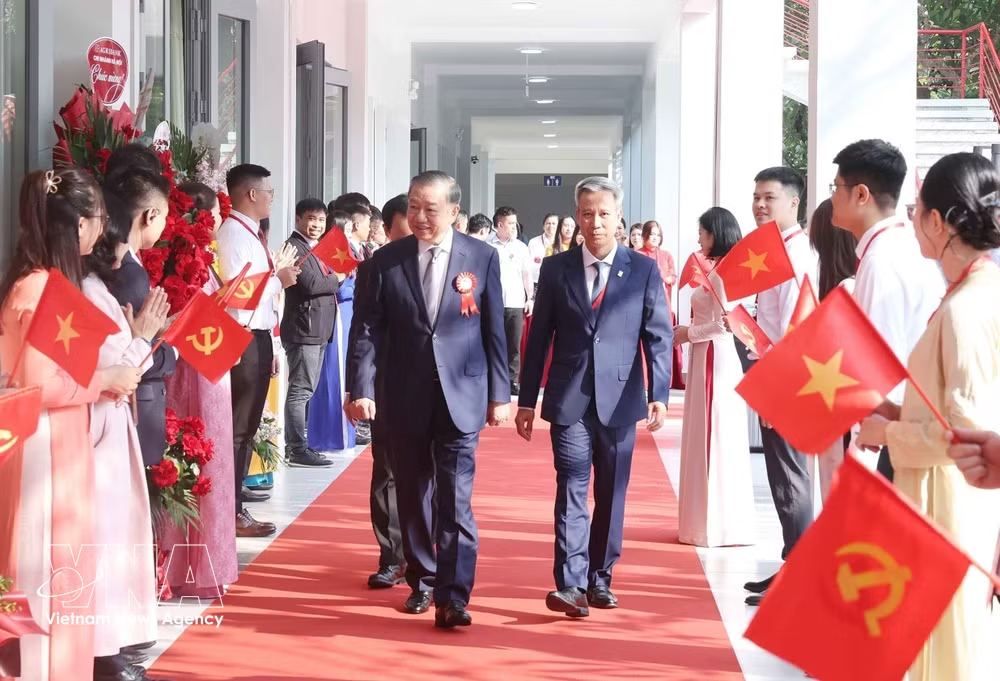
Earlier, the top leader and other delegates performed procedures to inaugurate HUST’s Interdisciplinary Innovation Space, an integrated innovation ecosystem developed under the internationally recognised Design Factory model. It combines the Interdisciplinary Innovation Centre, research institutes and collaborative spaces for corporations and businesses.
Designed to integrate people, methods, infrastructure and businesses, the facility includes open creative-thinking areas, design and digital simulation studios, rapid prototyping laboratories, product testing areas, group workspaces, exhibition and demonstration areas, and flexible classrooms for workshops and project-based training./.