Trade, export, and investment gain momentum in Vietnam

Vietnam’s economy recovered strongly in 2022 after two years of the COVID-19 pandemic, according to an article published on East Asia Forum website by Professor David Dapice, a senior economist in the Ash Center for Democratic Governance and Innovation at the John F Kennedy School of Government, Harvard University.
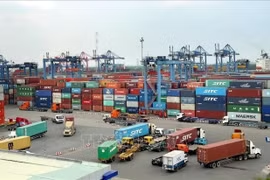
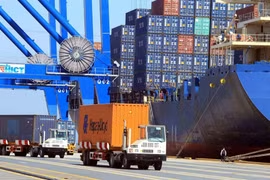
 Trade, export, and investment gain momentum in Vietnam ảnh 1Export of agricultural products has always been Vietnam’s strength: (Photo: VietnamPlus)

Hanoi (VNA) – Vietnam’s economy recovered strongly in 2022 after two years of the COVID-19 pandemic, according to an article published on East Asia Forum website by Professor David Dapice, a senior economist in the Ash Center for Democratic Governance and Innovation at the John F Kennedy School of Government, Harvard University.

According to the article, forecasts show that Vietnam’s Gross Domestic Product (GDP) growth in 2022 was slightly lower than the 8.8% rate in the first nine months of the year.


The country’s exports in the first 11 months of 2022 recorded a higher growth compared to imports with an export growth rate of 13% while 10% for imports, therefore trade surplus was modest. Tourism and production and industry also saw a slight recovery from 2021.

However, the article said slow export orders caused redundancy in factories, and issues related to the real estate sector will be big concerns for the country in 2023.

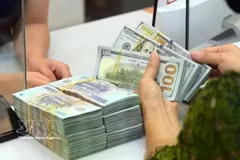
Professor Dapice acknowledged that Vietnam’s economy has strengths to offset challenges. Inflation was recorded at a single-digit rate. The devaluation of the local currency against the USD was much lower than in many counties, as of early December 2022, the VND only depreciated about 5% against the USD.

With a tight fiscal policy, most Vietnamese banks had abundant capital resources.

High capital inflow and the realisation of foreign investment mean that as the global economy recovers, there will be a transition of labour from low-productivity in agricultural sector to more productive manufacturing sector.

This will increase demand for real estate in cities, despite slower population growth.

Foreign direct investment in the manufacturing sector will support the growth and transition of the country’s economy.

Plans to increase and reduce construction of new coal-fired plants will avoid property stagnation and pollution.

Joining free trade agreements (FTAs) has helped Vietnam penetrate to the world market easier.

According to Professor Dapice, the driving force for the country’s economy in 2023 will no longer be exports or consumer spending, which increased sharply in 2022.  Instead, the tourism sector will recover stronger as China has eased its COVID-19 policy along with a strong investment of the government to propel Vietnam’s economy towards its growth target of 6.5% in GDP.

 Trade, export, and investment gain momentum in Vietnam ảnh 2With an advantage of 3,200 km of coastal line, Vietnam’s tourism sector is forecast to recover. (Photo: VietnamPlus)

This is an ambitious and challenging goal if the world economy or the country’s major export markets such as the US, the EU and China remain unstable.

Some international news agencies such as Reuters and Hong Kong’s Asia Financial website have cited economist warnings that although Vietnam’s economy in 2022 showed the fastest rate in decades, the country faces headwinds ahead with the gloomy outlook of the global economy.

However, the East Asia Forum website quoted Dapice as saying that in 2023, if there are no major natural disasters, it should be possible for Vietnam to keep its economy’s momentum up as long as the global environment improves over the year./.
VNA

See more

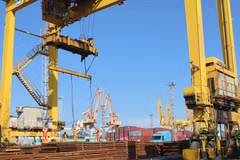
Loading and unloading steel products at Hoang Dieu–Chua Ve Port, Hai Phong city (Photo: VNA)

Hai Phong city seeks to boost inland waterway transport

According to the Hai Phong Maritime Administration, inland waterways carry coal, agricultural products, ores, stone, cement and other bulk cargoes, helping ease pressure on roads, particularly those connecting seaports and industrial parks.

Speakers at the conference (from left): AVPI Advisory Board Chair Dr Le Thu Huong, Australian Ambassador to Vietnam Gillian Bird, and Vietnamese Consul General in Sydney Nguyen Thanh Tung. (Photo: VNA)

Vietnam, Australia turn momentum into practical cooperation

Vietnam and Australia should focus on promoting two-way investment, expanding cooperation linked to APEC 2027 and making better use of people-to-people connections. Vietnam needs capital, skills, technology, infrastructure, and energy transition expertise - areas where Australia could offer valuable support.

The interface of the National E-Procurement System. (Photo: muasamcong.mpi.gov.vn)

Vietnam to move PPP bidding online from 2027

From January 1, 2027, PPP project proposals must be submitted through the National E-Procurement System. From September 1, 2027, investor selection for PPP projects tendered through open bidding will move fully online.

An automated robot-based production line at CAYI Technology Vietnam Co., Ltd. in Yen Phong II-C Industrial Park, Bac Ninh city (Photo: VNA)

EuroCham: Business Confidence Index in Vietnam remains high at 78.3 in Q3

The survey found that 64% of respondents described their current business conditions as good or very good, while 28% maintained a neutral or cautious outlook, reflecting a wait-and-see attitude as international demand remains flat and businesses look for policy momentum to translate into faster procedures and more predictable outcomes.

Workers manufacture handheld power tools at the Keystone Electrical Vietnam factory in Lien Ha Thai Industrial Park, Thai Thuy commune, Hung Yen province (Photo: VNA)

Vietnam seeks to turn FDI inflows into domestic value added

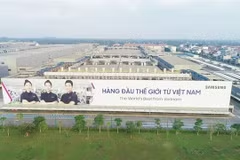
Vietnam is shifting its FDI attraction strategy from expanding investment volumes to prioritising capital inflows that brings technology, knowledge, modern management practices and stronger links with domestic businesses, particularly in semiconductors, artificial intelligence (AI), chips and renewable energy.

At Yadea Vietnam’s smart manufacturing plant in Tan Hung Industrial Park, Bac Ninh province (Photo: VNA)

Vietnam ties FDI incentives to local supplier commitments

Incentives will increasingly hinge on investors’ performance and commitments, not just on landing projects. Key commitments include transferring technology to Vietnamese firms, training workers, providing technical support and opening FDI supply chains to domestic companies.

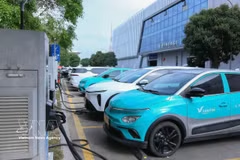
Green SM has launched all-electric taxi service in the US. (Illustrative photo: VNA)

Green SM launches all-electric taxi service in US

The move brings Green SM into one of the world’s most dynamic and demanding markets. It also marks another step in the international expansion of the Vietnamese mobility brand, following its rapid growth across markets in Asia and Europe.

An overview of the meeting between IMF Managing Director Kristalina Georgieva and ASEAN Finance Ministers and Central Bank Governors (Photo: VNA)

Vietnam strengthens financial cooperation at IMF-World Bank annual meetings

The Vietnamese Governor underscored the complementary roles of global and regional financial cooperation mechanisms, including the Chiang Mai Initiative Multilateralisation (CMIM) and the ASEAN+3 Macroeconomic Research Office (AMRO). He also highlighted the importance of technical assistance in fintech, digital transformation, cybersecurity and risk management.

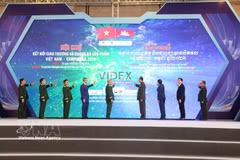
Representatives of the organising committee at the opening ceremony of the fair (Photo: VNA)

Vietnam-Cambodia trade expo promotes bilateral economic cooperation

The Vietnam-Cambodia Business Networking and Product Promotion Exposition has become a key trade promotion event, creating business and investment opportunities while strengthening mutual understanding and trust between the two countries’ armies, people and enterprises.