Vietnam ties FDI incentives to local supplier commitments

Incentives will increasingly hinge on investors’ performance and commitments, not just on landing projects. Key commitments include transferring technology to Vietnamese firms, training workers, providing technical support and opening FDI supply chains to domestic companies.

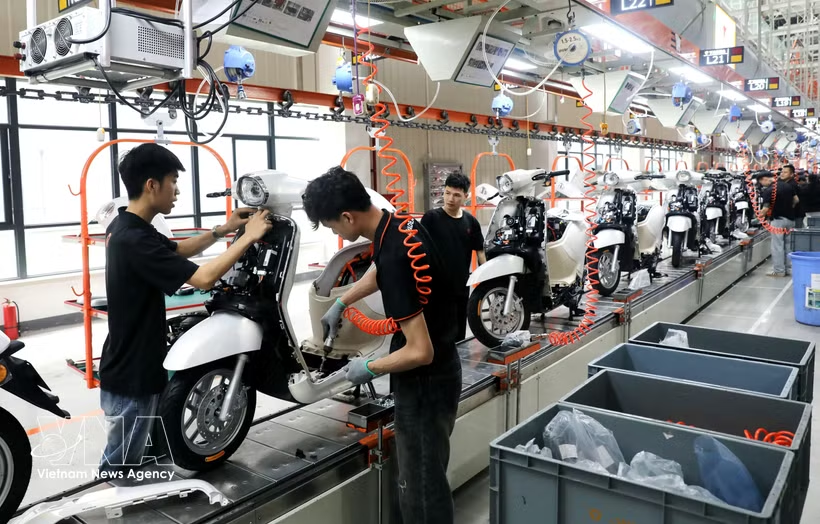
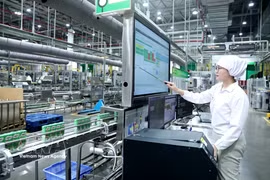
At Yadea Vietnam’s smart manufacturing plant in Tan Hung Industrial Park, Bac Ninh province (Photo: VNA)

Hanoi (VNA) – As localisation in FDI production chains currently stands at just 20-25%, Vietnam is moving to link investment incentives to foreign firms’ commitments to develop domestic suppliers, a shift expected to tighten business linkages, lift added value and sharpen competitiveness.

Technology transfer remains a bottleneck

Foreign-invested firms account for a large share of Vietnam’s exports, yet much of that value rests on imported raw materials and components. Domestic added value is below half, well behind other East and Southeast Asian economies, particularly in manufacturing and electronics. Most Vietnamese companies remain confined to simple processing and low-added-value stages of the value chain.

Technology transfer from FDI enterprises remains limited and has improved only slowly, said Bui Thu Thuy, Deputy Director of the Foreign Investment Agency (FIA) under the Ministry of Finance (MOF).

Citing the Ministry of Science and Technology data, Thuy said only about 600 technology transfer contracts were registered nationwide in 2006-2016, equal to less than 4.3% of FDI projects. Around 400 were recorded in 2018-2022, mostly intra-company transfers between parent companies and their Vietnamese branches, aimed chiefly at supporting the foreign firms’ own production and operations. Transfers centred on technical support (77%), training (71%) and production processes (73%), while those involving intellectual property made up just 13%.

Under the Politburo’s Resolution 10-NQ/TW dated June 8, 2026 on developing the foreign-invested economy, Vietnam is fundamentally overhauling its approach to FDI, shifting from passive attraction to proactively selecting quality, hi-tech investment with spillover impacts on the domestic economy.

The MOF is studying amendments to the Investment Law to codify more generous preferential mechanisms, steering investment attraction toward selectivity rather than courting capital at any cost.
vnanet-hn.jpg
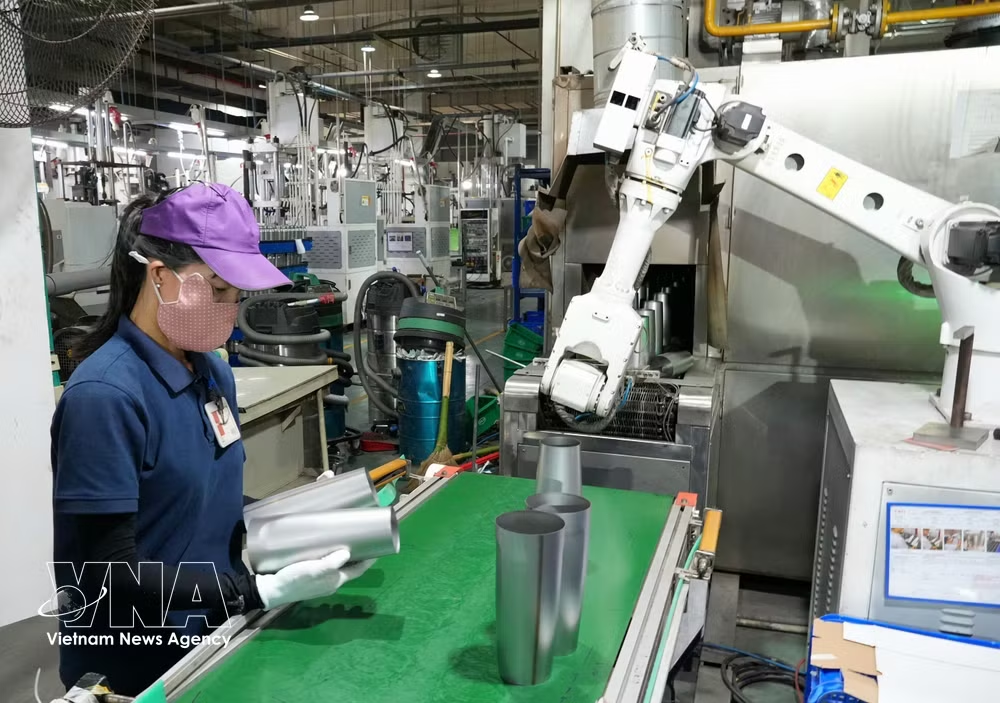
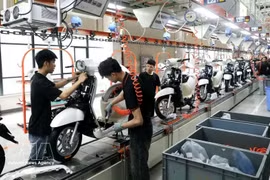
An automated robotic production line at Yen Phong II-C Industrial Park, Bac Ninh province (Photo: VNA)

Incentives will increasingly hinge on investors’ performance and commitments, not just on landing projects. Key commitments include transferring technology to Vietnamese firms, training workers, providing technical support and opening FDI supply chains to domestic companies.

Making Vietnam’s manufacturing ecosystem more competitive

Resolution 10-NQ/TW targets about 10,000 domestic firms in the value and supply chains of FDI enterprises by 2030, including 500-1,000 tier-1 suppliers. The 2026-2035 supporting industry development scheme, approved under Decision 929/2026/QD-TTg, makes developing supporting industries along global supply and value chains a priority, with leading enterprises’ technical requirements, quality standards and localisation rates serving as key criteria for support policies.

Many foreign-invested companies want to buy more from Vietnamese enterprises, Thuy said.

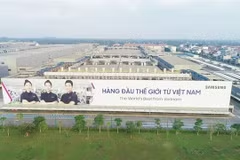
Cha Ji Ho, Samsung Vietnam’s Deputy General Director in charge of its procurement centre, said Samsung is shifting from boosting suppliers’ production capacity to building deeper specialised capabilities and a supplier ecosystem in Vietnam. The company plans to widen its support geographically, add participating firms and deepen their capabilities, extending from hubs like Bac Ninh and Ho Chi Minh City to Phu Tho, Hai Phong and Thai Nguyen, while stepping up cooperation with local suppliers.

Samsung proposed systematic cooperation among the Government, the company and Vietnamese enterprises, built on a supplier database and clear support policies and frameworks. The aim is to raise localisation rates, broaden access to supply chains and sharpen domestic manufacturers’ competitiveness.

It also suggested publishing an annual Supplier Development White Paper to establish a mechanism for cooperation and long-term monitoring of supply chain development.

Under this approach, ties between FDI and Vietnamese companies will move beyond simple buyer-supplier relationship toward joint development and sustainable partnerships, and better competitiveness of Vietnam’s manufacturing ecosystem as a whole./.
​

VNA

See more

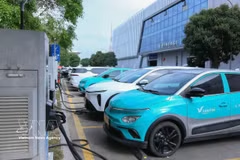
Green SM has launched all-electric taxi service in the US. (Illustrative photo: VNA)

Green SM launches all-electric taxi service in US

The move brings Green SM into one of the world’s most dynamic and demanding markets. It also marks another step in the international expansion of the Vietnamese mobility brand, following its rapid growth across markets in Asia and Europe.

An overview of the meeting between IMF Managing Director Kristalina Georgieva and ASEAN Finance Ministers and Central Bank Governors (Photo: VNA)

Vietnam strengthens financial cooperation at IMF-World Bank annual meetings

The Vietnamese Governor underscored the complementary roles of global and regional financial cooperation mechanisms, including the Chiang Mai Initiative Multilateralisation (CMIM) and the ASEAN+3 Macroeconomic Research Office (AMRO). He also highlighted the importance of technical assistance in fintech, digital transformation, cybersecurity and risk management.

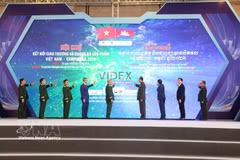
Representatives of the organising committee at the opening ceremony of the fair (Photo: VNA)

Vietnam-Cambodia trade expo promotes bilateral economic cooperation

The Vietnam-Cambodia Business Networking and Product Promotion Exposition has become a key trade promotion event, creating business and investment opportunities while strengthening mutual understanding and trust between the two countries’ armies, people and enterprises.

Vietjet Air’s Airbus A330 taxis at Vaclav Havel Airport in Prague, the Czech Republic. (Photo: VNA)

Vietnam’s airlines expand international networks

The Civil Aviation Authority of Vietnam forecasts that the country’s aviation market will handle 94 million passengers and more than 1.6 million tonnes of cargo in 2026, up 13% and 9.3%, respectively, from 2025.

A representative of Sumika Electronic Materials Vietnam (VSIP Bac Ninh Industrial Park, Tu Son Ward) briefs the delegation from Customs Sub-department Region V on the company's operations. (Photo: báo bắc ninh)

Bac Ninh customs facilitates clearance to boost exports

Pham Chi Thanh, head of Customs Sub-Department Region V, said the unit is focusing resources on developing a digital customs model and streamlining professional procedures to shorten clearance times and reduce costs for businesses while maintaining effective state management.

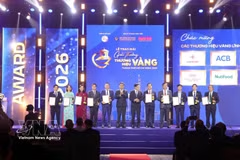
At the sixth Golden Brand Awards 2026 ceremony (Photo: VNA)

Ho Chi Minh City honours top 50 brands for 2026

The awards aim to recognise brands that can lead their industries, drive innovation and create a ripple effect across the business community, lifting the city’s standing in a new growth stage.

Luxury apartment projects in downtown Ho Chi Minh City (Photo: VNA)

Ho Chi Minh City's housing market sees price stabilisation, sharper buyer segmentation

According to Avison Young Vietnam, improved planning and infrastructure development have helped ease market uncertainty and prevented a complete freeze. More than 25,000 apartments are expected to enter the market in multiple launches between 2027 and 2030, with many projects scheduled to benefit from infrastructure improvements around 2030.

Vietnamese Deputy Minister of Industry and Trade Phan Thi Thang speaks at the forum (Photo: VNA)

Vietnam, Georgia look to more business opportunities

For Vietnamese firms, Georgia can serve as a gateway to broader regional markets, given its strategic location connecting the South Caucasus, Central Asia and China with European markets via the Black Sea.