Association strengthens Vietnamese businesses' links to European markets

From fashion and Vietnamese cuisine to renewable energy, Vietnamese entrepreneurs in Belgium, the Netherlands and Luxembourg – Benelux region – share a common goal of bringing more Vietnamese products and brands to European consumers.

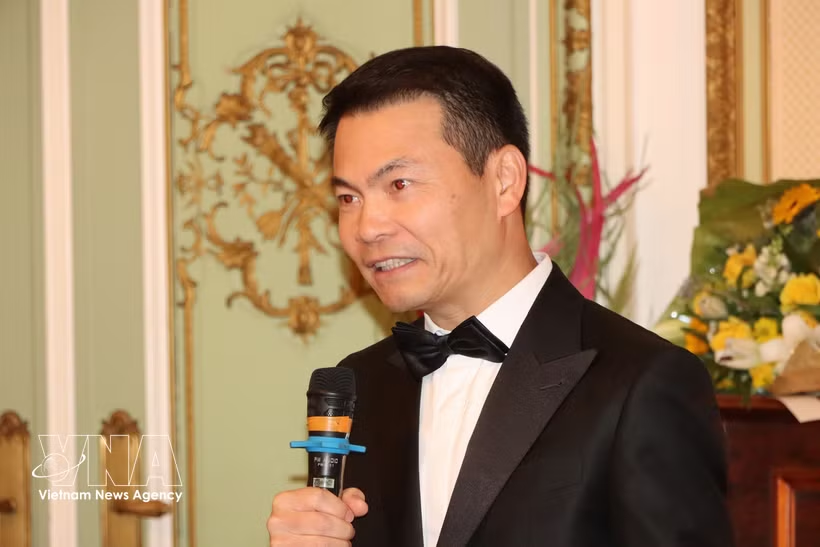
Nguyen Thanh Vinh, Chairman of the Vietnamese Business Association in Belgium, the Netherlands and Luxembourg (VBAB) and Chief Executive Officer of clothing company Sir Taillor. (Photo: VNA)

Brussels (VNA) – Connecting Vietnamese businesses with one another, domestic partners and European companies is a key priority of the Vietnamese Business Association in Belgium, the Netherlands and Luxembourg (VBAB) as it works to expand the presence of Vietnamese products and brands in Europe.

From fashion and Vietnamese cuisine to renewable energy, Vietnamese entrepreneurs in Belgium, the Netherlands and Luxembourg – Benelux region – share a common goal of bringing more Vietnamese products and brands to European consumers. Their association serves as a bridge to strengthen cooperation, share market knowledge and create new business opportunities.

Speaking to the Vietnam News Agency correspondent in Brussels on Vietnamese Entrepreneurs’ Day (October 13), Nguyen Thanh Vinh, Chairman of the VBAB and Chief Executive Officer of clothing company Sir Taillor, said the association was established in November 2024 with around 60 members in Belgium. It has since expanded its activities to the Netherlands and Luxembourg, established representatives in Hanoi and Ho Chi Minh City, and strengthened ties with other Vietnamese business associations across Europe.

Its management team comprises entrepreneurs who have established themselves in different fields and share a commitment to connecting Vietnamese businesses with partners at home and in Europe.

To expand its network, the VBAB has cooperated with the Vietnamese Business Association in the UK (VBUK), linking London, a major financial and commercial centre, with Brussels, the heart of the European Union’s institutions and policymaking. It has also worked with the Vietnamese Intellectuals Association in Belgium and Luxembourg (ViLaB) to organise larger events and joined the Vietnam Trade Office in Belgium in trade promotion activities, including the Vietnam International Sourcing Expo 2026 in Ho Chi Minh City.

Vinh said the Benelux region offers Vietnamese businesses a strategic gateway to the European market. The ports of Rotterdam in the Netherlands and Antwerp-Bruges in Belgium are major entry points for Asian goods, while Brussels provides access to EU institutions and information on regulations and market priorities.

In 2025, trade between Vietnam and the Netherlands reached 14.3 billion USD, making the Netherlands Vietnam’s largest export market in the EU. Meanwhile, although the scale of trade between Vietnam and Belgium is smaller, Belgium still plays an irreplaceable role as an institutional gateway.

The EU–Vietnam Free Trade Agreement (EVFTA), in force for more than six years, has created favourable conditions for trade, with tariffs on most product lines reduced to zero. Vinh said Vietnamese businesses in Benelux also benefited from their understanding of both markets and their experience of operating in Europe.

However, the benefits have not been shared equally. While some businesses have built import, distribution and partnership networks, many small and medium-sized enterprises still face resource constraints and limited access to distribution channels, he pointed out.

EU requirements on food safety, traceability, environmental protection, supply-chain responsibility and labelling pose significant challenges. In addition, the competitiveness of many businesses is still limited due to their small scale and the lack of long-term cooperative relationships with importers. Business face difficulties in accessing the market also because they lack information about customers, distribution systems, and specialised regulations, while having to cover logistics, marketing, and certification costs.

“EVFTA does not automatically generate orders. The agreement opens the door, but businesses need production capacity, quality, certification and a long-term market development strategy to walk through it,” Vinh said.

Regarding Vietnamese products’ position in Belgian market, Vinh said that Vietnamese textiles, footwear and fashion products have established a presence in Belgium, mainly through contract manufacturing for major brands. Coffee, pepper, spices, processed agricultural products, furniture and industrial goods are also available in the market.

He sees further potential for environmentally friendly products, sustainable materials, traceable goods and software outsourcing services.

Vietnamese companies should move beyond contract manufacturing towards building their own brands, shift from raw materials to processed products and compete on quality, design and reliability rather than price alone, he suggested.

To turn these opportunities into concrete results, Vinh called for closer coordination among trade promotion agencies, Vietnam’s trade offices in Europe and business associations. Sharing market intelligence, buyer requirements, potential partners and investment opportunities will help Vietnamese companies approach European customers more effectively.

VBAB also hopes to participate in Vietnamese delegations visiting and negotiating with European partners, while receiving timely updates on policy developments and cooperation priorities, he added./.

VNA
See more

Vietjet Air’s Airbus A330 taxis at Vaclav Havel Airport in Prague, the Czech Republic. (Photo: VNA)

Vietnam’s airlines expand international networks

The Civil Aviation Authority of Vietnam forecasts that the country’s aviation market will handle 94 million passengers and more than 1.6 million tonnes of cargo in 2026, up 13% and 9.3%, respectively, from 2025.

A representative of Sumika Electronic Materials Vietnam (VSIP Bac Ninh Industrial Park, Tu Son Ward) briefs the delegation from Customs Sub-department Region V on the company's operations. (Photo: báo bắc ninh)

Bac Ninh customs facilitates clearance to boost exports

Pham Chi Thanh, head of Customs Sub-Department Region V, said the unit is focusing resources on developing a digital customs model and streamlining professional procedures to shorten clearance times and reduce costs for businesses while maintaining effective state management.

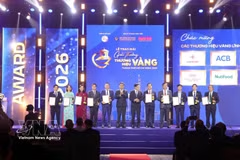
At the sixth Golden Brand Awards 2026 ceremony (Photo: VNA)

Ho Chi Minh City honours top 50 brands for 2026

The awards aim to recognise brands that can lead their industries, drive innovation and create a ripple effect across the business community, lifting the city’s standing in a new growth stage.

Luxury apartment projects in downtown Ho Chi Minh City (Photo: VNA)

Ho Chi Minh City's housing market sees price stabilisation, sharper buyer segmentation

According to Avison Young Vietnam, improved planning and infrastructure development have helped ease market uncertainty and prevented a complete freeze. More than 25,000 apartments are expected to enter the market in multiple launches between 2027 and 2030, with many projects scheduled to benefit from infrastructure improvements around 2030.

Vietnamese Deputy Minister of Industry and Trade Phan Thi Thang speaks at the forum (Photo: VNA)

Vietnam, Georgia look to more business opportunities

For Vietnamese firms, Georgia can serve as a gateway to broader regional markets, given its strategic location connecting the South Caucasus, Central Asia and China with European markets via the Black Sea.

Chairman of the Vietnamese Business Association in Laos (AVILA) Duong Dinh Bang (Photo: VNA)

PM’s visit injects fresh momentum into Vietnam-Laos special relations

At the 2026 Laos-Vietnam Investment Promotion Conference in Vientiane, the two PMs held direct dialogue with businesses and investors from both countries, affirming their determination to address bottlenecks in institutional frameworks, administrative procedures, transport infrastructure and payment connectivity. The goal of these efforts is to boost bilateral trade to 10 billion USD by 2030.

Deputy Secretary of the An Giang provincial Party Committee and Secretary of the Party Committee of the Phu Quoc special zone Dinh Van Noi speaks at the dialogue (Photo: baoangiang.com)

Phu Quoc moves to resolve infrastructure bottlenecks ahead of APEC 2027

Deputy Secretary of the An Giang provincial Party Committee and Secretary of the Party Committee of the Phu Quoc special zone Dinh Van Noi said an official information portal will be launched to receive public feedback, while hotlines for local leaders will allow businesses and residents to raise concerns directly.

Deputy Minister of Industry and Trade Phan Thi Thang at the forum. (Photo: VNA)

Vietnamese firms explore investment opportunities in Georgia

Priority areas with great cooperation potential include manufacturing, logistics infrastructure, renewable energy, tourism, hospitality, information and communications technology (ICT), and business process outsourcing (BPO), said a Georgian official.

Prime Minister Le Minh Hung and delegates launch the digital platform of the Vietnam Association of Small and Medium Enterprises (August 2026). Photo: VNA

Vietnamese businesses, entrepreneurs make growing contributions to national development

Vietnam Entrepreneurs’ Day is an opportunity to recognise businesses’ contributions and reinforce the entrepreneurial spirit, the pursuit of legitimate prosperity and national responsibility. With stronger policies and greater innovation, Vietnamese enterprises are expected to play an increasingly important role in economic growth and the country’s ambition to become a strong, prosperous nation.

A view at a CO.OPMART supermarket in Bac Ninh city (Photo: bacninh.gov.vn)

Bac Ninh’s CPI up 4.07% in nine months

The consumer price index (CPI) in Bac Ninh city rose 4.07% year-on-year in the first nine months of 2026, with housing and construction materials, education and transport recording the sharpest increases, according to the municipal Statistics Office.