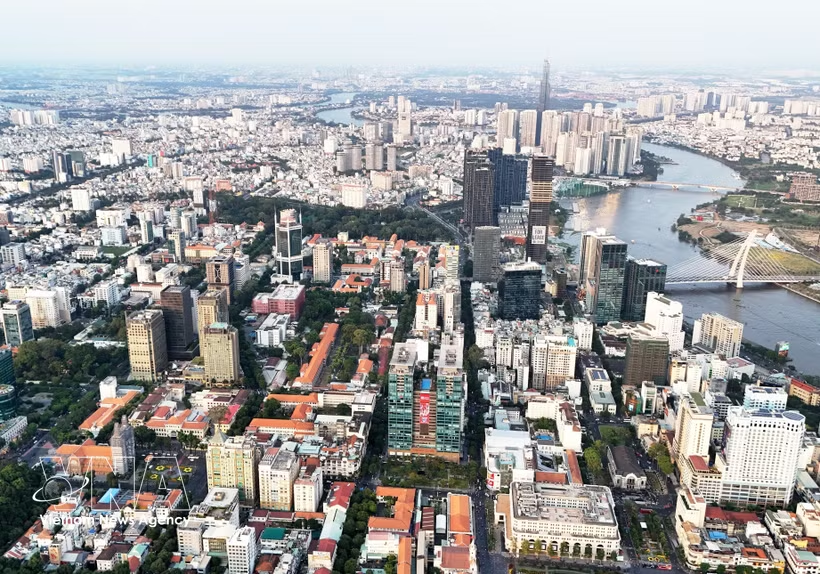
Ho Chi Minh City (VNA) – The apartment market in Ho Chi Minh City and neighbouring areas saw a clear shift, with price growth slowing down and buyers becoming more selective based on their financial capacity in the third quarter of 2026, while rising development and input costs continued to push up prices of newly launched landed-property projects, according to a report by Avison Young Vietnam.
The city’s primary apartment supply exceeded 11,500 units during the quarter, with new launches increasingly concentrated in the southern, northwestern and northeastern areas, supported by major infrastructure developments. Homebuyers and long-term investors favoured projects offering extended payment schedules to reduce reliance on bank loans.
Affordable apartments in neighbouring areas such as Di An and Thuan An continued to attract strong demand from genuine homebuyers, recording high transaction success rates over recent quarters. By contrast, sales of high-end and luxury apartments in central areas remained cautious, with transactions mainly involving buyers using their own capital for long-term asset accumulation.
According to Avison Young Vietnam, improved planning and infrastructure development have helped ease market uncertainty and prevented a complete freeze. More than 25,000 apartments are expected to enter the market in multiple launches between 2027 and 2030, with many projects scheduled to benefit from infrastructure improvements around 2030.
Average primary apartment prices in Ho Chi Minh City stood at 3,850 USD per sq.m, with prices increasingly differentiated by infrastructure quality and developer reputation rather than broad-based increases. Prices in the central area and Thu Thiem Peninsula ranged from 7,000 to 15,000 USD per sq.m, while high-end projects in the eastern and southern areas averaged 3,800–5,500 USD per sq.m. In the west, a newly developed luxury project established a record price range of 4,500–4,800 USD per sq.m.
Limited inner-city land and high land clearance costs have pushed prices in the former city boundaries upwards, effectively eliminating the affordable housing segment. Former Binh Duong and Ba Ria–Vung Tau areas have therefore played a growing role in meeting demand from workers seeking homes within their budgets, with primary apartment prices ranging from 1,800–2,800 USD and 1,900–4,500 USD per sq.m, respectively.
The landed-property segment remained a high-value asset class amid economic uncertainty and severe supply shortages in inner-city areas. The city had nearly 7,000 low-rise homes available for primary sale in the third quarter, with new supply concentrated in gated eco-urban developments in outlying areas such as Can Gio and Hoc Mon.
Home loan interest rates of 12–15% a year and rental yields of just 2–3% made leveraged purchases and short-term speculation less attractive. Buyers with strong financial capacity instead prioritised long-term investment in developments offering green living environments, comprehensive amenities, transparent legal status and convenient transport links.
Primary prices for townhouses and villas ranged from 8,000–14,500 USD per sq.m of land in central and eastern areas, 3,400–4,200 USD in the southwest, and 4,500–7,200 USD in Can Gio and Nha Be. Prices in former Binh Duong and Ba Ria–Vung Tau areas stood at 2,100–5,800 USD per sq.m.
Looking ahead to 2027–2030, major projects, including Ring Road 3, Can Gio Bridge and metro lines, are expected to boost demand for landed properties in satellite areas, particularly eco-urban developments integrated with transit-oriented development models. Meanwhile, apartments are projected to enter a stronger growth cycle driven by actual housing needs, accounting for more than 60% of total market absorption across the southern key economic region./.