Top leader pledges support for firms, presses tech self-reliance

The country needs more firms that master technologies, build trusted brands and run production networks able to compete globally. Progress over the next five to 10 years must show up in productivity, job quality and market position, said top leader To Lam.

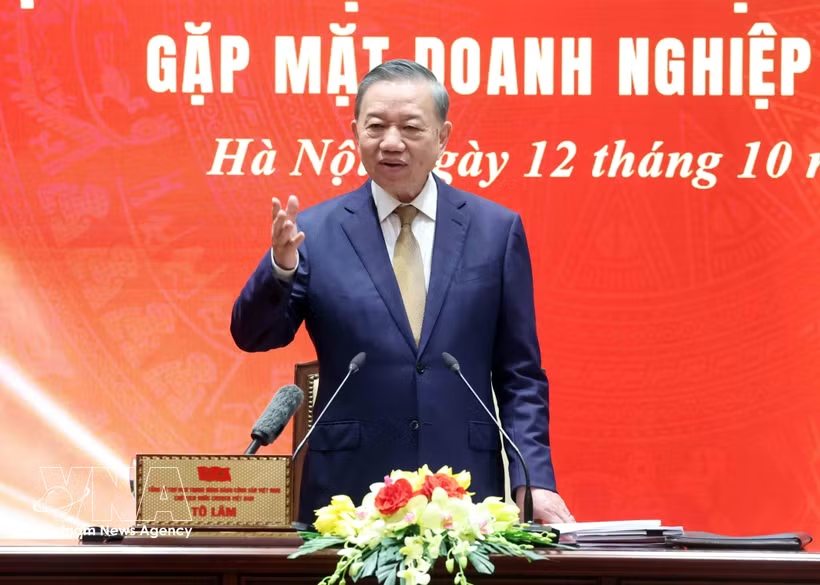
General Secretary of the Communist Party of Vietnam Central Committee and President To Lam speaks at the meeting (Photo: VNA)

Hanoi (VNA) – The Vietnamese Party and State value entrepreneurs’ dedication, protect their legitimate rights and interests, and offer all possible support to them to realise their potential and achieve legitimate prosperity, said General Secretary of the Communist Party of Vietnam Central Committee and President To Lam.

Meeting with representatives of outstanding companies in Hanoi on October 12 ahead of the Vietnamese Entrepreneurs’ Day (October 13), General Secretary and President Lam said Vietnam aims to become a modern-industry, upper-middle-income country by 2030 and a developed, high-income one by 2045. These goals must be translated into concrete schemes, projects, products and capabilities.

The country needs more firms that master technologies, build trusted brands and run production networks able to compete globally. Progress over the next five to 10 years must show up in productivity, job quality and market position, he said, adding that the State will honour its commitments, while firms must invest for the long term, obey the law and share responsibility for workers and the community.

He called for stronger confidence and a stable, favourable, transparent and fair low-cost business environment, along with substantive action on corporate difficulties. Policies must be consistent, shaped through consultation, assessed for impact and paired with appropriate roadmaps.

The Government should maintain macro-economic stability, control inflation, safeguard major economic balances and clear obstacles in land, planning, investment and construction, with clear responsibilities and deadlines. It should prioritise projects that can quickly add production capacity. Administrative procedures and data systems should be interconnected to cut paperwork, time and costs substantially. Guidance and early warnings should reduce the risk of legal violations, and a long-term National Brand Strategy should be built on companies’ genuine competitiveness.

He urged entrepreneurs to put technology, people and governance at the centre of their strategies, build on their strengths, invest persistently and make high-value products. Digital technology and artificial intelligence must lift productivity, quality and efficiency. The drive to advance must show up in technological self-reliance and tangible results.

Businesses, universities and research institutes should be linked more closely, from commissioning research to application and market development, while barriers in financing, intellectual property and benefit-sharing are cleared. Testing and certification facilities and shared services should be developed at affordable cost for small companies.

Stronger linkages, more market opportunities and fair competition are also needed so companies can grow together. State-owned enterprises must use resources efficiently and focus on key sectors, essential infrastructure and foundational technologies, combining operational autonomy with accountability and opening opportunities for domestic firms.

Production links with foreign-invested enterprises should be stronger and must generate orders and improve skills, technology and capacity. The State must ensure transparent, competitive public procurement, create opportunities for small and medium-sized enterprises, and help business households with accounting, management, digital platforms and market access so they can become formal enterprises. Access to resources must be fair, with favourable conditions for new entrants and capable firms looking to expand.

To uphold entrepreneurs’ role in building an independent, self-reliant economy alongside global integration, he urged businesses to master critical production stages, diversify markets and supply sources, respond proactively to volatility and bolster the domestic market through distribution networks, product and service quality, and branding.

He stressed that companies must ensure workplace safety, adequate incomes, employee benefits and skill development opportunities, use natural resources responsibly, meet tax obligations and stay committed to their communities.
vnanet-k.jpg
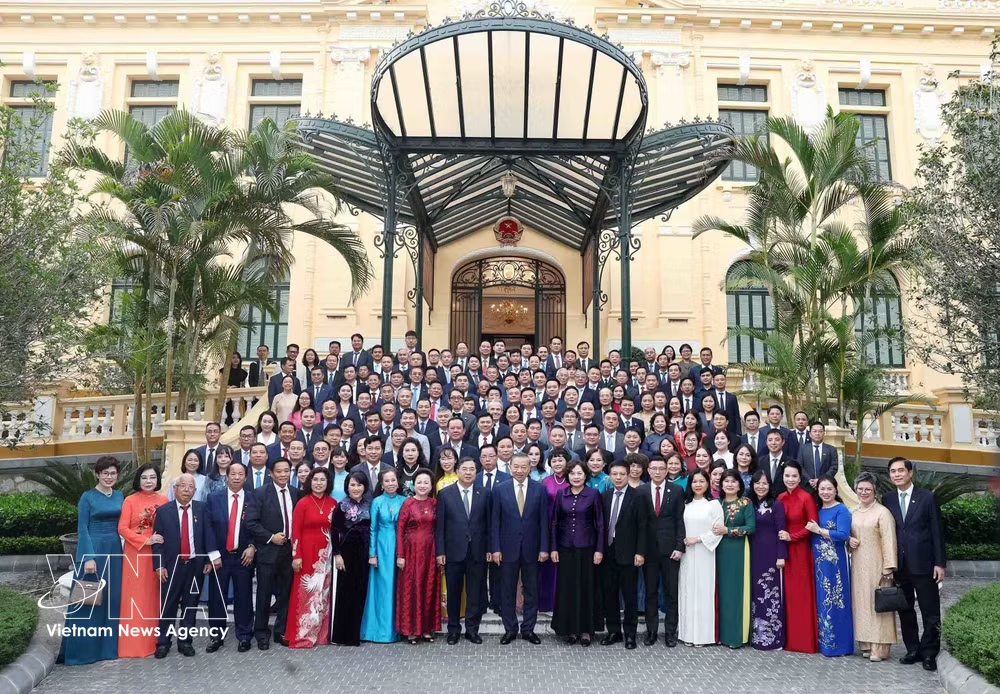
Top leader To Lam and oustanding entrepreneurs (Photo: VNA)

Over the past nearly two years, the Party Central Committee has issued a series of resolutions on socio-economic development to pave the way for business operations, production and labour, and set a legal framework for them, he noted.

The 14th Party Central Committee’s fourth plenum adopted a regulation on Party members’ involvement in business activities, under which the Party encourages members to build legitimate wealth while preserving the Party’s nature, strengthening Party building in the non-state sector and upholding integrity in public service.

The top leader called on Party committees and authorities at all levels to follow these orientations consistently, keep up regular dialogue and promptly address business proposals in line with the law. They must ensure seamless services for businesses through decentralisation, delegation of authority and the shift to a two-tier local administration model, while upholding the role of Party organisations and members in fostering solidarity, caring for workers and expanding production.

The Vietnam Chamber of Commerce and Industry, the Vietnam Association of Small and Medium Enterprises, and industry associations were assigned to conduct data-driven, evidence-based policy research and review; identify common obstacles, monitor proposals through to resolution, provide honest feedback on outcomes, and improve the quality of support in management, law, technology, standards, global integration and business networking./.
​

VNA

See more

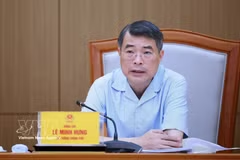
Prime Minister Le Minh Hung speaks at the meeting (Photo: VNA)

PM orders power plan overhaul to meet double-digit growth

Securing adequate power supply is an urgent priority and a prerequisite to successfully achieve socio-economic development goals 2026, a foundational year for accelerating progress, with breakthroughs to follow in 2027 and the goals for the full term to be delivered, said Prime Minister Le Minh Hung.

Then Prime Minister Pham Minh Chinh addresses the Autumn Economic Forum 2025 on November 26 last year. (Photo: VNA)

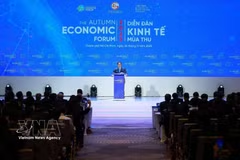
World Economic Forum to co-brand Autumn Economic Forum 2026 in Ho Chi Minh City

On October 27, the forum will host 16 thematic sessions across three parallel venues, focusing on AI – quantum, finance – digital economy – autonomy, and manufacturing – sustainability – next generation. Two sessions will be jointly organised with the WEF, addressing “Repositioning Vietnam and ASEAN in Global Value Chains” and “From AI Deployment to Future Manufacturing Workforce Readiness”.

Nguyen Dinh Kien, Secretary of the Sam Mun commune Party cell in Dien Bien province, builds wealth through spotted deer farming. (Photo: VNA)

📝OP-ED: Party Central Committee’s 4th plenum offers new thinking encouraging Party members to engage in business

Accordingly, the plenum reached a consensus on several key principles, including shifting from a mindset of “permission” to one of “encouragement and facilitation” for Party members engaging in the private sector; protecting their lawful economic activities; and maintaining strict oversight of those exercising control and benefiting from such activities.

AVAC ASF LIVE vaccine developed and manufactured by AVAC Vietnam Joint Stock Company. (Photo: avac.com.vn)

Vietnam ships first commercial ASF vaccine order to Philippines

Nguyen Van Diep, General Director of AVAC Vietnam, said this was the company’s first commercial export order following the Philippines’ approval of the vaccine for unrestricted circulation. The Philippine Department of Agriculture is expected to issue usage guidelines next week, paving the way for wider distribution and application.

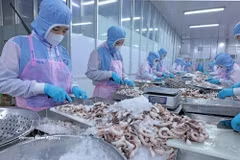
Workers process octopus for export to the Japanese market at Huy Nam Company in An Giang province. (Photo: VNA)

Fisheries sector strives for 12 billion USD in exports amid rising costs

The 12-billion-USD export target remains achievable given solid output growth and generally favourable market conditions. However, any fourth-quarter slowdown would not necessarily reflect raw material shortages but also impacts on economic efficiency amid rising material and fuel costs.

Commercial Counsellor at the Vietnamese Embassy in China Nong Duc Lai (Photo: VNA)

Vietnam-China trade growing rapidly, substantive: Commercial Counsellor

According to the Vietnam Customs data, bilateral trade hit 253.1 billion USD in the first nine months of this year, up 37.6% annually. Vietnam’s exports to China rose 32.9% to 65.8 billion USD while imports climbed 39.3% to 187.3 billion USD. China accounted for around 41.3% of Vietnam’s imports and 15.2% of its total exports.

Vietjet Air leaders and flight crew pose for a photo with guests at the launch ceremony. (Photo: VNA)

Vietjet launches Prague–Hanoi route

Vietjet Air operates the Prague–Hanoi route twice a week using Airbus A330-300 aircraft with a capacity of 377 passengers. Flights depart Prague at 8:55 p.m. every Tuesday and Saturday and arrive in Hanoi at 4:20 p.m. the following day, local time. In the opposite direction, flights leave Hanoi at 8:25 a.m. and arrive in Prague at 6:55 p.m. The route includes a stop in Almaty, Kazakhstan.

At Yen Phong II-C Industrial Park in Bac Ninh province (Photo: VNA)

Tax policy stability now key to keeping foreign investors: Officials

Companies must ensure records and data truthfully reflect the substance of transactions and engage in dialogue early when complex issues arise. Tax authorities, in turn, need to publish policies, give clear guidance, enforce rules consistently and deliver information in a timely manner.

The MoU signing ceremony between the gency for Domestic Market Surveillance and Development and Procter & Gamble (P&G). (Photo: Ministry of Industry and Trade)

Vietnam steps up fight against counterfeits, IP violations

The renewed memorandum between Vietnam's domestic market surveillance force and Procter & Gamble (P&G) is expected to build on the results achieved since 2023, strengthen IP enforcement, safeguard the legitimate rights and interests of businesses and consumers, and contribute to a more transparent and fair business environment.

A Jatropha cultivation area of Star Japan Co., Ltd in My Son commune, Khanh Hoa province (Photo of Star Japan Co., Ltd)

Vietnam – a potential regional supply hub for Jatropha seed oil

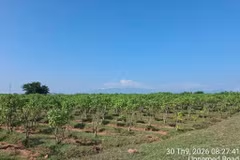
Japan’s research on non-edible oil feedstocks showed that Jatropha is highly drought-tolerant and could grow well on wasteland, eroded sandy land and infertile soil. Given this, areas in central Vietnam, including Ninh Thuan, Binh Thuan and the Central Highlands, have climatic, sunlight and soil conditions suitable for achieving high seed yields and oil content.

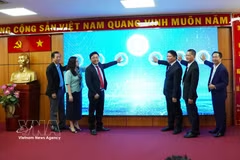
Officials launch the Expo Platform on September 29. It will be officially put into use on October 20, two days before the opening of HCMC Export 2026. (Photo: VNA)

Technology opens new routes for Vietnamese exports

As global markets impose increasingly stringent requirements on standards, traceability, sustainability and green transformation, digitalising product data and bringing buyers closer to production sites can help Vietnamese businesses demonstrate their capabilities and meet market-specific requirements.