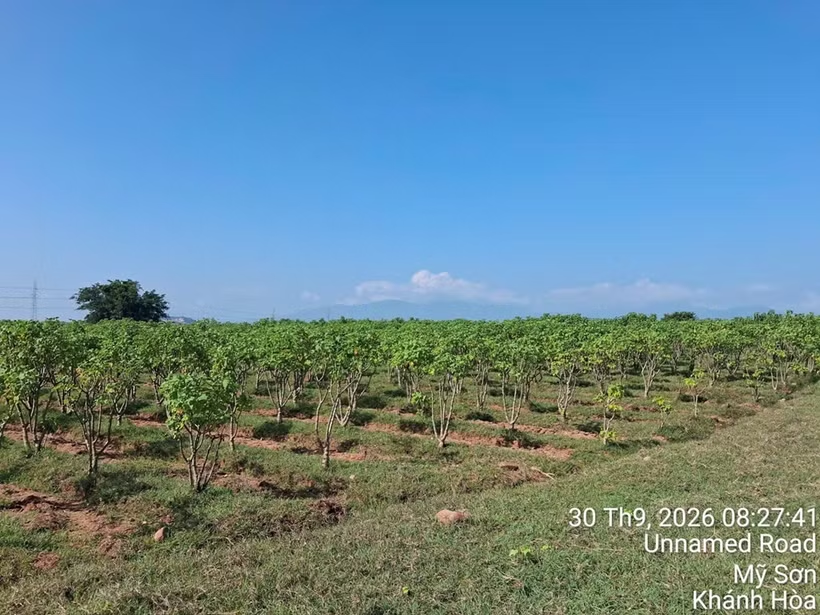
Hanoi (VNA) – Vietnam has outstanding potential to become a regional supply hub for Jatropha seed oil for biodiesel and sustainable aviation fuel (SAF) production, said Tetsuya Koshikawa, President of Star Japan Co., Ltd., a Japanese-owned company pioneering Jatropha cultivation in Vietnam.
Commonly known as physic nut, Jatropha is a genus of flowering plants in the spurge family, Euphorbiaceae. It has been developed in a number of countries as a source of raw material for biodiesel-B100 and SAF production, while also helping rehabilitate degraded land.
Talking to the Vietnam News Agency, Koshikawa said Japan’s research on non-edible oil feedstocks showed that Jatropha is highly drought-tolerant and could grow well on wasteland, eroded sandy land and infertile soil. Given this, areas in central Vietnam, including Ninh Thuan, Binh Thuan and the Central Highlands, have climatic, sunlight and soil conditions suitable for achieving high seed yields and oil content.
Unlike maize, soybean and sugarcane, Jatropha produces non-edible oil containing natural toxins. Expanding Jatropha cultivation on sloping and nutrient-poor land could therefore support bioenergy development without affecting farmland for food crops or competing with food security, he said.
Koshikawa also noted that crude Jatropha oil is compatible with technologies for converting feedstock into SAF and biodiesel, as its fatty acid content and other indicators are suitable for hydroprocessed esters and fatty acids (HEFA) technology used to produce SAF and esterification technology for new-generation biodiesel.
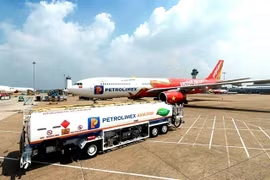
Vietnam’s location on international maritime routes also facilitates supply-chain connections for exporting SAF to Japan, Europe and markets facing pressure to reduce aviation emissions, including those covered by the International Civil Aviation Organisation’s Carbon Offsetting and Reduction Scheme for International Aviation (CORSIA) and the EU’s ReFuelEU aviation regulation, he added.
However, he said, previous and ongoing Jatropha projects have revealed several major challenges, including seed quality and yields, high manual harvesting costs, weak linkages between raw-material production areas and processors, and stringent international sustainability certification requirements.
According to him, many previous cultivation areas used unselected seeds, resulting in uneven yields and low oil content, while reliance on manual harvesting has increased input costs amid rising labour expenses. Farmers are also hesitant to switch crops or adopt intercropping without long-term purchase commitments and risk-protective floor prices.
For exports to demanding markets, the entire cultivation and processing chain must also meet stringent requirements on carbon emissions and deforestation, including ISCC EU, ISCC PLUS and CORSIA certification.
To address these challenges, Star Japan plans to develop a closed value-chain model, working with farms, cooperatives and agro-forestry enterprises to select and supply high-quality, disease-resistant Jatropha varieties adapted to local conditions. It also plans to promote intercropping with short-term crops such as peanuts and mung beans, or industrial crops, to improve land-use efficiency and provide farmers with short-term income alongside revenue from Jatropha seeds.
The company will invest in oil pressing and pre-processing facilities, including central crude-oil pressing and refining plants near raw-material production areas. It will also apply technical processes to utilise by-products, such as using Jatropha press cake as microbial biofertiliser and fruit shells to make biomass pellets.
In the first phase, Star Vietnam will collect and press high-quality crude Jatropha oil (CJO) meeting ISCC certification requirements. In the second phase, Star Japan, through its parent company Revo International Co., Ltd. of Japan, will cooperate with domestic and foreign petrochemical refining technology firms to supply feedstock or form joint ventures to build facilities for further conversion into biodiesel and SAF, Koshikawa said.
He stressed that Star Japan has proposed five support mechanisms to the Vietnamese Government to help businesses and farmers develop green raw-material areas.
These include flexible land allocation and leasing mechanisms for degraded land, alluvial land and inefficiently used forestry land; green credit and tax incentives; measures to develop the domestic market and a legal framework for SAF; support for research and development of high-yield Jatropha varieties; and assistance in establishing default values toward CORSIA certification.
Under the framework of ICAO, he noted, SAF must qualify as CORSIA-eligible fuel to be recognised for its CO2 emission-reduction performance. Vietnam therefore needs to support the registration of SAF feedstocks and the development of default values to facilitate the wider use of certified SAF, Koshikawa noted./.