Turning OCOP products into rural tourism experiences

Experts stressed that rural tourism can develop sustainably only when local communities actively participate and benefit from it. Investment in transport, accommodation and attractions must go hand in hand with clean water, waste treatment, hygiene, traditional craft preservation and environmental protection.

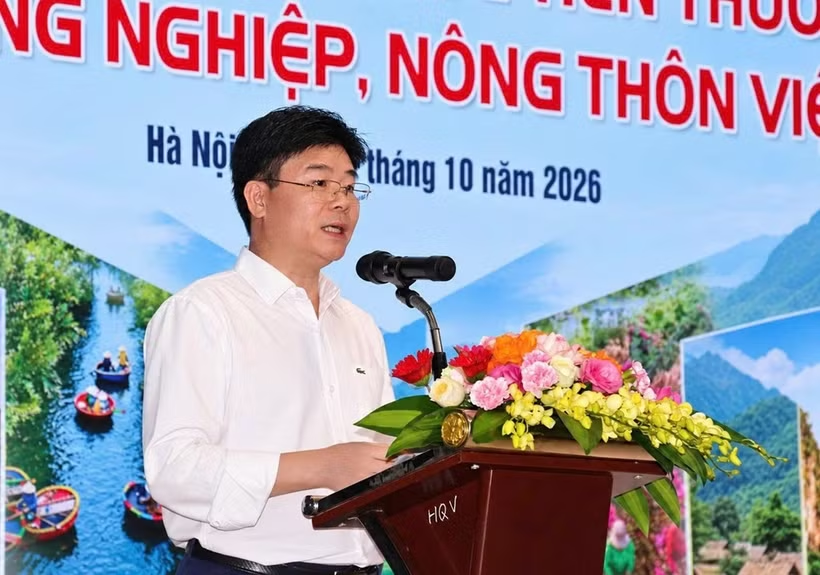
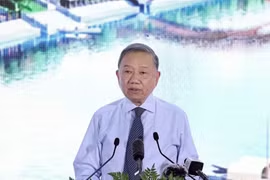
Phuong Dinh Anh, Deputy Chief of the Office of the Central Coordination Office for the National Target Programme, speaks at the event.( VNA)

Hanoi (VNA) – Vietnam needs to turn its One Commune One Product (OCOP) products, traditional craft villages and agricultural resources into distinctive tourism experiences to increase the value of local products and generate stable incomes for rural communities, experts said at a conference in Hanoi on October 9.

The conference on agricultural and rural tourism promotion was held as part of Vietnam’s Agricultural and Rural Tourism Promotion Week.

Phuong Dinh Anh, Deputy Chief of the Central Coordination Office for National Target Programmes, said Vietnam had more than 21,000 OCOP items rated three stars or higher as of September 2026, with over 10,000 participating entities. The country had also developed more than 600 rural tourism models, including nearly 400 recognised tourist destinations.

These resources offer significant potential for agricultural and rural tourism. However, links between production and tourism remain limited. Many OCOP products are simply displayed and sold at tourist destinations, while their production processes, local cultural value, and traditional craft stories remain underutilised.

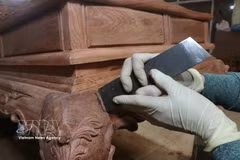
Anh said production facilities should become destinations in their own right, allowing visitors to learn about production processes, take part in selected activities, sample products and discover the cultural stories behind traditional occupations. These experiences could be enjoyed at tea and coffee farms, fish sauce production facilities, pottery studios, and agricultural cooperatives.

To develop these products, producers need to invest in visitor facilities, hygiene, safety and service quality. Travel companies should also participate from the planning stage, helping assess market demand and design suitable experiences rather than connecting with destinations only after they are fully developed.

Doan Truong Giang, Deputy Director of the Agricultural Trade Promotion Centre, said many localities had developed community and agriculture-based tourism and craft village tours linked to local specialties and OCOP products. However, not all destinations had turned their potential into competitive products capable of generating stable revenue.

Some experiences still focus mainly on sightseeing, photography, dining and shopping, while service quality, infrastructure and hospitality skills vary. Limited coordination among local authorities, producers, cooperatives, travel companies and media organisations has also prevented destinations from making full use of available resources.

Giang called for a shift from developing individual destinations to building connected experience-based tourism routes. A single itinerary could combine visits to raw-material growing areas and craft villages with hands-on production activities, local cuisine and OCOP shopping. This approach would enrich visitors’ experiences, expand markets for agricultural products and increase local incomes.

Digital technology also needs to play a greater role in promotion, providing information about destinations and services and supporting bookings. Attractive communications highlighting local characteristics and distinctive experiences would help visitors find and choose suitable itineraries.

Hoang Hoa Quan, a representative of the Vietnam National Authority of Tourism under the Ministry of Culture, Sports and Tourism, stressed the need for closer coordination between tourism, agriculture, industry and trade. Local authorities can improve infrastructure and connections, travel companies can create tours and engage customers, while residents, cooperatives, and producers can offer experiences directly.

Cooperation between localities with complementary strengths could also create joint tourism routes, broaden visitor choices and encourage longer stays. Clear service standards, responsibilities and benefit-sharing mechanisms are needed to ensure local communities receive a fair share of tourism revenue.

Experts stressed that rural tourism can develop sustainably only when local communities actively participate and benefit from it. Investment in transport, accommodation and attractions must go hand in hand with clean water, waste treatment, hygiene, traditional craft preservation and environmental protection.

As part of the programme, participating parties signed a memorandum of understanding on agricultural and rural tourism development to strengthen cooperation and promote sustainable tourism products./.
​

VNA

See more

Prime Minister Le Minh Hung and his Cambodian counterpart Hun Manet witness the exchange of cooperation agreements between businesses of the two countries (Photo: VNA)

Vietnam, Cambodia look to elevate economic links

Prime Minister Le Minh Hung said that economic, trade and investment cooperation constitutes an important pillar of bilateral ties, which has achieved positive results. However, considerable room remains for further expansion to match the strong political ties and the potential of both countries.

An overview of the meeting (Photo: chinhphu.vn)

Deputy PM calls for tighter price management of essential goods

Deputy PM Thang, who is also head of the committee, urged ministries and agencies to coordinate closely to deliver effective fiscal and macroeconomic policies. The aim is to control inflation, stabilise the macroeconomy, ensure major economic balances, create room to support growth and bolster the economy’s resilience to external shocks.

Vietnamese Ambassador to India Trinh Minh Manh discusses potential areas and strengths for cooperation between Vietnam and India’s Gujarat state. (Photo: VNA)

Vietnam, India’s Gujarat state seek to unlock cooperation potential

Vietnam attaches importance to strengthening cooperation with Indian states boasting strong economic potential, including Gujarat, to further advance the two countries’ Enhanced Comprehensive Strategic Partnership, particularly in the economy, trade and investment, said Ambassador Trinh Minh Manh.

At Nestlé Vietnam factory in Hung Yen province (Photo: VNA)

Vietnam seeks to build stronger ecosystem for FDI

The World Bank has stressed the need to connect global companies with domestic suppliers, improve the business climate and develop supply-chain finance solutions. Those steps will let domestic firms gradually meet requirements on quality, technology, costs and delivery times, and position them to become suppliers to multinational corporations.

Construction of technical infrastructure facilities serving APEC 2027 in Phu Quoc Special Zone, An Giang province. (Illustrative photo: VNA)

Vietnam enters investment grade credit rating category for first time

Vietnam has maintained robust growth, outperforming other Southeast Asian economies. Its ongoing government reforms aimed at streamlining the state apparatus, promoting the private sector, improving the institutional framework and developing capital markets will strengthen the country’s growth potential and economic resilience.

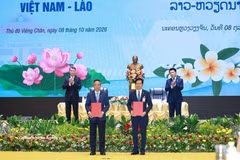
Vietnamese Prime Minister Le Minh Hung and Lao Prime Minister Saleumxay Kommasith witness the presentation of investment certificates and investment cooperation agreements between businesses of the two countries. (Photo: VNA)

Vietnam, Laos strengthen “strategic cohesion” in economic sector

The great friendship, special solidarity, comprehensive cooperation and strategic cohesion between Vietnam and Laos, and between Laos and Vietnam, are an invaluable asset of the Vietnamese and Lao Parties, States and people. It is the responsibility of today's generation to transform this invaluable political asset into new resources for the development of the two countries’ people.

West Food Hau Giang JSC’s factory at the Nam Song Hau Industrial Park – Phase 1, Can Tho city (Photo: VNA)

Southern industrial property market enters new phase of competition

Industrial site selection was previously driven largely by land prices, location and access to markets. However, as supply chains become more complex and manufacturing projects face higher technical requirements, businesses are increasingly assessing sites based on their long-term operational capabilities.

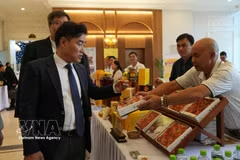
Members of the RoK delegation visit booths showcasing signature agricultural products of Da Lat – Lam Dong. (Photo: VNA)

Lam Dong seeks stronger economic, tourism links with RoK

Lam Dong is particularly interested in sectors in which Korean businesses have strengths, including agriculture, green energy, the circular economy, high-quality tourism, healthcare, education, human resources training and digital transformation, an official said.

Illustrative image (Photo: EVNNPT)

EVNNPT seeks over 224 mln USD in bank loans for grid expansion

Three projects account for part of the financing need, including 13.3 million EUR for the 220kV Ung Hoa substation and connection lines, 18.6 million EUR for the 220kV Tan Viet substation and the 220kV Tan Viet–Gia Loc–Pho Noi line, and 35.3 million EUR for the 220kV substation connecting the Dong Anh–Van Tri transmission line.