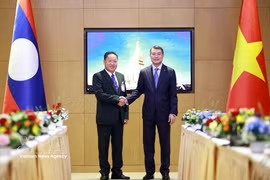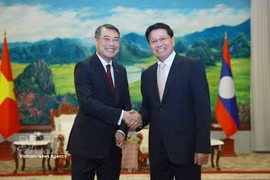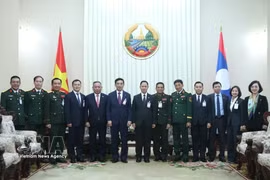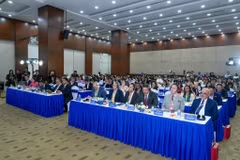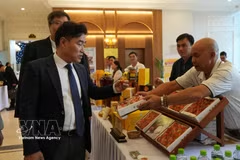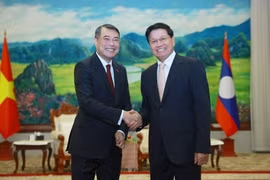
Vientiane (VNA) - Prime Minister Le Minh Hung and his Lao counterpart Saleumxay Kommasith attended and delivered remarks at the Vietnam-Laos Investment Promotion Conference in Vientiane on the afternoon of October 8 as part of the Vietnamese leader’s official visit to Laos.
The conference was attended by leaders of ministries, sectors and localities, as well as a large number of representatives from businesses and investors of both countries.
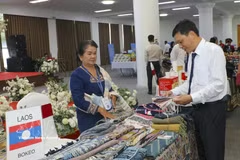
At the event, delegates introduced Laos's investment environment and policies; reviewed Vietnam-Laos investment cooperation and orientations for the coming period; assessed the investment and business cooperation potential of enterprises from both countries; and put forward proposals and recommendations to address difficulties and obstacles facing businesses.
They also discussed measures to promote specific cooperation projects, particularly in such fields as minerals, rubber, energy, railways, roads, seaports and other areas.
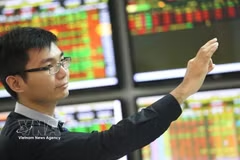
According to reports presented at the event, two-way trade between Vietnam and Laos reached nearly 3 billion USD in 2025, up 32.7% year-on-year and the highest level ever recorded. Laos continued to be Vietnam's largest destination for outward investment, with more than 300 projects and total registered capital of over 7 billion USD. In the first nine months of 2026 alone, 24 new projects were licensed with total investment capital of 670 million USD, 1.7 times higher than the figure recorded in the same period of 2025.
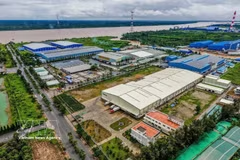
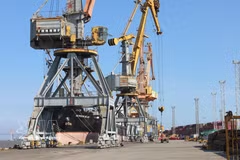
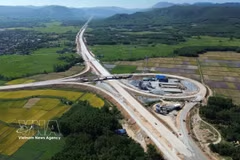
The two sides are promoting strategic infrastructure connectivity projects, including the Hanoi-Vientiane expressway, the Vientiane-Vung Ang railway, Vung Ang Port, energy infrastructure and electricity cooperation.
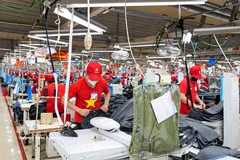
Vietnam is accelerating construction and shortening the implementation time to complete the Vinh-Thanh Thuy expressway ahead of schedule. Projects invested in by Vietnamese enterprises have created jobs and increased incomes for hundreds of thousands of Lao workers, while contributing an average of around 300 million USD annually to the Lao state budget.
Speaking at the conference, the two PMs highly appreciated the successful organisation of the event as the two countries are actively preparing to celebrate the 65th anniversary of diplomatic relations (1962-2027) and the 50th anniversary of the signing of the Treaty of Amity and Cooperation (1977-2027).
They emphasised that this is an important occasion to concretise agreements reached by the high-ranking leaders of the two countries, particularly the goal of raising two-way trade to 10 billion USD by 2030, while discussing solutions to deepen investment cooperation during the 2026-2030 period in a substantive and effective manner.
While acknowledging and highly appreciating the achievements made, the leaders frankly noted that economic cooperation between the two countries still faces limitations. Some projects remain behind schedule, while investment procedures, land issues, payments and infrastructure connectivity continue to face obstacles, as reflected by businesses. Two-way trade in the first eight months of 2026 reached only around 1.65 billion USD.
Sharing information on Vietnam's socio-economic situation, PM Hung said that as Vietnam enters a new era of development, the country is determined to strongly renew its growth model, with science and technology, innovation and digital transformation, human-resource quality, productivity and competitiveness serving as the key drivers. Vietnam aims to achieve double-digit growth during the 2026-2030 period and become a developed, high-income country by 2045.
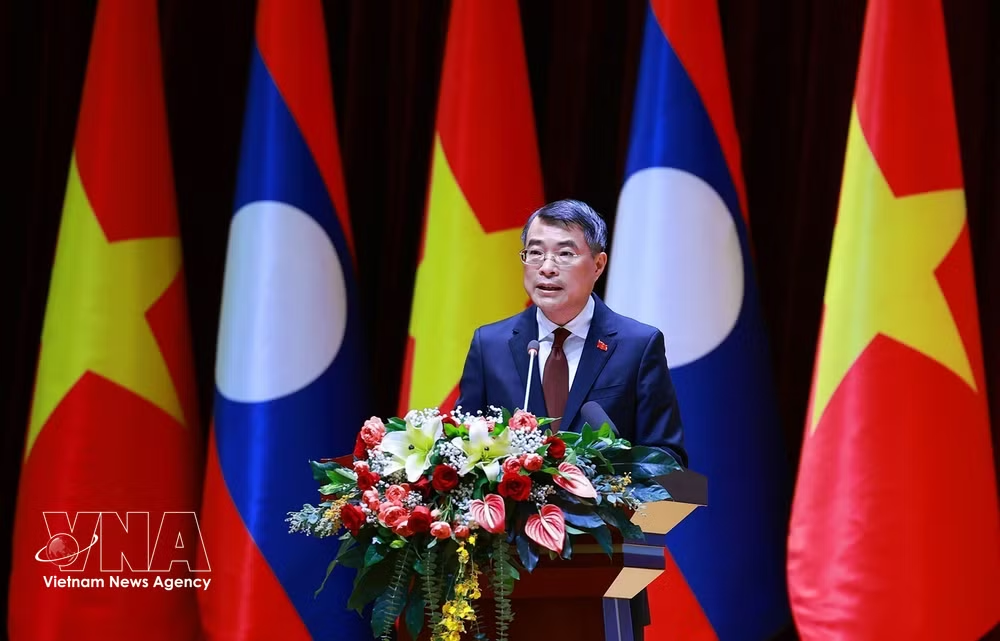
Vietnam has issued and is resolutely implementing a number of breakthrough resolutions on science and technology and digital transformation; international integration; law-making and law enforcement; development of the private economic sector, the state economic sector and the foreign-invested sector; energy security; education and training; culture; and people's healthcare.
Despite continued global volatility, Vietnam's macroeconomy has remained basically stable, inflation has been controlled, high economic growth has been maintained, and major economic balances have been ensured. In particular, GDP growth in the first nine months of 2026 reached more than 9.01%, the highest level in many years.
Total import-export turnover reached 888 billion USD, up 30.4% year-on-year; registered foreign direct investment (FDI) capital reached 50.36 billion USD, up 76.4%, while disbursed FDI hit 21.07 billion USD, up 12.1%. Total social investment capital reached 3.11 quadrillion VND, up 15.1%. Vietnam also officially joined the group of upper-middle-income countries on July 1, 2026.
PM Hung affirmed that the high-ranking leaders of the two countries have consistently determined that economic, trade and investment cooperation must become a solid pillar commensurate with the stature of the “great friendship, special solidarity, comprehensive cooperation and strategic cohesion” between Vietnam and Laos, and between Laos and Vietnam.
Under the close direction of the two Parties, the two States and the two Governments, and with close coordination among ministries, sectors and localities, bilateral economic cooperation has achieved many important results.
On behalf of the Vietnamese Government, PM Hung praised and highly appreciated the efforts of the business communities of both countries in overcoming difficulties and maintaining and expanding production and business activities. He also commended the ministries, sectors and localities of the two countries for resolutely implementing directions from the two Politburos and the two Governments and resolving many long-standing obstacles facing major and strategic projects.
According to the Vietnamese Government leader, as the world and regional situation is forecast to remain complex and unpredictable, the Governments and businesses of the two countries need to continue renewing their thinking, demonstrating greater determination and taking stronger action to create breakthroughs in investment and trade cooperation.
First, he suggested continuing to concretise the “strategic cohesion” in the economic sector, with a focus on connectivity in institutions and policies, transport infrastructure, logistics, energy, science and technology, and digital transformation.
Accordingly, the two sides need to accelerate investment in the Hanoi-Vientiane expressway; operate and effectively operate Vung Ang Port; and soon develop an appropriate plan to implement the Vientiane-Vung Ang railway. They should also strengthen electricity trading and power-grid connectivity. These will provide the foundation for achieving the goal of 10 billion USD in two-way trade by 2030.
Second, the two sides should work together to improve the investment and business environment. Vietnam is ready to share its experience in institutional reform and administrative procedure simplification, while working alongside Laos to maintain macroeconomic stability, as this is a prerequisite for attracting resources for development investment.
Third, they should make more effective use of cooperation mechanisms, particularly the Vietnam-Laos, Laos-Vietnam Intergovernmental Committee, to promptly advise on, address or coordinate in resolving difficulties and obstacles that arise.
Fourth, it is necessary to accelerate project implementation. Investors from both countries must mobilise resources to implement projects on schedule and ensure quality, particularly for major and strategic projects.
Fifth, the two sides should continue expanding investment in new fields. PM Hung called on major Vietnamese state-owned groups and enterprises, as well as large private businesses, to increase investment in Laos in such areas as high-tech agriculture, deep processing of minerals, renewable energy, logistics, finance and banking, digital transformation and tourism. Vietnam also welcomes Lao businesses to invest and operate in Vietnam.
“The great friendship, special solidarity, comprehensive cooperation and strategic cohesion between Vietnam and Laos, and between Laos and Vietnam, are an invaluable asset of the Vietnamese and Lao Parties, States and people. It is the responsibility of today's generation to transform this invaluable political asset into new resources for the development of the two countries’ people,” he affirmed.
PM Hung expressed his belief that with the determination of the leaders, people and business communities of both countries, Vietnam-Laos and Laos-Vietnam relations will certainly reach new heights, for the strength, prosperity, well-being and happiness of the two countries’ people.
For his part, Lao PM Saleumxay spoke highly of PM Hung's visit, and strongly agreed with the Vietnamese leader’s assessments of bilateral relations in general and economic, trade and investment cooperation in particular.
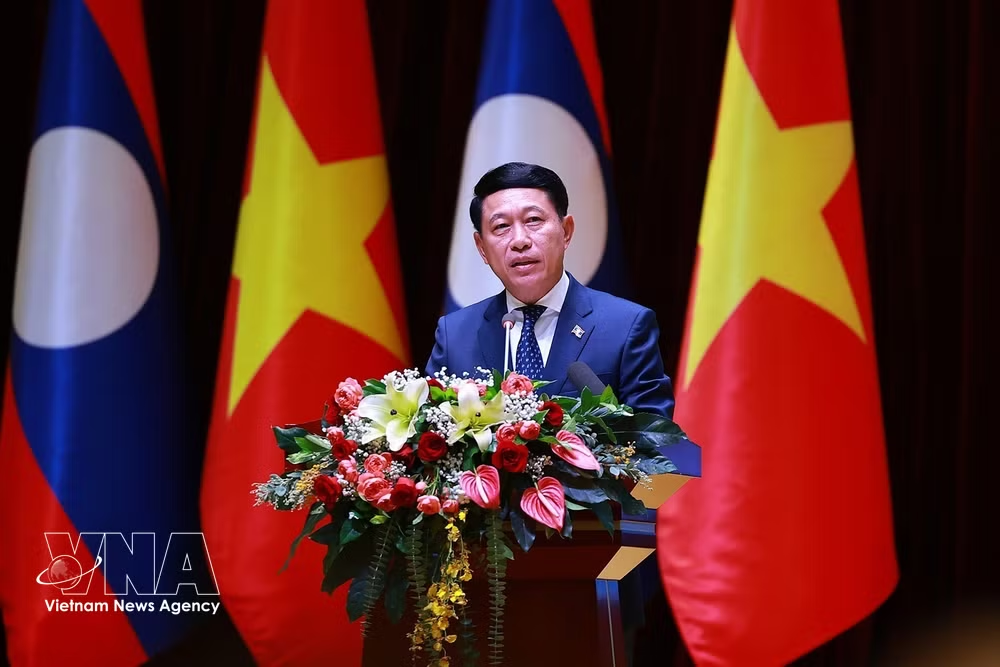
The Lao PM affirmed that the investment promotion conference would make an important contribution to strengthening economic and trade cooperation between the two countries. He emphasised that the two sides need to enhance cooperation and support so that their economies can continue to develop, address shortcomings and limitations in cooperation, and strive to achieve the targets set by the leaders of the two countries.
Echoing PM Hung's views on future orientations, he said that Laos takes note of the proposals and recommendations made by Vietnamese businesses to further improve the business environment and investment management and promotion, and to continue creating more favourable conditions for Vietnamese investment projects.
The Lao PM called on businesses from both countries, including state-owned and private enterprises, to strengthen cooperation, particularly through equity partnerships; help and support each other; and share technological experience in the spirit of brotherhood, thereby helping Lao businesses develop further.
PM Saleumxay called on Vietnamese investors, particularly major companies, to visit Laos and explore investment opportunities more frequently in areas prioritised and encouraged by the Lao Government. He also asked Vietnamese businesses and investors to promptly report any difficulties and obstacles, saying that the Lao side would listen, take note of petitions and work together to resolve them thoroughly.
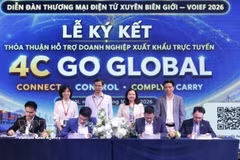
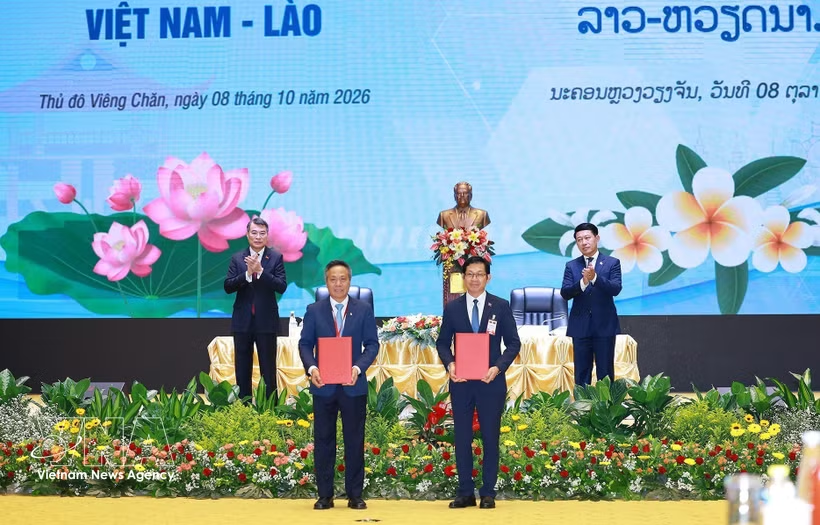
Also at the conference, the two PMs witnessed the presentation of 17 investment certificates and cooperation agreements for projects between agencies and businesses of the two countries.
PM Hung expressed his hope that these projects would be effective and practical, create jobs, generate revenue and new values, while serving as additional bridges connecting the two economies, the two countries and the two peoples./.