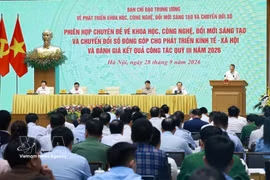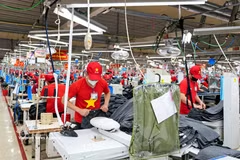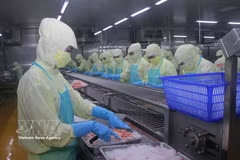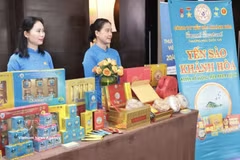
Hanoi (VNA) — Bringing research into production, developing strategic technology products, and building databases and traceability systems are laying important foundations for the agriculture and environment sectors to improve quality, added value, and resource-use efficiency.
A notable shift is the Ministry of Agriculture and Environment’s move from managing science and technology tasks to focusing on results and value generated.
Since 2021, the ministry has put 225 crop, livestock, aquaculture and forestry varieties, 150 technical advances, and 158 patents and other intellectual property products into production and commercial use. It has also implemented more than 2,000 high-tech, smart, and climate-resilient agricultural practices.
According to the ministry, technology research and application have helped reduce investment costs and increased economic efficiency in agricultural production by around 20-30%, demonstrating closer links between science and technology and practical production needs.
The ministry plans to further reform the commissioning and evaluation of science and technology tasks by identifying, from the outset, the final product, recipient, applicability, commercialisation potential and measurable impact. The move aims to narrow the gap between research, technology transfer and application, while directing resources towards production and market needs.
Data infrastructure is another priority. The ministry is developing 21 databases and four sector-wide information systems. It has synchronised 12 national and specialised databases, while four shared information systems are operational and nine databases are being completed under the 2026 plan.
The databases cover fisheries, aquaculture, crop production, hydrometeorology, environment, land and remote sensing, providing a foundation for an integrated agriculture and environment data ecosystem.
The national land database is also being accelerated. As of September 27, data from localities covered about 62.7 million of nearly 104.8 million land parcels, or 59.8%. The completed database will support State management and connectivity with the National Population Database and National Data Centre.
The national agricultural product traceability system, launched on July 1, has recorded 820,723 products from 3,031 farming households and 208 enterprises in 28 of the country’s 34 provinces and cities. The system is designed to improve supply-chain transparency, product quality, and market access.
The ministry is also focusing on strategic technologies, including next-generation crop, livestock and aquatic varieties using genetic and biotechnology, veterinary vaccines and biological products, and the national agricultural product traceability system.
In the first nine months of 2026, the ministry approved 187 ministerial-level science and technology tasks in these areas. A review identified 22 products that basically met criteria for a strategic technology product, including varieties, a vaccine and biological products. Four biological products currently meet the criteria.
It will restructure science and technology tasks in line with production and market demand, while accelerating the standardisation, connectivity and use of data, particularly land and traceability data. It will also concentrate resources on strategic technology products with breakthrough potential.
The impact of science, technology, innovation, and digital transformation will be gauged not just by the number of tasks undertaken or research results, but also by productivity, added value, efficient use of resources, and reduced time and costs for individuals and businesses. This will help position science and technology as a key driver of higher-quality growth in the agriculture and environmental sector./.