Ho Chi Minh City (VNA) – The development of artificial intelligence (AI) and data centres is creating new requirements for Vietnam’s industrial property market, with investors increasingly looking beyond land availability to power supply, connectivity, human resources and expansion capacity.
Vietnam aims to become an AI hub of ASEAN by 2030, with the AI economy accounting for 6% of GDP. Realising this ambition will require substantial increases in computing capacity, data centres and electricity supply.
According to Avison Young Vietnam, the key question for investors is no longer simply whether there is enough land for data centre development, but whether sufficient electricity is available to ensure stable operations and future expansion. With Vietnam forecast to face a power shortfall of 61 billion kWh by 2030, electricity supply has become a key factor in industrial property competitiveness.
Vietnam has favourable conditions to attract AI investment and develop data centres, including a population of more than 100 million, a young and tech-savvy workforce, competitive costs and a strategic regional position. However, investors are increasingly looking for locations where technology projects can operate efficiently and scale up.
Demand for data centres is therefore going beyond the emergence of a new property segment. Investors are seeking an ecosystem with suitable human resources, reliable power supply, good connectivity and room for expansion.
David Jackson, Principal and CEO for Avison Young in Vietnam and Cambodia, said factors surrounding a site are becoming as important as the site itself in assessing industrial property.
For data centres and high-tech production projects, investors need reliable power capacity in the right place and at the right time, with scope for expansion as operations grow. This requires close coordination in power generation, transmission, and supporting infrastructure in project areas.
High-tech projects consume large amounts of electricity, but their demand is also predictable and long-term, providing a basis for planning power sources and infrastructure in advance. For example, a semiconductor project may require power equivalent to or close to that of an entire industrial park despite occupying a much smaller area.
Therefore, industrial park developers seeking to attract high-tech industries cannot rely solely on existing power capacity. Power demand must be planned from the outset, with early coordination with Vietnam Electricity (EVN) and local authorities, as well as a phased capacity expansion plan to provide clear commitments for tenants.
Avison Young Vietnam said investors are already convinced of the potential of AI and data centres, with capital readily available. The challenge now is to translate policy commitments into favourable conditions that enable projects to be implemented quickly and efficiently.
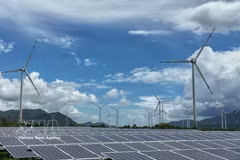
This requires broader access to electricity. The Government has opened the direct electricity market and allowed foreign investors to own 100% of data centre operations. The cooperation between BIM Energy and Evolution Data Centres to supply renewable energy to a new data centre in Ho Chi Minh City is an example of the direct power purchase agreement (DPPA) model.
According to experts from Avison Young Vietnam, data centres cannot afford power outages, so backup power sources and storage systems are needed to ensure uninterrupted operations. Data centre development requires clear procedures and an empowered focal agency to streamline approval and implementation./.