Vietnam turns AI ambitions into tangible business results

AI has become a high or top priority for 69% of surveyed Vietnamese businesses, while 84% expect their use of AI to increase over the next year. Although 61% of adopters remain at the experimentation stage, 71% said their AI investments have already broken even or generated returns.

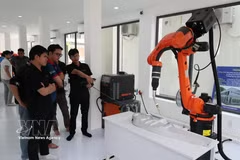
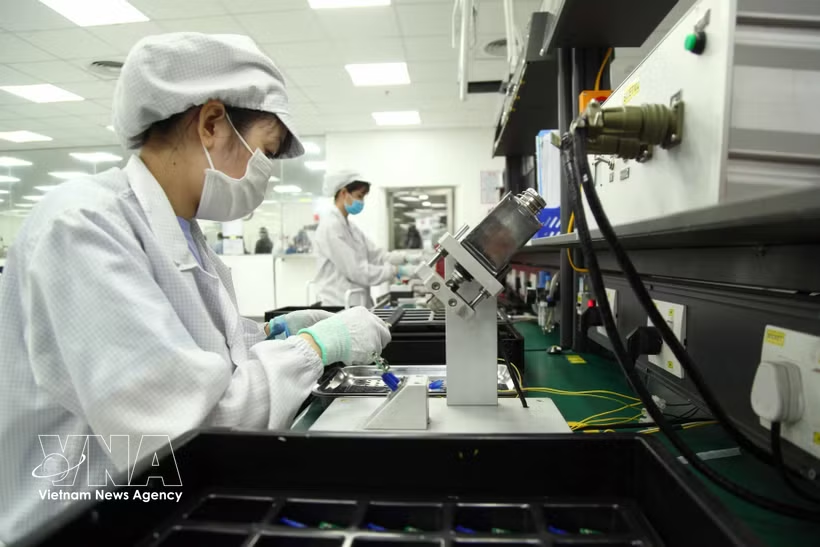
Electronic component production at Star Engineers Vietnam Co., Ltd. in Binh Xuyen Industrial Park, Phu Tho province. (Photo: VNA)

Hanoi (VNA) - A new study commissioned by Amazon Web Services (AWS) shows that 26% of Vietnamese businesses have adopted artificial intelligence (AI), with many moving beyond experimentation to generate measurable business results.

The “Unlocking Vietnam’s AI Potential 2026” study, conducted by Strand Partners and unveiled at the recent AWS Cloud and AI Day Hanoi, surveyed 1,000 business leaders and 1,000 citizens to assess AI and cloud adoption nationwide.

The study estimated that about 245,000 Vietnamese businesses have adopted AI, with 78% of them expecting the technology to remain a key growth driver over the next year. Among AI adopters, 73% said AI is central to their overall business strategy, while 72% reported higher productivity, up from 66% a year earlier. Meanwhile, 64% said AI helps increase their average revenue by 15%.

The momentum is growing, but turning ambition into sustainable results requires more than investment. Businesses need clear AI strategies backed by effective governance, reliable return-on-investment (ROI) measurement, and the skills needed to use AI responsibly.

Each business has its own AI journey

AI has become a high or top priority for 69% of surveyed Vietnamese businesses, while 84% expect their use of AI to increase over the next year. Although 61% of adopters remain at the experimentation stage, 71% said their AI investments have already broken even or generated returns.

Financial services and healthcare are among the sectors showing strong AI adoption. In financial services, 41% of businesses have adopted AI, with 79% reporting productivity gains. In healthcare, the adoption rate stands at 23%, while 69% report higher productivity.

The study also highlights growing interest in agentic AI. Among surveyed businesses, 38% are familiar with the technology, with 8% having integrated AI agents into core processes and 19% experimenting with or piloting them. Early adopters reported significant gains, with 81% recording improved productivity. Meanwhile, 61% said AI agents enable faster decision-making and execution, while 49% reported easier business expansion.

AI-native startups are also gaining momentum. Unburdened by legacy systems, these cloud-first businesses recorded average revenue growth of 147% over the past year. Their likelihood of generating more than 1 million USD in annual revenue was 4.8 times higher, while 96% expected AI to continue driving revenue growth.

Building a foundation for AI growth


Despite the progress, only 23% of AI-adopting businesses have a formal, comprehensive AI strategy. Just 13% have a clear and consistently applied AI ROI framework, while 46% lack a reliable way to measure returns.

Skills remain another major challenge. Some 54% of businesses cite shortages of digital and AI skills as a barrier to adoption and expansion. At the same time, 87% of employers consider workforce reskilling important to their AI strategies.

Human judgment is also becoming increasingly important. Some 62% of business leaders see critical thinking and judgement as essential, while 57% highlight the importance of interpreting, verifying and challenging AI-generated outputs.

AWS has trained more than 157,000 people in Vietnam in cloud and AI skills and recently launched an AWS Local Zone in Hanoi. Its Vietnam First Cloud & AI Journey programme has also reached more than 15,000 participants since 2021.

Eric Yeo, General Manager of AWS Vietnam, said Vietnam is gradually realising its ambition of becoming an ASEAN AI hub by 2030. Businesses that move systematically from experimentation to deployment, supported by cloud infrastructure, a transparent regulatory environment and appropriate skills, will be better positioned to compete and grow, he noted./.

VNA
See more

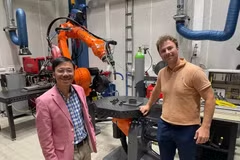
Assoc. Prof. Vu Viet Hung (left) visits a robotic 3D printing facility. (Photo published by VNA)

Vietnam, Canada look to turn strategic partnership into tech projects

Canada's research strength paired with Vietnam's manpower, market size and speed of adoption could address national-level challenges and help small- and medium-sized enterprises modernise production and tap into the international innovation ecosystem, said Assoc. Prof. Vu Viet Hung.

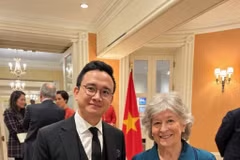
Associate Professor Dang Duc Huy (left) poses for a photo with Canadian Governor General Louise Arbour. (Photo: VNA)

Overseas Vietnamese intellectuals drive innovation

Overseas Vietnamese scientists do not have to return to Vietnam for long-term work to make an impact. They can contribute by joining collaborative research teams, sharing analytical techniques, facilitating access to modern equipment, and linking Vietnam with international labs and universities.

The Better Choice Awards 2026 Gala is a key activity in response to the National Innovation Day 2026 (Photo: qdnd.vn)

Better Choice Awards 2026 honours innovative Vietnamese businesses, tech products

The fourth edition of the awards featured a complete restructuring into four award tracks: Innovative Choice Awards, Smart Choice Awards, Car Choice Awards and the newly introduced Nation Builders Awards. The latter honours businesses contributing to national development by building infrastructure, energy systems and technological capacity for the national economy.

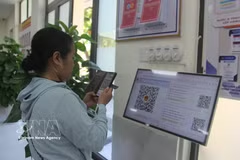
A resident scans a QR code to get a queue number at the public administrative service centre in Hoa Xuan ward, Da Nang city (Photo: VNA)

Localities apply AI, data to drive practical digital transformation

In the central province of Quang Tri, an AI-powered “People’s Assistant” is being piloted from October 1 to 31 at the provincial Public Administration Service Centre and the centres of this kind in Dong Thuan and Dong Ha wards. The system provides information on procedures, required documents, forms and fees, while also supporting declaration and preliminary checks.

Science, technology and innovation products on display. (Photo: VNA)

Businesses must be at heart of innovation: Deputy PM

“Businesses must be placed at the centre of this process,” he said, noting that enterprises understand market demand, formulate practical requirements, invest resources, adopt and master technologies, organise production and bring products to consumers.

The Vietnamese Ministry of Public Security's delegation holds a discussion with representatives of the WIPO's Advisory Committee on Enforcement. (Photo: VNA)

WIPO innovation report viewed through Resolution 57 perspective

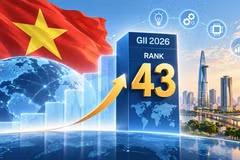
He said the GII 2026 results should be viewed in the broader context of Vietnam’s implementation of Resolution No. 57-NQ/TW, which identifies science and technology, innovation and national digital transformation as key breakthroughs and major drivers for developing modern productive forces and enhancing economic competitiveness.

Minister of Science and Technology Vu Hai Quan (left) meets with Japanese Minister of Internal Affairs and Communications Fujii Hisayuki (Photo: VNA)

Vietnam, Japan expand cooperation in strategic technology fields

Meeting with Japanese Minister of Education, Culture, Sports, Science and Technology Seki Yoshihiro on October 2, Minister of Science and Technology Vu Hai Quan proposed the Japanese side continue providing postgraduate scholarships, particularly at master's and doctoral levels in strategic technological sectors, facilitate exchanges among students and researchers, and maintain support for the Vietnam Japan University (VJU).

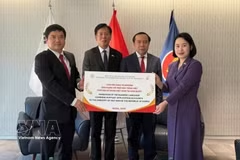
Minister of Science and Technology Vu Hai Quan (second, right) witnesses Director of the Posts and Telecommunications Institute of Technology Dang Hoai Bac presenting the Vietnamese-learning app to representatives of the Vietnamese Embassy in the Republic of Korea. (Photo: VNA)

Vietnamese-learning app presented to community in RoK

The initiative aims to support language learning among children growing up in more than 100,000 Vietnamese-Korean multicultural families, while helping preserve Vietnamese cultural identity and strengthen their ties with their homeland.

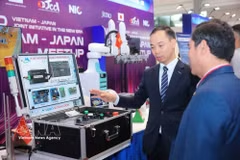
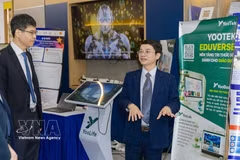
Prof. Dr. Nguyen Ngoc Diep (R), Director of the Australia-Vietnam Strategic Technologies Centre, introduces strategic technology products to delegates at the forum. (Photo: VNA)

Strategic technologies expand space for Vietnam - Australia cooperation

Vietnamese Deputy Minister of Science and Technology Tran Trung Tinh said that amid global uncertainties, strategic technologies are becoming a decisive driver of national competitiveness and sustainable development. Vietnam has identified science, technology, innovation and digital transformation as key strategic breakthroughs.

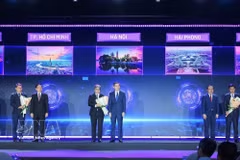
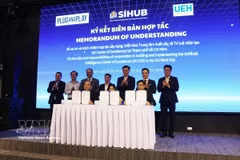
The signing ceremony of an MoU on the roles and responsibilities of cooperation in building and implementing the Artificial Intelligence Centre of Excellence (AI COE) in Ho Chi Minh City (Photo: VNA)

AI Centre of Excellence developed in Ho Chi Minh City

Under the MoU, the AI COE is envisioned as a platform bringing together the State, academia and businesses to promote research, incubation, startup acceleration and the practical application of AI in Ho Chi Minh City.

Vietnam accelerates innovation to boost growth, competitiveness

Vietnam accelerates innovation to boost growth, competitiveness

By 2030, Vietnam aims to rank among the world’s top 40 in the GII; raise total social investment in R&D to at least 2% of GDP, with non-State funding accounting for over 60%; increase international scientific publications by an average of 10% annually; and raise the number of patent applications and granted patents by an average of 16-18% annually.

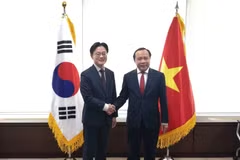
Vietnamese Minister of Science and Technology Vu Hai Quan (right) and RoK Minister of Trade, Industry and Resources Kim Jung Kwan at their meeting on September 30 (Photo: vnexpress.net)

Vietnam seeks RoK help on nuclear power, AI

The Korean Ministry of Trade, Industry and Resources (MOTIR) was urged to share practical lessons from its nuclear sector with Vietnam, including institutional and policy frameworks governing the roles of policymaking and regulatory agencies, advanced nuclear power technology, experience in building a domestic nuclear supply chain, and long-term workforce training through specialised courses, hands-on work and staff exchanges.