Hanoi (VNA) – Localities nationwide are shifting the focus of digital transformation from building digital foundations to generating practical value, with artificial intelligence (AI) and data increasingly applied to improve governance, public services and development opportunities.
The shift follows the Political Bureau’s Resolution No. 57-NQ/TW, dated December 22, 2024, on breakthroughs in science and technology, innovation and national digital transformation.
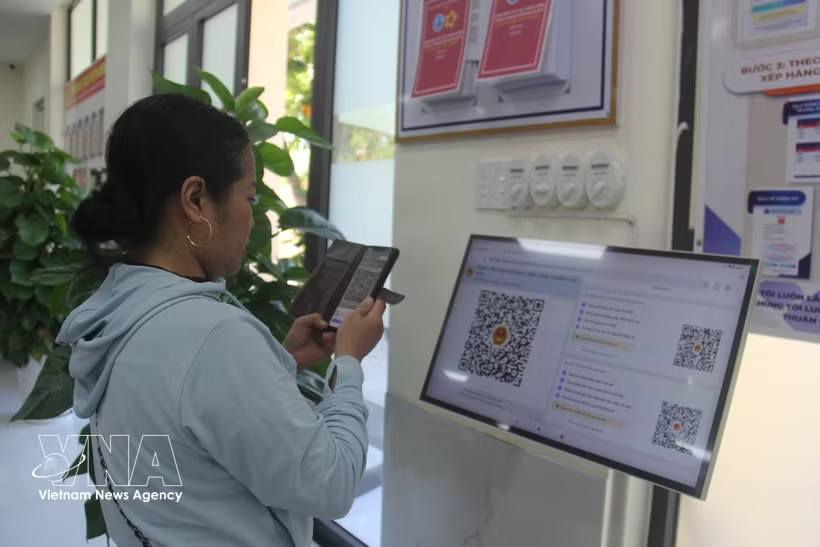
In the central province of Quang Tri, an AI-powered “People’s Assistant” is being piloted from October 1 to 31 at the provincial Public Administration Service Centre and the centres of this kind in Dong Thuan and Dong Ha wards. The system provides information on procedures, required documents, forms and fees, while also supporting declaration and preliminary checks.
The pilot covers 20 administrative procedures, including 10 at the commune level and 10 at the provincial level, in areas such as certification, civil status, marriage registration, death registration, household business registration and disability assessment, as well as several procedures in fisheries, advertising, tourism and transport.
Its effectiveness will be assessed through indicators including processing time, the rate of applications completed at the first submission, requests for supplementation, AI accuracy and user satisfaction. The AI serves only as an assistant, while officials remain responsible for verification and decisions.
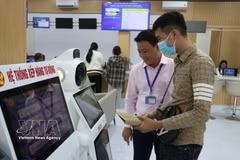
In Gia Lai province, an AI robot has been operating at the public administrative service centre of Hoi Phu ward since August 2025, assisting more than 100 people a day with procedures, information, queue numbers and service counters.
AI is being used here as a support tool rather than a replacement for professional officials. For routine procedures, the system reduces the need for direct guidance, while officials continue to handle specific applications and address issues as they arise. The approach demonstrates how AI can be deployed at the grassroots level to support both citizens and public servants.
Meanwhile, Ho Chi Minh City is promoting AI development through cooperation among the Saigon Innovation Hub (SIHUB), the University of Economics Ho Chi Minh City and Plug and Play Singapore to study, build and launch an AI Centre of Excellence (AI COE). The model focuses on cooperation among the State, universities and businesses, with three pillars: a Capability Centre, an Acceleration Track and a Venture Client Track/Proof of Concept - PoC.
The parties also plan to connect experts, investors, startups and international technology networks, thereby expanding resources for the city’s innovation ecosystem.
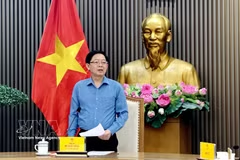
Vice Chairman of the Ho Chi Minh City People’s Committee Truong Minh Huy Vu said the cooperation could help startups, businesses and researchers access international expertise, technology, networks and markets, expressing hope that the commitments would be turned into concrete programmes, projects and results.
These initiatives share a common approach: applying AI to specific local needs rather than adopting technology for its own sake, thereby making digital transformation more directly relevant to people and businesses.
Alongside AI, localities are stepping up efforts to build and exploit high-quality data.
An Giang province launched a 45-day campaign from October 2 to November 16 to review and clean databases, develop digital citizens and remove bottlenecks in digital transformation. Agencies are tasked with supplementing missing information, correcting inaccurate data, reconciling inconsistencies and connecting eligible databases, with priority given to information systems and connectivity at the commune level.
This is considered a prerequisite for standardised data to be effectively integrated into the digital government system, rather than merely stored.
The Mekong Delta locality also plans to make greater use of the national population database while standardising data on land, justice, health, education and personnel.
In Nghe An, a trial shared data warehouse and provincial data analysis and management platform was launched on September 30. Eight of 10 sectors have contributed 158 datasets, while the provincial shared warehouse contains 138 datasets across 31 categories. The system also includes a multi-level management platform, iNgheAn, an AI data assistant, and an open data portal.
The experience of An Giang and Nghe An shows that building, standardising, connecting and effectively exploiting data is essential for deeper digital transformation, more effective governance and better public services./.