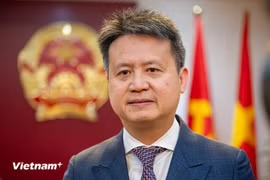
Geneva (VNA) – Following the World Intellectual Property Organisation (WIPO)’s release of the Global Innovation Index (GII) 2026, a Vietnam News Agency correspondent in Switzerland interviewed Ambassador Mai Phan Dung, Permanent Representative of Vietnam to the United Nations, the World Trade Organisation, and other international organisations in Geneva, on October 1, about the report and its implications for Vietnam.
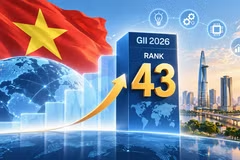
According to the ambassador, GII 2026, the 19th edition of WIPO’s flagship annual report, assesses the innovation capabilities of 139 economies. For Vietnam, the notable point is not merely its one-place rise in the ranking. The country ranks 35th globally in innovation outputs, compared with 54th in inputs, showing that it continues to generate relatively strong innovation results from its available resources.
WIPO also highlighted a long-term achievement: India and Vietnam are the only two economies to have maintained innovation performance above expectations for their level of development for 16 consecutive years, the longest period among all economies covered by the index. In its presentation of GII 2026, WIPO again placed Vietnam among the fastest-advancing middle-income economies and noted the expanding research and development capabilities of middle-income economies, including Vietnam.
Another notable point was WIPO Director General Daren Tang’s reference to a Vietnamese molecular diagnostics company when discussing the emergence of science-intensive start-ups that commercialise research results in fields such as biotechnology, advanced materials, semiconductors, robotics and medical technology. The example demonstrated that such businesses are emerging beyond traditional scientific hubs.
Within ASEAN, Singapore ranked fifth globally, followed by Malaysia at 34th, Vietnam at 43rd, Thailand at 44th, the Philippines at 52nd and Indonesia at 55th. WIPO noted that these economies are deeply integrated into regional and global value chains, although their strengths differ. Malaysia ranks 17th globally in high-tech manufacturing, the Philippines 18th in ICT services exports, and Indonesia 26th in late-stage venture capital deals. Vietnam ranks 34th in unicorn valuation relative to the size of its economy and fifth globally in mobile app creation.
Dung said the report shows that Vietnam’s model of trade openness, investment attraction, high-tech manufacturing and participation in international supply chains has produced tangible results. However, moving from around the 40th position towards the leading group will increasingly depend on the country’s ability to turn manufacturing activities into domestically retained knowledge, develop its research workforce, increase the number of Vietnamese-origin patents, improve university quality and encourage domestic businesses to engage more deeply in R&D.
He said the GII 2026 results should be viewed in the broader context of Vietnam’s implementation of Resolution No. 57-NQ/TW, which identifies science and technology, innovation and national digital transformation as key breakthroughs and major drivers for developing modern productive forces and enhancing economic competitiveness.
The report, he noted, reflects the spirit of Resolution 57: beyond increasing resources for science, technology and innovation, the key is to turn those resources into products, technologies, businesses and tangible economic value. WIPO’s recognition of Vietnam’s high-tech exports, high-tech manufacturing and creative products demonstrates that the country has developed certain capabilities to connect innovation with markets and global value chains./.
See more
Vietnam, Japan expand cooperation in strategic technology fields
Meeting with Japanese Minister of Education, Culture, Sports, Science and Technology Seki Yoshihiro on October 2, Minister of Science and Technology Vu Hai Quan proposed the Japanese side continue providing postgraduate scholarships, particularly at master's and doctoral levels in strategic technological sectors, facilitate exchanges among students and researchers, and maintain support for the Vietnam Japan University (VJU).
Vietnamese intellectuals in China: AI offers chance to narrow development gap
The resolution offers a broader approach, with contributions possible through knowledge, experience or by connecting businesses, universities and research institutes in Vietnam and abroad. Individual contributions may be small, but when multiplied, they can create significant strength.
Vietnam, WIPO seek stronger cooperation in intellectual property enforcement
After three months of intensive enforcement, Vietnamese police had identified and verified 600 cases, initiated legal proceedings in 205 cases involving 293 suspects, and seized goods worth more than 300 million VND (11,400 USD).
Vietnamese-learning app presented to community in RoK
The initiative aims to support language learning among children growing up in more than 100,000 Vietnamese-Korean multicultural families, while helping preserve Vietnamese cultural identity and strengthen their ties with their homeland.
Strategic technologies expand space for Vietnam - Australia cooperation
Vietnamese Deputy Minister of Science and Technology Tran Trung Tinh said that amid global uncertainties, strategic technologies are becoming a decisive driver of national competitiveness and sustainable development. Vietnam has identified science, technology, innovation and digital transformation as key strategic breakthroughs.
National ecosystem needed for Vietnam to master quantum technology: Israeli expert
Dr Nissan Maskil said Vietnam should place particular emphasis on developing human resources, research infrastructure, and technical capabilities, while gradually putting quantum technologies into practical use and moving toward commercialisation.
National cybersecurity architecture framework issued
The framework aims to establish a national master plan for technologies, data and defence processes, and specify shared cybersecurity components under the National Digital Architecture Framework.
Cross-border QR payments: Efforts must go beyond expanding coverage
Data from the State Bank of Vietnam’s Payment Department shows that Vietnam currently has more than 2.5 million domestic payment-accepting units. However, the number accepting VietQR Global remains relatively small, at around 154,000, or just over 6%.
AI Centre of Excellence developed in Ho Chi Minh City
Under the MoU, the AI COE is envisioned as a platform bringing together the State, academia and businesses to promote research, incubation, startup acceleration and the practical application of AI in Ho Chi Minh City.
Vietnam accelerates innovation to boost growth, competitiveness
By 2030, Vietnam aims to rank among the world’s top 40 in the GII; raise total social investment in R&D to at least 2% of GDP, with non-State funding accounting for over 60%; increase international scientific publications by an average of 10% annually; and raise the number of patent applications and granted patents by an average of 16-18% annually.
Vietnam seeks RoK help on nuclear power, AI
The Korean Ministry of Trade, Industry and Resources (MOTIR) was urged to share practical lessons from its nuclear sector with Vietnam, including institutional and policy frameworks governing the roles of policymaking and regulatory agencies, advanced nuclear power technology, experience in building a domestic nuclear supply chain, and long-term workforce training through specialised courses, hands-on work and staff exchanges.
Up to 192,000 USD available for each AI technology innovation task
The tasks will run for no more than 12 months, with state funding capped at half of total costs, while participating companies are required to provide at least half in cash.
Science ministry focuses on eliminating mobile signal dead zones in 273 villages
The Ministry of Science and Technology will launch a project to develop a system of national key research and testing centres and laboratories in October, while continuing to restructure national science and technology programmes towards more focused resource allocation.
Data, technology key to strengthening marine governance: experts
Key priorities include accelerating the use of AI, IoT, satellite data, autonomous vehicles and automated monitoring; developing a national marine data centre; investing in core technologies and high-quality human resources; and creating a market for marine technology products.
Strong science - technology promotion efforts drive Vietnam’s innovation ranking higher
Vietnam’s innovation output ranking also rose two places from 37th to 35th, helping the country meet the target set by the Government in Resolution No. 02/NQ-CP for 2026.
Da Nang aims to become global city
Experts at the Da Nang Innovation Startup Festival (SURF) 2026 said that although Vietnam has a promising domestic market, international venture capital funds expect innovative startups seeking rapid growth to develop products to compete in international markets.
National key laboratories must focus on strategic technologies: Deputy PM
The Ministry of Science and Technology was tasked with coordinating with ministries, sectors and localities to build a database and capacity map of laboratories and research and testing centres nationwide by November 2026, and assess the capacity of each facility.
Vietnam offers up to 150,000 USD to accelerate enterprise AI adoption
NATIF plans to select and sign contracts for about 15 key AI application projects in 2026. From 2027, the programme is expected to expand to around 50 projects annually.
Ho Chi Minh City to develop specialised digital technology park
According to Su Ngoc Khuong, Senior Director of Investment at Savills Vietnam, infrastructure will become one of the key drivers shaping a new development cycle for the property market. Major transport projects are improving inter-regional connectivity and creating new growth poles along economic corridors.
PM urges stronger contribution of science, technology to economic growth
Ministries, agencies and localities were also told to accelerate the development of national databases and digital infrastructure, with key databases on education, social security, personnel and health to be completed by November 30, 2026.