Businesses must be at heart of innovation: Deputy PM

“Businesses must be placed at the centre of this process,” he said, noting that enterprises understand market demand, formulate practical requirements, invest resources, adopt and master technologies, organise production and bring products to consumers.

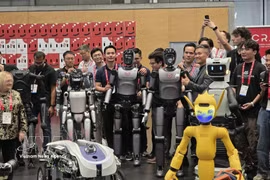
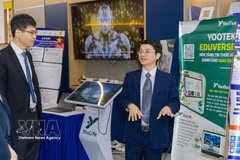
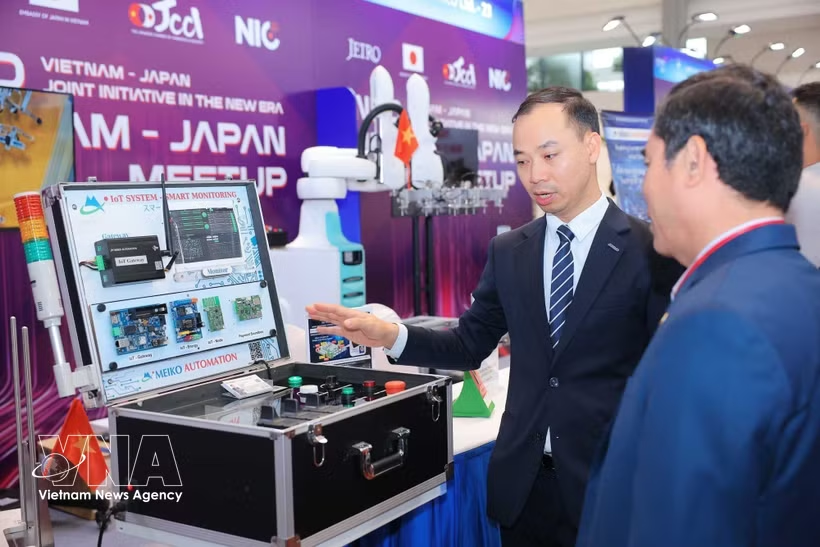
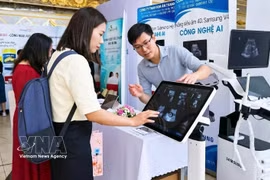
Science, technology and innovation products on display. (Photo: VNA)

Hanoi (VNA) – The National Innovation Day 2026 was held in Hanoi on October 4, with Deputy Prime Minister Ho Quoc Dung calling for businesses to be placed at the heart of the national innovation process.

Addressing the event, held by the Ministry of Science and Technology in coordination with the Hanoi People’s Committee, Deputy PM Dung said Politburo Resolution No. 57-NQ/TW identifies science and technology, innovation and national digital transformation as a top breakthrough and a key driver for developing modern productive forces, reforming production relations and renewing national governance.

Against this backdrop, innovation must not be viewed merely as an area requiring support, but as a driving force to be activated across the economy and society, he said.

According to the Deputy PM, innovation should raise productivity, improve the efficiency of capital and resource use, and create new products, services, industries and markets. For businesses, it should promote technological adoption and renewal, improve quality, cut costs, expand markets and enable deeper participation in value chains. For people, innovation should translate into better jobs, higher incomes, better products and services, and improved quality of life.

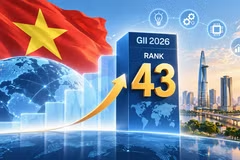
Vietnam has made notable progress in innovation capacity in recent years. The country ranked 43rd among 139 economies in the 2026 Global Innovation Index, up one place from 2025. Its innovation ecosystem now includes more than 4,000 innovative startups, organisations and individuals, around 208 venture capital funds and over 1,400 support organisations. Some 34.6% of businesses engage in innovation activities, while 20 science and technology exchanges are currently operating.
vnanet_potal-national-innovation-day-2.jpg
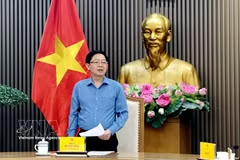
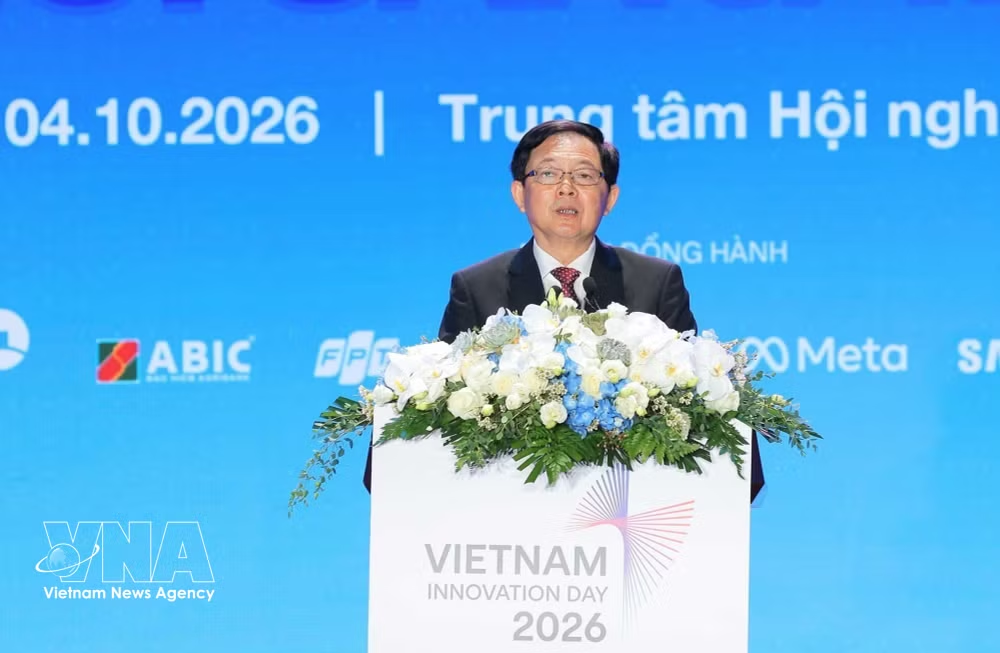
Deputy Prime Minister Ho Quoc Dung addresses Vietnam Innovation Day 2026. (Photo: VNA)

However, Deputy PM Dung noted that these achievements remain below the country’s development requirements and competitiveness goals. The proportion of domestic enterprises engaged in technological innovation remains very low. Many businesses remain concentrated in processing and assembly with low added value, while their capacity to master core technologies remains limited. The science and technology market and technology exchanges also need further development.

At the July 30 meeting of the Central Steering Committee on science and technology, innovation and digital transformation, General Secretary of the Communist Party of Vietnam Central Committee and President To Lam called on every ministry, sector and locality to become an innovation hub in its respective field.

Deputy PM Dung said this requires ministries and sectors to promote innovation in their respective areas, localities to use innovation to address development challenges, businesses to regard innovation as key to improving productivity and competitiveness, and research institutes and universities to bring knowledge and technology closer to practical needs, particularly those of businesses.

He stressed that Vietnam’s policy framework for science, technology and innovation has made important progress, providing a legal foundation for innovation, technology transfer and the commercialisation of research results. The focus now must shift from simply having innovation activities to delivering tangible innovation outcomes and gradually building a stronger national innovation ecosystem.

“Businesses must be placed at the centre of this process,” he said, noting that enterprises understand market demand, formulate practical requirements, invest resources, adopt and master technologies, organise production and bring products to consumers.

He called for stronger support for technological innovation in businesses and the development of the science and technology market, creating closer links between business demand and technology, expertise, finance, intellectual property, intermediaries and markets.

Innovation hubs should serve as connectors linking businesses, research institutes, universities, experts and investors, while focusing on practical strengths and needs, he said. Research institutes and universities should improve research quality, promote technology transfer and commercialisation, foster innovative startups and train high-quality human resources.

International cooperation in innovation should directly contribute to strengthening domestic technological capacity and enhancing Vietnam’s position in global innovation networks, the Deputy PM added.

At the event, delegates launched the National Innovation Day 2026, calling for greater joint efforts, connectivity and action to spread the spirit of innovation from State agencies to businesses, research institutes, universities and the wider community./.
VNA

See more

The Vietnamese Ministry of Public Security's delegation holds a discussion with representatives of the WIPO's Advisory Committee on Enforcement. (Photo: VNA)

WIPO innovation report viewed through Resolution 57 perspective

He said the GII 2026 results should be viewed in the broader context of Vietnam’s implementation of Resolution No. 57-NQ/TW, which identifies science and technology, innovation and national digital transformation as key breakthroughs and major drivers for developing modern productive forces and enhancing economic competitiveness.

Minister of Science and Technology Vu Hai Quan (left) meets with Japanese Minister of Internal Affairs and Communications Fujii Hisayuki (Photo: VNA)

Vietnam, Japan expand cooperation in strategic technology fields

Meeting with Japanese Minister of Education, Culture, Sports, Science and Technology Seki Yoshihiro on October 2, Minister of Science and Technology Vu Hai Quan proposed the Japanese side continue providing postgraduate scholarships, particularly at master's and doctoral levels in strategic technological sectors, facilitate exchanges among students and researchers, and maintain support for the Vietnam Japan University (VJU).

Minister of Science and Technology Vu Hai Quan (second, right) witnesses Director of the Posts and Telecommunications Institute of Technology Dang Hoai Bac presenting the Vietnamese-learning app to representatives of the Vietnamese Embassy in the Republic of Korea. (Photo: VNA)

Vietnamese-learning app presented to community in RoK

The initiative aims to support language learning among children growing up in more than 100,000 Vietnamese-Korean multicultural families, while helping preserve Vietnamese cultural identity and strengthen their ties with their homeland.

Prof. Dr. Nguyen Ngoc Diep (R), Director of the Australia-Vietnam Strategic Technologies Centre, introduces strategic technology products to delegates at the forum. (Photo: VNA)

Strategic technologies expand space for Vietnam - Australia cooperation

Vietnamese Deputy Minister of Science and Technology Tran Trung Tinh said that amid global uncertainties, strategic technologies are becoming a decisive driver of national competitiveness and sustainable development. Vietnam has identified science, technology, innovation and digital transformation as key strategic breakthroughs.

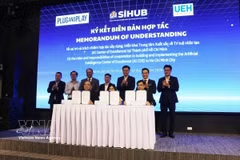
The signing ceremony of an MoU on the roles and responsibilities of cooperation in building and implementing the Artificial Intelligence Centre of Excellence (AI COE) in Ho Chi Minh City (Photo: VNA)

AI Centre of Excellence developed in Ho Chi Minh City

Under the MoU, the AI COE is envisioned as a platform bringing together the State, academia and businesses to promote research, incubation, startup acceleration and the practical application of AI in Ho Chi Minh City.

Vietnam accelerates innovation to boost growth, competitiveness

Vietnam accelerates innovation to boost growth, competitiveness

By 2030, Vietnam aims to rank among the world’s top 40 in the GII; raise total social investment in R&D to at least 2% of GDP, with non-State funding accounting for over 60%; increase international scientific publications by an average of 10% annually; and raise the number of patent applications and granted patents by an average of 16-18% annually.

Vietnamese Minister of Science and Technology Vu Hai Quan (right) and RoK Minister of Trade, Industry and Resources Kim Jung Kwan at their meeting on September 30 (Photo: vnexpress.net)

Vietnam seeks RoK help on nuclear power, AI

The Korean Ministry of Trade, Industry and Resources (MOTIR) was urged to share practical lessons from its nuclear sector with Vietnam, including institutional and policy frameworks governing the roles of policymaking and regulatory agencies, advanced nuclear power technology, experience in building a domestic nuclear supply chain, and long-term workforce training through specialised courses, hands-on work and staff exchanges.

Moving a jack-up rig to an offshore oil and gas drilling site (Photo: Petrovietnam)

Data, technology key to strengthening marine governance: experts

Key priorities include accelerating the use of AI, IoT, satellite data, autonomous vehicles and automated monitoring; developing a national marine data centre; investing in core technologies and high-quality human resources; and creating a market for marine technology products.

Da Nang city is actively attracting investment and talents (Photo: nhandan.vn)

Da Nang aims to become global city

Experts at the Da Nang Innovation Startup Festival (SURF) 2026 said that although Vietnam has a promising domestic market, international venture capital funds expect innovative startups seeking rapid growth to develop products to compete in international markets.

Digital technology applications in cultural and tourism in Ho Chi Minh City (Photo: VNA)

Ho Chi Minh City to develop specialised digital technology park

According to Su Ngoc Khuong, Senior Director of Investment at Savills Vietnam, infrastructure will become one of the key drivers shaping a new development cycle for the property market. Major transport projects are improving inter-regional connectivity and creating new growth poles along economic corridors.