Hanoi tops 2026 Provincial Innovation Index

Hanoi led in 18 of the 52 component indicators – the highest number among the 34 localities assessed.

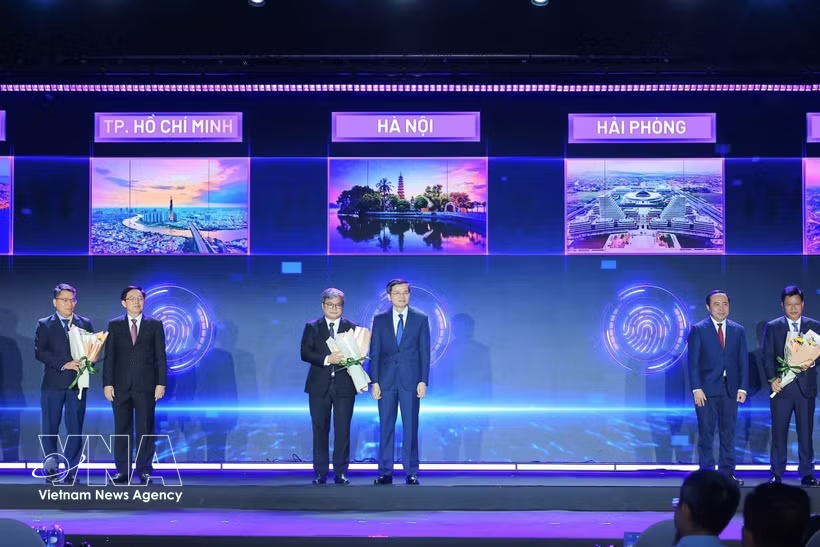
Hanoi tops the 2026 Provincial Innovation Index (PII) announced by he Ministry of Science and Technology at the 2026 National Innovation Day in Hanoi on October 4. (Photo: VNA)

Hanoi (VNA) – Hanoi topped the 2026 Provincial Innovation Index (PII), retaining the leading position for the fourth consecutive year, according to results announced by the Ministry of Science and Technology at the 2026 National Innovation Day in Hanoi on October 4.

The PII is designed to provide data and evidence to help localities formulate and implement measures to improve innovation performance.

The top 10 localities in the 2026 rankings are Hanoi, Ho Chi Minh City, Hai Phong, Quang Ninh, Bac Ninh, Hue, Da Nang, Thai Nguyen, Tay Ninh and Hung Yen. The list comprises seven centrally governed cities, six northern localities, two in the central region and two in the south.

Hanoi scored 63.80 points, while Cao Bang province ranked 34th with 21.22 points.

The 2026 results highlight differences among localities in both innovation inputs and outputs. Hanoi led in 18 of the 52 component indicators – the highest number among the 34 localities assessed. Its strengths included research and development (R&D) capacity, R&D spending, the number of science and technology organisations, and the proportion of businesses engaged in R&D and innovation activities.
vnanet_potal-hanoi-pii-2026-2.jpg
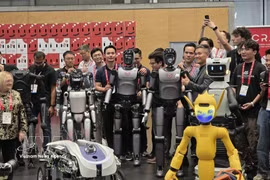
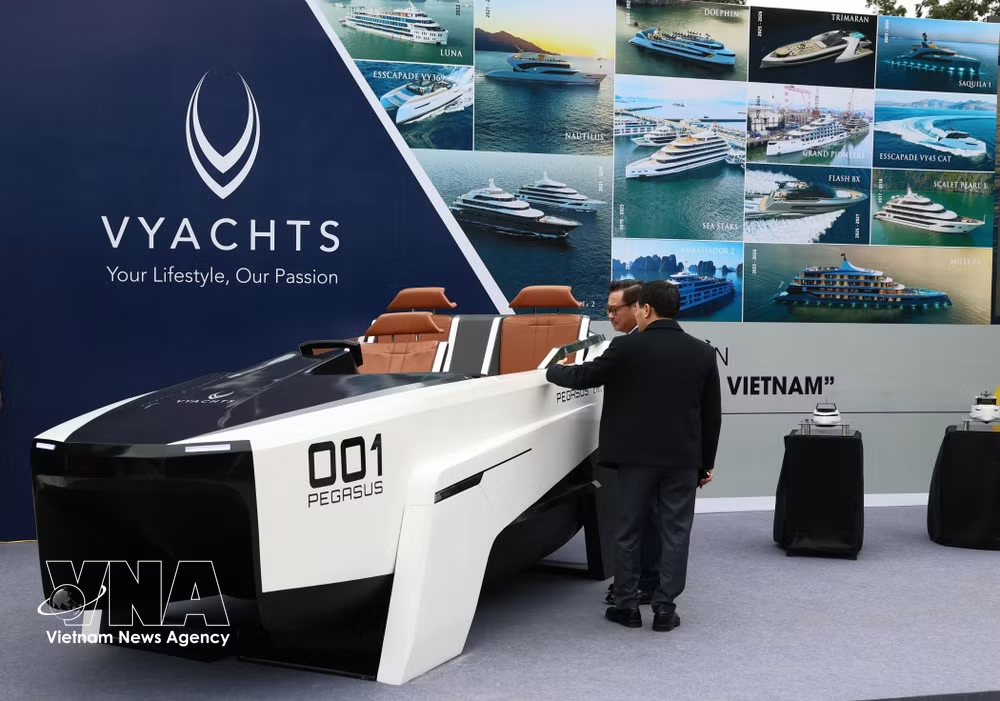
A part of Hanoi innovation network exhibition (Photo: VNA)

Hanoi also led in a number of innovation output indicators related to intellectual property such as patents, utility solutions, plant varieties, trademarks and industrial designs, as well as indicators related to poverty reduction and human development. The results reflect the capital’s strong capacity to create conditions for innovation and turn those resources into tangible outcomes.

Ho Chi Minh City ranked second, leading in 12 of the 52 indicators, with strengths in science and technology organisations, infrastructure, private-sector credit, microfinance, business density and corporate R&D and innovation activities. The city also shared the lead with Hanoi in several intellectual property indicators.

Quang Ninh ranked third, leading in five indicators, including digital infrastructure, private-sector credit, investment projects in industrial clusters, OCOP products and poverty reduction.

By pillar, Hanoi led in Human Capital and Research & Development and Market Development; Quang Ninh topped Infrastructure; Ho Chi Minh City ranked second in Infrastructure and Market Development; Bac Ninh led Business Development; and Hanoi topped Knowledge, Creative and Technology Outputs. Notably, the Impact pillar showed a different pattern, with Phu Tho, Bac Ninh and Ninh Binh ranking first, second and third, respectively.

The 2026 PII comprises 52 indicators grouped into seven pillars. Five input pillars cover Institutions; Human Capital and Research & Development; Infrastructure; Market Development; and Business Development. Two output pillars cover Knowledge, Creative and Technology Outputs and Impact.

Data for the index came from two main sources. Official statistics and government data accounted for 40 indicators, while the remaining 12 were collected and submitted by localities with supporting documentation.

According to the Ministry of Science and Technology, the index is intended to measure the role and contribution of science, technology and innovation to local socio-economic development. It also provides a basis for local authorities to identify strengths and weaknesses, assess innovation performance and formulate policies to promote development driven by science, technology and innovation./.

VNA

See more

The Vietnamese Ministry of Public Security's delegation holds a discussion with representatives of the WIPO's Advisory Committee on Enforcement. (Photo: VNA)

WIPO innovation report viewed through Resolution 57 perspective

He said the GII 2026 results should be viewed in the broader context of Vietnam’s implementation of Resolution No. 57-NQ/TW, which identifies science and technology, innovation and national digital transformation as key breakthroughs and major drivers for developing modern productive forces and enhancing economic competitiveness.

Minister of Science and Technology Vu Hai Quan (left) meets with Japanese Minister of Internal Affairs and Communications Fujii Hisayuki (Photo: VNA)

Vietnam, Japan expand cooperation in strategic technology fields

Meeting with Japanese Minister of Education, Culture, Sports, Science and Technology Seki Yoshihiro on October 2, Minister of Science and Technology Vu Hai Quan proposed the Japanese side continue providing postgraduate scholarships, particularly at master's and doctoral levels in strategic technological sectors, facilitate exchanges among students and researchers, and maintain support for the Vietnam Japan University (VJU).

Minister of Science and Technology Vu Hai Quan (second, right) witnesses Director of the Posts and Telecommunications Institute of Technology Dang Hoai Bac presenting the Vietnamese-learning app to representatives of the Vietnamese Embassy in the Republic of Korea. (Photo: VNA)

Vietnamese-learning app presented to community in RoK

The initiative aims to support language learning among children growing up in more than 100,000 Vietnamese-Korean multicultural families, while helping preserve Vietnamese cultural identity and strengthen their ties with their homeland.

Prof. Dr. Nguyen Ngoc Diep (R), Director of the Australia-Vietnam Strategic Technologies Centre, introduces strategic technology products to delegates at the forum. (Photo: VNA)

Strategic technologies expand space for Vietnam - Australia cooperation

Vietnamese Deputy Minister of Science and Technology Tran Trung Tinh said that amid global uncertainties, strategic technologies are becoming a decisive driver of national competitiveness and sustainable development. Vietnam has identified science, technology, innovation and digital transformation as key strategic breakthroughs.

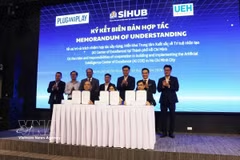
The signing ceremony of an MoU on the roles and responsibilities of cooperation in building and implementing the Artificial Intelligence Centre of Excellence (AI COE) in Ho Chi Minh City (Photo: VNA)

AI Centre of Excellence developed in Ho Chi Minh City

Under the MoU, the AI COE is envisioned as a platform bringing together the State, academia and businesses to promote research, incubation, startup acceleration and the practical application of AI in Ho Chi Minh City.

Vietnamese Minister of Science and Technology Vu Hai Quan (right) and RoK Minister of Trade, Industry and Resources Kim Jung Kwan at their meeting on September 30 (Photo: vnexpress.net)

Vietnam seeks RoK help on nuclear power, AI

The Korean Ministry of Trade, Industry and Resources (MOTIR) was urged to share practical lessons from its nuclear sector with Vietnam, including institutional and policy frameworks governing the roles of policymaking and regulatory agencies, advanced nuclear power technology, experience in building a domestic nuclear supply chain, and long-term workforce training through specialised courses, hands-on work and staff exchanges.

Moving a jack-up rig to an offshore oil and gas drilling site (Photo: Petrovietnam)

Data, technology key to strengthening marine governance: experts

Key priorities include accelerating the use of AI, IoT, satellite data, autonomous vehicles and automated monitoring; developing a national marine data centre; investing in core technologies and high-quality human resources; and creating a market for marine technology products.

Da Nang city is actively attracting investment and talents (Photo: nhandan.vn)

Da Nang aims to become global city

Experts at the Da Nang Innovation Startup Festival (SURF) 2026 said that although Vietnam has a promising domestic market, international venture capital funds expect innovative startups seeking rapid growth to develop products to compete in international markets.

Digital technology applications in cultural and tourism in Ho Chi Minh City (Photo: VNA)

Ho Chi Minh City to develop specialised digital technology park

According to Su Ngoc Khuong, Senior Director of Investment at Savills Vietnam, infrastructure will become one of the key drivers shaping a new development cycle for the property market. Major transport projects are improving inter-regional connectivity and creating new growth poles along economic corridors.