Vietnam’s approach to innovation inspires countries worldwide: WIPO

Vietnam's approach to adopting the GII and coordinating with government agencies at both central and local levels is an invaluable lesson many other countries are studying and trying to replicate.

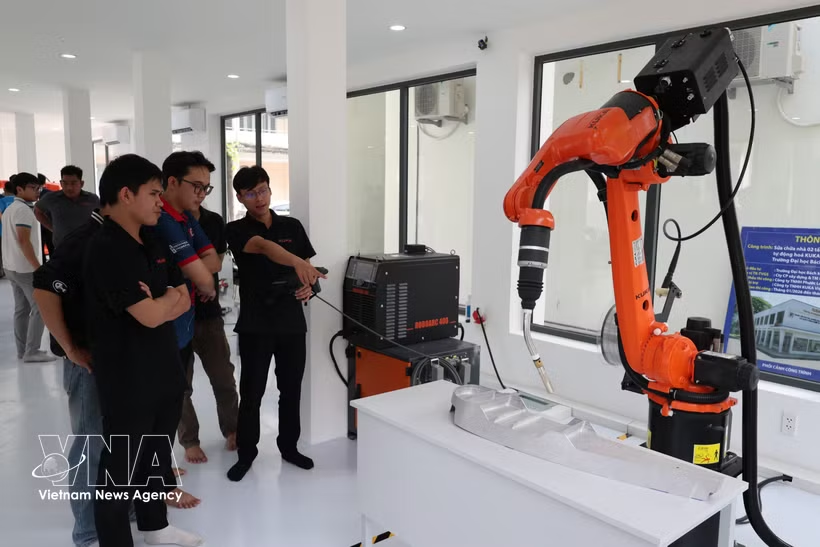
Testing industrial robots at the University of Science and Technology – University of Da Nang (Photo: VNA)

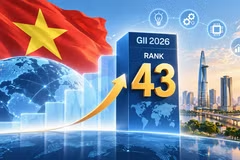
Geneva (VNA) – The World Intellectual Property Organisation (WIPO)'s Global Innovation Index (GII) 2026 report ranked Vietnam 43rd among 139 countries and economies, making it a leading example of how to turn the index into a practical tool for action.

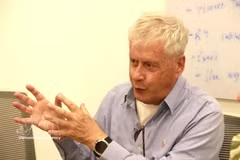
In an interview recently granted to Vietnam News Agency correspondents in Switzerland, Sacha Wunsch-Vincent, Head of Section, Economics and Statistics Division and co-editor of the GII report, gave insights into this year's theme: "Powering Entrepreneurs at the Frontier of Science: Turning Pilots into Pipelines".

According to him, the theme underscores the need to turn scientific breakthroughs into startups and technology commercialising firms. Doing so requires countries to combine three core elements.

The first is a strong research system, where universities and scientists patent inventions and found companies around them. The second is long-term financing: a sustainable funding chain, especially late-stage venture capital, that spans 10 to 15 years and supports projects from prototype to industrial-scale production. The third is dynamic businesses with a heavy focus on research and development (R&D) to bring products to market.

Wunsch-Vincent said the GII has evolved beyond a ranking into a policy diagnostic tool used by about 70% of WIPO member states, or nearly 100 countries.

Vietnam earned "full marks" on all three criteria for using the index effectively, he said. The first is in-depth research. Vietnam works closely with WIPO and analyses its strengths, weaknesses and long-term trends in detail.

The second is pooling resources nationwide. Vietnam set up a dedicated GII working group linking central and local authorities and adopted ambitious targets, notably lifting R&D spending to 2% of gross domestic product.

The third is systematic monitoring and promotion of innovation at the local level, shown by annual tracking of performance results. Vietnam's creation of its own Provincial Innovation Index (PII) has burnished the capacity of individual cities and provinces.

He said Vietnam's approach to adopting the GII and coordinating with government agencies at both central and local levels is an invaluable lesson many other countries are studying and trying to replicate. Vietnam has thereby contributed considerably to capacity building and sci-tech cooperation, and its PII has prompted many other WIPO members to adopt similar models.

Looking ahead, he praised the close cooperation between the two sides, which goes well beyond the GII report. WIPO will keep helping Vietnam make effective use of the IP system, including not only patents but also trademarks and industrial designs, to help local companies raise their value and move up in global supply chains, he said.

The two sides will also deepen cooperation in strategic areas, including accelerating technology transfer from research institutes and universities to companies and expanding IP-based financing, such as using patents as collateral, laying a foundation for faster growth in the years ahead, he added./.


VNA

See more

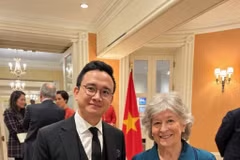
Associate Professor Dang Duc Huy (left) poses for a photo with Canadian Governor General Louise Arbour. (Photo: VNA)

Overseas Vietnamese intellectuals drive innovation

Overseas Vietnamese scientists do not have to return to Vietnam for long-term work to make an impact. They can contribute by joining collaborative research teams, sharing analytical techniques, facilitating access to modern equipment, and linking Vietnam with international labs and universities.

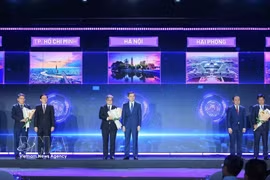
The Better Choice Awards 2026 Gala is a key activity in response to the National Innovation Day 2026 (Photo: qdnd.vn)

Better Choice Awards 2026 honours innovative Vietnamese businesses, tech products

The fourth edition of the awards featured a complete restructuring into four award tracks: Innovative Choice Awards, Smart Choice Awards, Car Choice Awards and the newly introduced Nation Builders Awards. The latter honours businesses contributing to national development by building infrastructure, energy systems and technological capacity for the national economy.

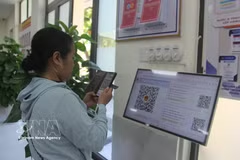
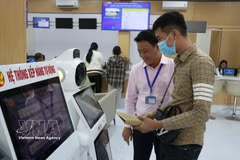
A resident scans a QR code to get a queue number at the public administrative service centre in Hoa Xuan ward, Da Nang city (Photo: VNA)

Localities apply AI, data to drive practical digital transformation

In the central province of Quang Tri, an AI-powered “People’s Assistant” is being piloted from October 1 to 31 at the provincial Public Administration Service Centre and the centres of this kind in Dong Thuan and Dong Ha wards. The system provides information on procedures, required documents, forms and fees, while also supporting declaration and preliminary checks.

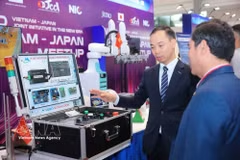
Science, technology and innovation products on display. (Photo: VNA)

Businesses must be at heart of innovation: Deputy PM

“Businesses must be placed at the centre of this process,” he said, noting that enterprises understand market demand, formulate practical requirements, invest resources, adopt and master technologies, organise production and bring products to consumers.

Minister of Science and Technology Vu Hai Quan (left) meets with Japanese Minister of Internal Affairs and Communications Fujii Hisayuki (Photo: VNA)

Vietnam, Japan expand cooperation in strategic technology fields

Meeting with Japanese Minister of Education, Culture, Sports, Science and Technology Seki Yoshihiro on October 2, Minister of Science and Technology Vu Hai Quan proposed the Japanese side continue providing postgraduate scholarships, particularly at master's and doctoral levels in strategic technological sectors, facilitate exchanges among students and researchers, and maintain support for the Vietnam Japan University (VJU).

Minister of Science and Technology Vu Hai Quan (second, right) witnesses Director of the Posts and Telecommunications Institute of Technology Dang Hoai Bac presenting the Vietnamese-learning app to representatives of the Vietnamese Embassy in the Republic of Korea. (Photo: VNA)

Vietnamese-learning app presented to community in RoK

The initiative aims to support language learning among children growing up in more than 100,000 Vietnamese-Korean multicultural families, while helping preserve Vietnamese cultural identity and strengthen their ties with their homeland.

Prof. Dr. Nguyen Ngoc Diep (R), Director of the Australia-Vietnam Strategic Technologies Centre, introduces strategic technology products to delegates at the forum. (Photo: VNA)

Strategic technologies expand space for Vietnam - Australia cooperation

Vietnamese Deputy Minister of Science and Technology Tran Trung Tinh said that amid global uncertainties, strategic technologies are becoming a decisive driver of national competitiveness and sustainable development. Vietnam has identified science, technology, innovation and digital transformation as key strategic breakthroughs.

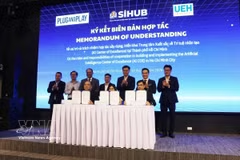
The signing ceremony of an MoU on the roles and responsibilities of cooperation in building and implementing the Artificial Intelligence Centre of Excellence (AI COE) in Ho Chi Minh City (Photo: VNA)

AI Centre of Excellence developed in Ho Chi Minh City

Under the MoU, the AI COE is envisioned as a platform bringing together the State, academia and businesses to promote research, incubation, startup acceleration and the practical application of AI in Ho Chi Minh City.

Vietnam accelerates innovation to boost growth, competitiveness

Vietnam accelerates innovation to boost growth, competitiveness

By 2030, Vietnam aims to rank among the world’s top 40 in the GII; raise total social investment in R&D to at least 2% of GDP, with non-State funding accounting for over 60%; increase international scientific publications by an average of 10% annually; and raise the number of patent applications and granted patents by an average of 16-18% annually.

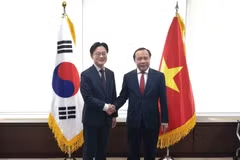
Vietnamese Minister of Science and Technology Vu Hai Quan (right) and RoK Minister of Trade, Industry and Resources Kim Jung Kwan at their meeting on September 30 (Photo: vnexpress.net)

Vietnam seeks RoK help on nuclear power, AI

The Korean Ministry of Trade, Industry and Resources (MOTIR) was urged to share practical lessons from its nuclear sector with Vietnam, including institutional and policy frameworks governing the roles of policymaking and regulatory agencies, advanced nuclear power technology, experience in building a domestic nuclear supply chain, and long-term workforce training through specialised courses, hands-on work and staff exchanges.

Moving a jack-up rig to an offshore oil and gas drilling site (Photo: Petrovietnam)

Data, technology key to strengthening marine governance: experts

Key priorities include accelerating the use of AI, IoT, satellite data, autonomous vehicles and automated monitoring; developing a national marine data centre; investing in core technologies and high-quality human resources; and creating a market for marine technology products.

Da Nang city is actively attracting investment and talents (Photo: nhandan.vn)

Da Nang aims to become global city

Experts at the Da Nang Innovation Startup Festival (SURF) 2026 said that although Vietnam has a promising domestic market, international venture capital funds expect innovative startups seeking rapid growth to develop products to compete in international markets.