Cashless payments open gateway to financial inclusion

Cashless payments continued to grow rapidly in the first eight months of 2026. The number and value of cashless transactions rose 34.56% and 13.26% year-on-year, respectively, while online transactions increased 46.57% in number and 21.77% in value.

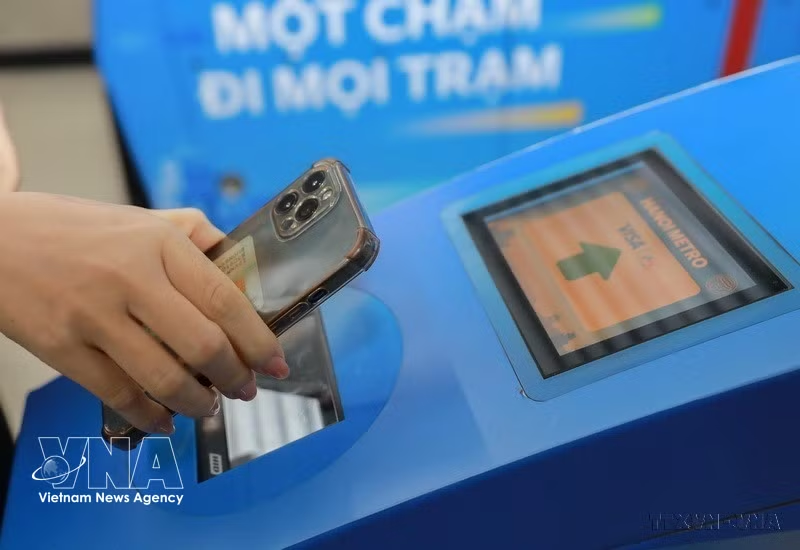
The automatic ticketing system that uses electronic identification, authentication, biometric recognition and cashless payment for passengers on the Cat Linh-Ha Dong railway line in Hanoi. (Photo: VNA)

Hanoi (VNA) – Cashless payments are shifting from a convenient way of making transactions to a gateway that enables people and businesses to gain broader access to the financial system, heard at a workshop on promoting financial inclusion through cashless payments held in Hanoi on October 6.

Speaking at the event, Acting Editor-in-Chief of Thoi bao Ngan hang (Banking Times) Nguyen Xuan Hai said cashless payments are becoming increasingly common in commerce, services, healthcare, education, public services and production and business activities. The development of payment infrastructure and digital payment methods not only makes transactions more convenient but also expands access to formal financial services, he said.

Cashless payments are a key pillar of the National Financial Inclusion Strategy for 2026-2030, as they serves as a “bridge” enabling people and businesses to gain deeper access to the financial ecosystem, from payment accounts to savings, credit, insurance, and other suitable financial products, he noted.

Nguyen Thi Thu, Deputy Director of the Payment Department under the State Bank of Vietnam (SBV), said digital transformation is changing how people and businesses access banking and financial services.

Digital payments are increasingly becoming the first point of entry for people to familiarise themselves with and gradually make greater use of other financial services, she said.

According to her, cashless payments can be viewed from four aspects: opening the gateway to financial services, removing geographical and cost barriers, generating financial data, and improving transparency and security.

As users become familiar with basic transactions, they can gradually access services such as savings, investment and insurance without relying heavily on physical transaction points.

Cashless payments continued to grow rapidly in the first eight months of 2026. The number and value of cashless transactions rose 34.56% and 13.26% year-on-year, respectively, while online transactions increased 46.57% in number and 21.77% in value.

Mobile payments rose 35.33% in number and 23.9% in value. Notably, QR payments at payment-accepting units increased 6.66% in number and 25.85% in value.

Account coverage has also expanded significantly. By the end of 2025, 88.96% of adults had payment accounts, while the total value of cashless payments was equivalent to about 28 times GDP. The figures are approaching the 2030 targets of 95% of people aged 15 and above having transaction accounts and cashless payment value reaching 30 times GDP.

However, Thu said the next phase should shift the focus from quantity to quality, with access accompanied by convenience, transparency, reasonable costs and regular use.

Nguyen Thanh Tung, Deputy General Director of the National Payment Corporation of Vietnam (NAPAS), said financial inclusion can begin with everyday needs such as transferring money, paying for goods and services, electricity and water bills, tuition, medical fees and public services.

When such transactions can be carried out conveniently online, people gradually develop the habit of using accounts and formal financial services.

“The success of financial inclusion is not measured only by the number of accounts opened, but more importantly by whether they are used conveniently, regularly and meaningfully in daily life,” Tung said.

According to him, shared payment infrastructure plays an important role in this process as it helps connect people, banks, businesses and service providers, while also reducing the cost of individual connections and making it easier to expand services to rural areas, remote regions and underserved customer groups.

NAPAS currently connects 70 member institutions and processed about 12 billion transactions in 2025, serving 100 million customers through a network of more than 20,000 ATMs and over 930,000 POS/mPOS terminals, he said./.

VNA

See more

MICE visitors enjoy services at Song Be Golf Resort in Ho Chi Minh City. (Photo: VNA)

Ho Chi Minh City shifts MICE tourism from venues to experiences

Ho Chi Minh City boasts significant advantages for MICE tourism, with the central area offering strengths in finance, trade and services; Binh Duong in industry, exhibitions and business connectivity; and Ba Ria-Vung Tau and Con Dao in marine tourism, resorts, ecology and distinctive experiences.

National Brand products are on display at the Vietnam National Brand International Forum. (Photo: VNA)

Vietnam's national brand value jumps 45% to over 462 bln USD

Deputy Minister of Industry and Trade Luong Hoang Thai outlined Vietnam's National Brand Programme 's achievements, the role of business community and plans for brand development in a press interview ahead of the 10th Vietnam National Brand Product recognition ceremony on October 16.

Khanh Hoa province possesses significant advantages for renewable energy projects and new energy sectors. (Photo: VNA)

New value chains from two industrial – renewable energy centres

To implement the revised Power Development Plan VIII, the Ministry of Industry and Trade has proposed establishing two inter-regional renewable energy industrial and service centres in the northern and southern regions to develop the renewable energy sector and a complete value chain.

WB Senior Environmental Specialist and Task Team Leader Stephen Ling speaks at the working session (Photo; VNA)

Ca Mau, WB cooperate in sustainable fisheries development

Scheduled to run from 2026 to 2029, the project aims to develop the local fisheries sector and deepen global integration, while adapting to climate change and protecting the environment through infrastructure upgrades, technological innovation, and better management and production capacity.

Vice President of the Vietnamese National Assembly Nguyen Hong Dien speaks at the forum. (Photo: Vietnam Trade Promotion Agency)

Tanzanian businesses seek greater cooperation, investment opportunities with Vietnam

Attending the forum during his working visit to Tanzania, Vice President of the National Assembly Nguyen Hong Dien said the two economies were highly complementary. Tanzania has strengths in natural resources, agriculture, energy, its domestic market and its strategic position in East Africa, while Vietnam has advantages in manufacturing and processing, high-tech agriculture, electronics, telecommunications and international trade.

Ho Chi Minh City attracts more than 17.8 billion USD in FDI in the first nine months of 2026 (Illustrative image. Photo: VNA)

Ho Chi Minh City offers new destinations for FDI flows

The merger of Ho Chi Minh City with Binh Duong and Ba Ria-Vung Tau has opened up a larger development space, enabling the city to reshape its approach to attracting foreign investment. In particular, Resolution No. 10-NQ/TW of the Politburo sets out clear orientations for developing the foreign-invested economic sector, providing a basis for shifting the focus from the amount of investment capital to the quality of investment.

Vietnam exports about 1.4 million tonnes of coffee worth 6.54 billion USD in the first nine months of 2026. (Photo: VNA)

Vietnam seeks to boost value, expand markets for coffee sector

Acording to VICOFA, Vietnam needs to focus on exporting green coffee beans that meet EUDR criteria, particularly as compliance levels among some other producing countries remain low. At the same time, it should develop specialty and organic coffee lines as well as deeply processed products to serve the premium segment in Europe.