Low-altitude economy could grow to 500 million USD by 2035

Vietnam's low-altitude economy is forecast to grow by around 13% annually, potentially reaching 500 million USD by 2035.

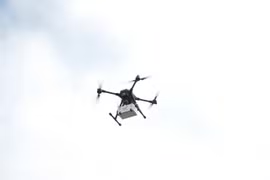
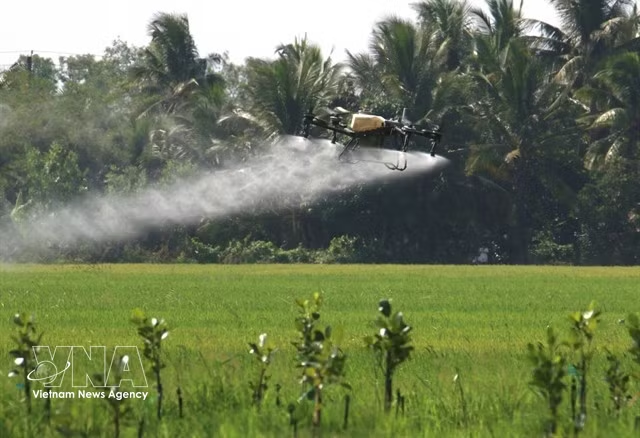
A drone used to apply fertiliser to rice fields in Can Tho city (Photo: VNA)

Hanoi (VNS/VNA) – Vietnam is seeking to develop a broader low-altitude economy ecosystem, moving beyond drone manufacturing to applications, data services and supporting infrastructure, as unmanned aerial vehicles (UAVs) create new opportunities in agriculture, logistics, energy, transport and other sectors.

Nguyen Van Thuat, deputy director of the Department of Economy and Digital Society under the Ministry of Science and Technology, spoke at a forum on developing the low-altitude economy and promoting space technology applications in Vietnam on October 2.

The low-altitude economy was based on an ecosystem of aircraft operating from the ground to altitudes of around 1,000–3,000 metres, depending on how individual countries define it. China, for example, sets the upper limit at 3,000 metres.

According to MarketsandMarkets, the global UAV market could reach approximately 40 billion USD by 2030. However, this represents only part of the potential market. Including services in agriculture, logistics and traditional industries, the global low-altitude economy could be worth around 488 billion USD by 2035, Thuat said.

China is among the fastest-growing markets. In 2025, it had more than three million registered UAVs and approximately 45 million flights. Its ecosystem spans UAV design, manufacturing, maintenance, physical infrastructure, charging stations, frequency infrastructure, low-altitude airspace management systems and flight services. This has also enabled the emergence of companies operating large drone fleets to provide services.

Vietnam, by comparison, remains at an early stage of development. The country's low-altitude economy is forecast to grow by around 13% annually, potentially reaching 500 million USD by 2035.

Thuat said Vietnam's strategy should focus not only on producing equipment, but also on developing the wider ecosystem and participating more deeply in the low-altitude economy's value chain.

"UAVs themselves do not directly create value. Value lies in the flights, the data collected and the ability to exploit that data to solve real-world problems," he said.

UAV applications could span agriculture, electricity and energy, transport, dike management and healthcare. However, developing these applications would require more than technological capabilities.

Vietnam currently lacks a dedicated regulatory framework for the development of the low-altitude economy, according to Thuat. While institutional and regulatory development is important, he stressed that the country should not wait until the entire legal framework is completed before allowing the sector to develop.

Instead, businesses would need controlled environments and mechanisms to test technologies and gradually bring new models into practical use.

Standards and radio frequency allocation would also require attention. Under Decision 1493, Vietnam has identified 10 strategic technology groups, with implementation divided into the 2026–2030 and 2031–2035 periods and an emphasis on mastering strategic technologies and products.

Thuat also highlighted the need for coordinated workforce development, from school students and university students to doctoral researchers, engineers and specialists.

Outstanding students are eligible for support of 1 billion VND annually for three years to support study, research, international publications and academic exchanges. For professionals, the objective is to train and attract talent with international competitiveness and skills aligned with market and technology needs.

Bui The Duy, alternate member of the Party Central Committee and president of Vietnam National University Hanoi (VNU), said the low-altitude economy would integrate advanced UAV technologies with applications in logistics, agriculture and smart transport, creating new opportunities to bring emerging technologies into everyday life.

VNU had developed training and research activities in UAV design and manufacturing, and was working to establish UAV pilot training centres for agriculture, search and rescue, transport and logistics.

At its Hoa Lac campus, the university was also working with logistics and automation groups to establish research centres and laboratories focused on research, training and the localisation of low-altitude economy technologies.

Duy cited practical applications already emerging in Vietnam, including UAV delivery of essential medical supplies and pilot zones in several localities and industries. In rural areas, adoption advanced rapidly, particularly in agriculture.

Many durian orchards in the Central Highlands now use UAVs, with workers receiving pilot training and drones carrying out regular irrigation and spraying operations, according to Duy.

During recent storms and floods, UAVs were also used to search for and locate stranded people and deliver food and essential supplies./.

VNA
See more

WB Senior Environmental Specialist and Task Team Leader Stephen Ling speaks at the working session (Photo; VNA)

Ca Mau, WB cooperate in sustainable fisheries development

Scheduled to run from 2026 to 2029, the project aims to develop the local fisheries sector and deepen global integration, while adapting to climate change and protecting the environment through infrastructure upgrades, technological innovation, and better management and production capacity.

Vice President of the Vietnamese National Assembly Nguyen Hong Dien speaks at the forum. (Photo: Vietnam Trade Promotion Agency)

Tanzanian businesses seek greater cooperation, investment opportunities with Vietnam

Attending the forum during his working visit to Tanzania, Vice President of the National Assembly Nguyen Hong Dien said the two economies were highly complementary. Tanzania has strengths in natural resources, agriculture, energy, its domestic market and its strategic position in East Africa, while Vietnam has advantages in manufacturing and processing, high-tech agriculture, electronics, telecommunications and international trade.

The automatic ticketing system that uses electronic identification, authentication, biometric recognition and cashless payment for passengers on the Cat Linh-Ha Dong railway line in Hanoi. (Photo: VNA)

Cashless payments open gateway to financial inclusion

Cashless payments continued to grow rapidly in the first eight months of 2026. The number and value of cashless transactions rose 34.56% and 13.26% year-on-year, respectively, while online transactions increased 46.57% in number and 21.77% in value.

Ho Chi Minh City attracts more than 17.8 billion USD in FDI in the first nine months of 2026 (Illustrative image. Photo: VNA)

Ho Chi Minh City offers new destinations for FDI flows

The merger of Ho Chi Minh City with Binh Duong and Ba Ria-Vung Tau has opened up a larger development space, enabling the city to reshape its approach to attracting foreign investment. In particular, Resolution No. 10-NQ/TW of the Politburo sets out clear orientations for developing the foreign-invested economic sector, providing a basis for shifting the focus from the amount of investment capital to the quality of investment.

Vietnam exports about 1.4 million tonnes of coffee worth 6.54 billion USD in the first nine months of 2026. (Photo: VNA)

Vietnam seeks to boost value, expand markets for coffee sector

Acording to VICOFA, Vietnam needs to focus on exporting green coffee beans that meet EUDR criteria, particularly as compliance levels among some other producing countries remain low. At the same time, it should develop specialty and organic coffee lines as well as deeply processed products to serve the premium segment in Europe.

Part of Khanh Hoa province in central Vietnam (Photo: VNA)

Malaysian economist upbeat about Vietnam’s growth outlook

Among ASEAN’s “Fabulous Five”, namely Vietnam, Malaysia, Indonesia, Thailand and the Philippines, Vietnam demonstrates how industrial depth and effective investment can underpin rapid growth, Shan Saeed said, noting strong investment momentum.

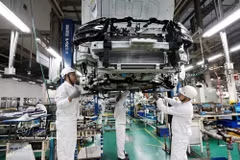
Automobile production at the Honda Vietnam factory in Vinh Phuc ward, Phu Tho (Photo: VNA)

Vietnam’s auto market accelerates amid growing electrification trend

According to data released by PwC in late September, total vehicle sales across the six ASEAN-6 markets, namely Vietnam, Indonesia, Thailand, Malaysia, the Philippines and Singapore, reached about 1.755 million units in the first half of 2026, up 11% year on year. Vietnam recorded the highest sales growth in the group at 31.1%, followed by Indonesia at 15.9% and Thailand at 15.1%.

The headquarters of the Vietnam International Financial Centre in Da Nang (Photo: VNA))

VIFC-DN gradually establishes position on global financial centre map

According to Dang Dinh Duc, Standing Vice Chairman of the VIFC-DN Executive Agency, the ranking marks an important milestone, reflecting the foundations that VIFC-DN and Da Nang authorities are gradually building to connect with international capital flows, institutions and markets.

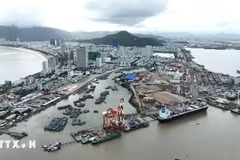
Quy Nhon Port, located in Quy Nhon Bay of Gia Lai province, offers highly favourable conditions for vessel anchoring and cargo handling throughout the year. (Photo: VNA)

Vietnam Logistics Forum 2026 to be held in early November

The Vietnam Logistics Forum 2026 will take place on November 6-7 in Gia Lai province, bringing together management agencies, local authorities, associations, experts and businesses to identify opportunities and challenges and discuss logistics development solutions suited to the new period.

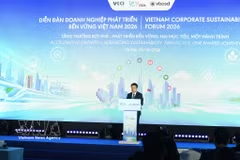
VCCI Chairman Ho Sy Hung speaks at the Vietnam Corporate Sustainability Forum (VCSF) 2026 in Hanoi on October 5, 2026. (Photo: VNA)

Vietnam’s corporate sustainability forum calls for new growth paradigm

Breakthrough growth and sustainable development should be pursued as a shared journey in which the State creates an enabling environment, localities support businesses, enterprises take the pioneering role, science and technology provide momentum, and society as a whole participates.