Vietnam’s auto market accelerates amid growing electrification trend

According to data released by PwC in late September, total vehicle sales across the six ASEAN-6 markets, namely Vietnam, Indonesia, Thailand, Malaysia, the Philippines and Singapore, reached about 1.755 million units in the first half of 2026, up 11% year on year. Vietnam recorded the highest sales growth in the group at 31.1%, followed by Indonesia at 15.9% and Thailand at 15.1%.

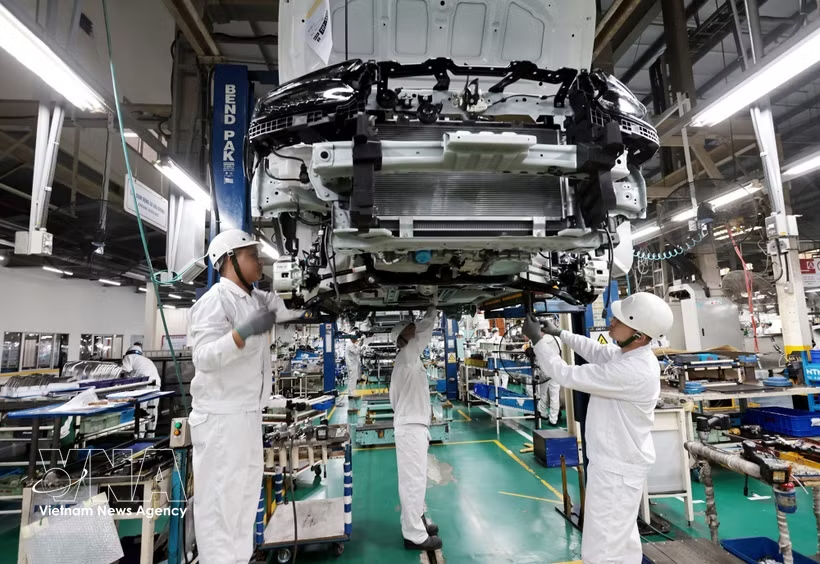
Automobile production at the Honda Vietnam factory in Vinh Phuc ward, Phu Tho (Photo: VNA)

Hanoi (VNA) — Vietnam’s automobile market is undergoing significant changes in both sales volume and product structure. Electrified vehicles have emerged as a notable growth driver, while a race in promotions and a wave of new model launches are expected to boost demand in the final months of the year.

Vietnam records highest sales growth among ASEAN-6

Once considered an emerging segment, electrified vehicles are increasingly becoming an important part of the automobile market.

According to data released by PwC in late September, total vehicle sales across the six ASEAN-6 markets, namely Vietnam, Indonesia, Thailand, Malaysia, the Philippines and Singapore, reached about 1.755 million units in the first half of 2026, up 11% year on year. Vietnam recorded the highest sales growth in the group at 31.1%, followed by Indonesia at 15.9% and Thailand at 15.1%.

With around 291,000 vehicles sold in the first six months of 2026, Vietnam ranked fourth among ASEAN-6 markets in terms of market size, after Indonesia, Thailand and Malaysia. The figures show that demand for automobiles in Vietnam continues to grow, while the product mix is rapidly shifting towards electrified vehicles.

According to the latest data from the Vietnam Automobile Manufacturers’ Association (VAMA), cumulative sales by its member companies have reached 246,935 units, up 12% year on year. However, a fuller picture of the market emerges when sales by Hyundai Thanh Cong, which contributed 31,540 units, are included. Notably, VinFast recorded a remarkable 71% increase in sales year on year, with cumulative sales reaching 154,073 units.

Assessing the results, Duong Thi Thu Trang, Deputy CEO of Global Sales at VinFast, said Vietnam is currently one of the world's fastest-growing electric vehicle markets, with EV market share continuing to expand. From September 2024 to August 2026, VinFast maintained its position as Vietnam's top-selling carmaker for 24 consecutive months, directly driving the share of electrified vehicles to a record high in the domestic automobile industry.

Combining sales figures from the three main groups, namely VAMA, VinFast and Hyundai Thanh Cong, total actual vehicle sales in Vietnam have surpassed 400,000 units, reaching 432,548 units of all types. This represents a 26.4% increase from the same period in 2025, reflecting the market's rapid recovery and expansion.

EVs, hybrids gain market share

A key feature of Vietnam's automobile market in 2026 is the rapid adoption of electrified vehicles. According to PwC, electrified vehicles (xEVs) accounted for around 44% of total passenger vehicle sales in Vietnam in the first half of 2026.

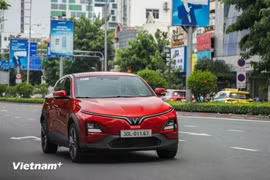
Battery electric vehicles (BEVs) continue to play an important role in this group. Models positioned at accessible price points and targeting urban, family and commercial-use needs have made significant contributions. In the first eight months, VF 3 sales reached 35,798 units, VF 5 sales 27,948 units and Limo Green sales 34,991 units.

The growth of EVs comes as Vietnam's electrified vehicle market has expanded significantly in recent years. According to PwC, xEV penetration in Vietnam reached 36% in 2025, up from 22% in 2024. xEV sales reached around 189,000 units in 2025, up 95%.

Data for the first half of 2026 show that Vietnam sold more than 127,000 electric and hybrid passenger vehicles. This indicates that electrification is no longer limited to early adopters but is spreading across a broader range of segments and user needs.

Alongside pure EVs, hybrid vehicles have emerged as a transitional option. In the first eight months of 2026, hybrid sales by VAMA members reached 13,889 units, up 65% year on year. The increase shows growing consumer interest in fuel efficiency and lower operating costs while maintaining less reliance on charging infrastructure.

Changes in powertrain technology have been accompanied by a growing preference for higher-riding vehicles. SUVs, crossovers and MPVs remain popular thanks to their flexible space and practicality. Meanwhile, the emergence of urban EVs and electric MPVs is broadening choices for both individual customers and commercial operators.

The 2026 market is therefore changing not only in terms of sales volume but also in product structure. Petrol-powered vehicles, hybrids and pure EVs are coexisting, creating more diverse competition over prices, technology and ownership costs.

In the final months of the year, experts held that competition in the automobile market is expected to remain intense as manufacturers and dealers step up demand-stimulation programmes while preparing to launch new products./.


VNA

See more

The headquarters of the Vietnam International Financial Centre in Da Nang (Photo: VNA))

VIFC-DN gradually establishes position on global financial centre map

According to Dang Dinh Duc, Standing Vice Chairman of the VIFC-DN Executive Agency, the ranking marks an important milestone, reflecting the foundations that VIFC-DN and Da Nang authorities are gradually building to connect with international capital flows, institutions and markets.

Quy Nhon Port, located in Quy Nhon Bay of Gia Lai province, offers highly favourable conditions for vessel anchoring and cargo handling throughout the year. (Photo: VNA)

Vietnam Logistics Forum 2026 to be held in early November

The Vietnam Logistics Forum 2026 will take place on November 6-7 in Gia Lai province, bringing together management agencies, local authorities, associations, experts and businesses to identify opportunities and challenges and discuss logistics development solutions suited to the new period.

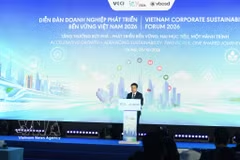
VCCI Chairman Ho Sy Hung speaks at the Vietnam Corporate Sustainability Forum (VCSF) 2026 in Hanoi on October 5, 2026. (Photo: VNA)

Vietnam’s corporate sustainability forum calls for new growth paradigm

Breakthrough growth and sustainable development should be pursued as a shared journey in which the State creates an enabling environment, localities support businesses, enterprises take the pioneering role, science and technology provide momentum, and society as a whole participates.

Khanh Hoa province is rolling out infrastructure projects for the Van Phong Economic Zone. (Photo: VNA)

Khanh Hoa targets green, smart marine economy

The province aims for average annual GRDP growth of 11-12% during 2026-2030, with the digital economy accounting for 35% of GRDP and total factor productivity contributing more than 55% to growth. Labour productivity is expected to rise by an average of 11% annually.

Comb honey produced using Le Loc Quan’s interlocking-frame technique is well regarded for its quality and popular in the Korean market (Photo: VNA)

Scientific initiatives add value to Vietnamese farm produce

In 2026, the Vietnam Farmers’ Union (VFU) Central Committee honoured 42 “Scientists for Farmers” and presented 24 “Farmers’ technical innovation” awards for initiatives developed from practical production needs. The recognised works demonstrate the growing role of science and technology in improving production efficiency, increasing the value of farm produce and helping farmers access new markets.

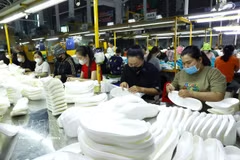
Shoe sole production at Kepai Co., Ltd. (a Japanese-invested enterprise) in Tan Kim Industrial Park (Tay Ninh) (Photo: VNA)

Tay Ninh expands industrial space to attract investment

To date, Tay Ninh has 3,234 domestic investment projects with total registered capital of nearly 800 trillion VND and 2,152 FDI projects with total registered capital exceeding 27 billion USD, ranking seventh nationwide in FDI attraction.

The Thu Thiem peninsula, an area positioned as the core of Vietnam's international financial centre. (Photo: VNA)

Vietnam revises scheme to improve sovereign credit rating by 2030

Under the decision, Vietnam aims to become a developing country with modern industry and upper-middle income by 2030, while building a competitive and effective governance system and a dynamic economy driven by science, technology, innovation and digital transformation.

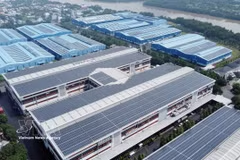
Rooftop solar power system at Kizuna JV Joint Stock Company in Tan Kim Industrial Park (Can Giuoc commune, Tay Ninh). (Photo: VNA)

Rooftop solar power development falls short of target: deputy minister

Deputy Minister of Industry and Trade Truong Thanh Hoai noted that rooftop solar power has several advantages, including short construction time, limited land requirements and reduced transmission losses. The Government has therefore promoted its development amid rapidly rising electricity demand, projected to increase by around 10% annually.

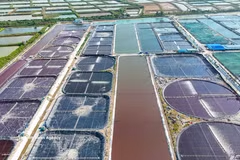
Intensive shrimp farming zone of Vietnam Clean Seafood JS Company. (Photo: VNA)

Agriculture, forestry, fishery sector continues to underpin economy

The performance reflected relatively broad-based growth, with fisheries, livestock farming and perennial crops emerging as key drivers. These areas helped the sector continue to underpin the economy, safeguard food security and contribute to exports, Dau Ngoc Hung, head of the NSO’s agriculture, forestry and fishery statistics division, said at a press conference in Hanoi on October 3.

Shoppers at the Vietnamese goods section of Co.opmart Ly Thuong Kiet supermarket in Ho Chi Minh City. (Photo: VNA)

Vietnam’s CPI rises 4.52% in first nine months of 2026

Speaking at a press conference in Hanoi on October 3, NSO Director Nguyen Thi Huong said the CPI in September rose 0.62% from the previous month, mainly due to higher domestic fuel prices following global energy price movements and tuition fee increases at some universities and private schools for the new academic year.

DEEP C Hai Phong Industrial Park is envisioned as a model of an eco-industrial park and sustainable development in Vietnam. (Photo published by VNA)

Hai Phong works to expand cooperation space, anticipate green investment

In line with the Politburo's Resolution No. 10-NQ/TW on boosting the foreign-invested economic sector, the northern port city of Hai Phong is stepping up economic, trade, and investment connections with Chinese partners, creating new growth opportunities and enhancing foreign direct investment (FDI).