Hai Phong (VNA) – In line with the Politburo's Resolution No. 10-NQ/TW on boosting the foreign-invested economic sector, the northern port city of Hai Phong is stepping up economic, trade, and investment connections with Chinese partners, creating new growth opportunities and enhancing foreign direct investment (FDI).
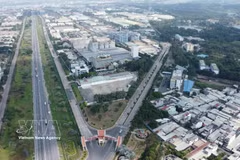
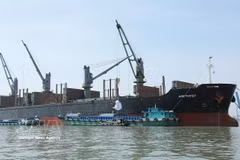
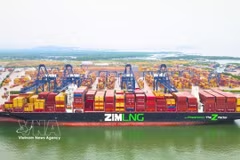
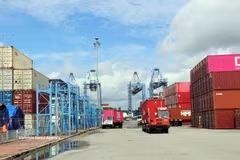
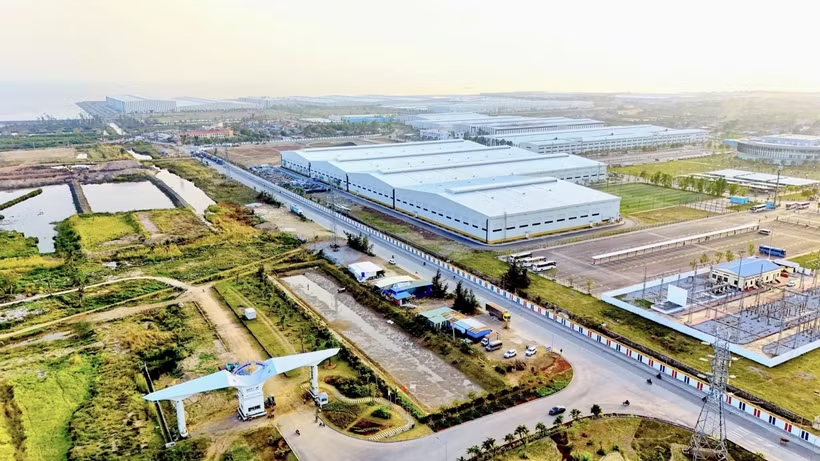
With its expanded administrative boundaries and development space, Hai Phong is consolidating its role as a major maritime gateway connecting northern Vietnam with regional and international markets. Its integrated transport infrastructure, including the deep-water Lach Huyen international seaport, Cat Bi International Airport, expressways, railways and inland waterways, is important for attracting FDI.
The city recorded strong external economic performance in the first eight months of 2026. Exports reached 42.2 billion USD, while imports stood at 31.1 billion USD, up 18.56% year-on-year. FDI attraction reached 3.47 billion USD, 1.8 times higher than the same period last year.
Chinese investors have made a significant contribution, with 823 FDI projects worth 13.26 billion USD. Manufacturing accounts for 72.73% of the projects and 76.63% of registered investment capital, followed by thermal power, infrastructure, real estate, logistics, trade and services, and agro-processing.
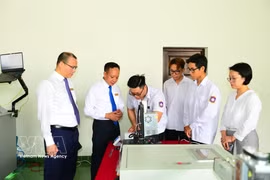
Huang Jen Chieh, General Director of Pegatron Vietnam, said the company currently employs about 9,000 workers, including more than 8,400 Vietnamese, and expects its 2026 revenue to rise 19.59% year-on-year. He attributed the company’s stable production and expansion plans to the close support of Hai Phong authorities and relevant agencies.
During a recent visit to the city, Shu Zhongjun, Secretary-General of the ASEAN-China Centre (ACC), said Hai Phong is emerging as an attractive destination for Chinese investors. Chinese businesses are interested in cooperation in port infrastructure, manufacturing, the digital economy and green energy, he said, adding that the ACC is ready to serve as a bridge between Hai Phong and the Chinese business community.
From “connection” to “co-creation”
Cooperation between Hai Phong and Chinese localities is also expanding beyond economic ties. The city maintains friendship and cooperation with major Chinese localities, including Tianjin, Nanning, Ningbo, Shenzhen, Foshan, Yunnan and the Guangxi Zhuang Autonomous Region.
The 20-year partnership between Hai Phong and Nanning has developed in education, culture, tourism, healthcare and trade, with regular high-level exchanges and a charter flight route between the two localities launched in early 2025.
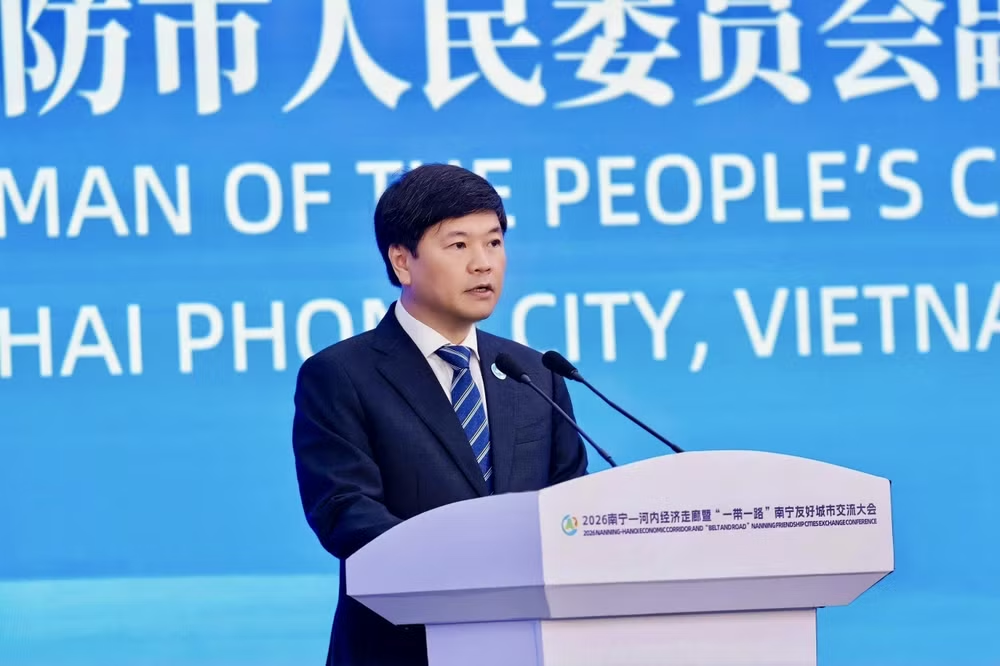
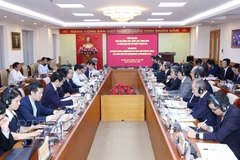
At the Nanning-Hanoi Economic Corridor and Belt and Road Nanning Friendship Cities Conference held in Nanning on September 18, Vice Chairman of the Hai Phong People’s Committee Hoang Minh Cuong said the city aims to shift from “connection” to “co-creation”, focusing on more efficient supply chains, new technologies, human resources and people-to-people exchanges.
Hai Phong and Nanning are working to promote cooperation in artificial intelligence, semiconductors, biotechnology and renewable energy.
Cuong said Hai Phong’s seaport system, including the Lach Huyen international gateway port, together with its expressway, aviation, railway and logistics networks, gives the city favourable conditions to participate more deeply in regional supply chains.
The city is ready to work with Nanning and other localities to improve transport links between Guangxi and Hai Phong, promote road, rail and maritime connectivity, and encourage logistics and import-export businesses to establish more stable and efficient transport chains.
By better connecting infrastructure and logistics services, the partners can gradually build a more efficient multimodal transport network, helping reduce logistics time and costs and improve regional competitiveness.
The implementation of Resolution No. 10-NQ/TW is creating new momentum for Hai Phong’s economic development, while its position along the Nanning-Lang Son-Hanoi-Hai Phong-Quang Ninh economic corridor and its two decades of friendship with Chinese partners are strengthening the port city’s role as a strategic destination for regional supply chains./.