Agriculture, forestry, fishery sector continues to underpin economy

The performance reflected relatively broad-based growth, with fisheries, livestock farming and perennial crops emerging as key drivers. These areas helped the sector continue to underpin the economy, safeguard food security and contribute to exports, Dau Ngoc Hung, head of the NSO’s agriculture, forestry and fishery statistics division, said at a press conference in Hanoi on October 3.

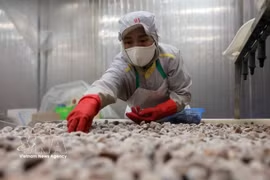
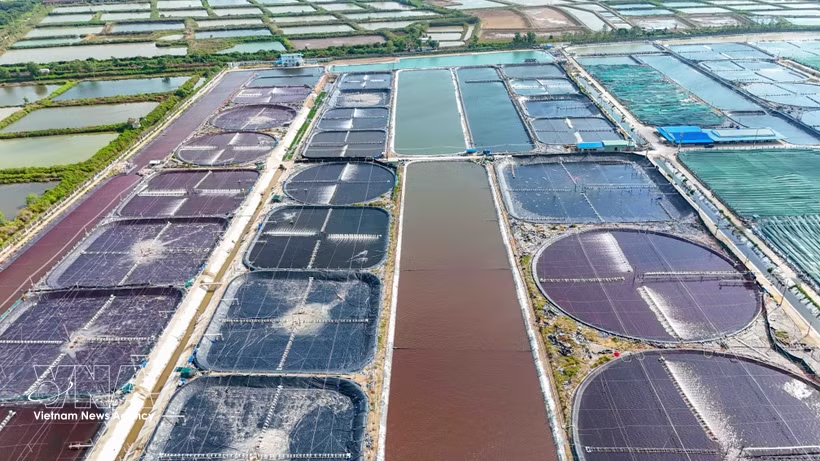
Intensive shrimp farming zone of Vietnam Clean Seafood JS Company. (Photo: VNA)

Hanoi (VNA) - The agriculture, forestry and fishery sector continued to post positive results in the third quarter and the first nine months of 2026, maintaining its role as a key pillar of the economy, according to the National Statistics Office (NSO) under the Ministry of Finance.

The sector grew an estimated 4.21% year-on-year in the third quarter, significantly higher than the 3.6% recorded in the third quarter of 2024 and 3.71% in the third of 2025, Dau Ngoc Hung, head of the NSO’s agriculture, forestry and fishery statistics division, said at a press conference in Hanoi on October 3 to release socio-economic statistics for the third quarter and the first nine months of 2026.

In the first nine months, the sector expanded 4.02%, the highest nine-month growth rate since 2019, he added.

The performance reflected relatively broad-based growth, with fisheries, livestock farming and perennial crops emerging as key drivers. These areas helped the sector continue to underpin the economy, safeguard food security and contribute to exports, Hung said.

Fisheries recorded strong growth, with output value estimated to rise 5.19% in the third quarter and 4.99% in the nine-month period. The result was driven mainly by robust aquaculture, increased use of high technology and the expansion of intensive, super-intensive and marine farming models.

In the first nine months, brackish-water shrimp production reached 940,800 tonnes, up 8.3%, while tilapia and marine farming increased 10.2% and 10.4%, respectively. Fisheries accounted for about 28% of the sector’s overall nine-month growth.
vnanet_potal-agriculture-forestry-fishery-2.jpg
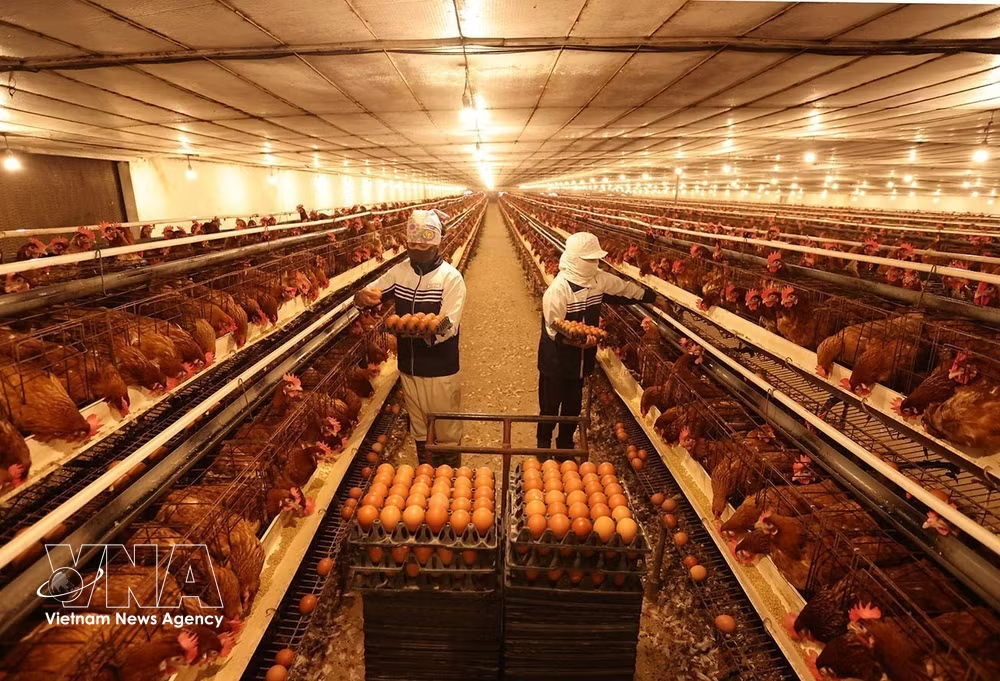
A commercial egg farm in Can Thuong village, Kieu Phu commune, Hanoi, supplies around 13,000 food-safe eggs to the market each day. (Photo: VNA)

Livestock production also maintained solid momentum as pig and poultry herds expanded in scale and output, supported by a shift towards farm-based, concentrated production, value-chain linkages and enhanced biosecurity. Livestock output value rose an estimated 5.13% in the third quarter and 4.92% in the first nine months, contributing more than 25% to the sector’s overall growth.

Perennial crops also performed well, with fruit output benefiting from expanded cultivation of high-value crops, improved productivity and quality, and the development of production-area codes to facilitate domestic sales and exports.

Output value from perennial crops grew an estimated 4.49% in third quarter and 4.91% in the nine-month period, accounting for around 21% of the sector’s overall growth.

Annual crops and forestry, meanwhile, remained a stable foundation for the sector. Although rice cultivation area declined, higher yields and output helped ensure food security and meet domestic and export demand. Increased timber production also helped secure raw materials for the processing and export industries
vnanet_potal-agriculture-forestry-fishery-3.jpg
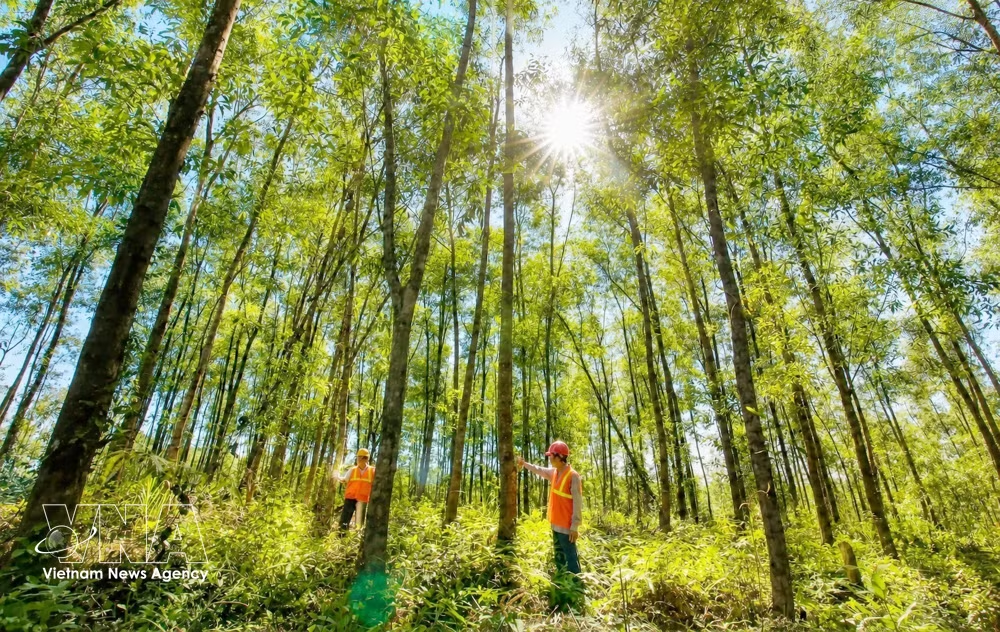
Quang Tri aims to expand its certified forest area to 80,000ha by 2030, positioning the province as a major hub for plantation timber supply and processing in central Vietnam. (Photo: VNA)

Exports remained an important growth driver, with the value of agricultural, forestry and fishery exports reaching 39.1 billion USD in the first nine months, up 3.7% year-on-year. A recovery in domestic consumer demand also provided additional support for production.

However, the sector continues to face challenges, including lower prices for some agricultural products, high input costs for animal feed, seeds, fertilisers and crop protection products, and persistent disease risks. Extreme weather, storms, drought and saltwater intrusion could also affect production in the final months of the year.

Besides, rising requirements in export markets for quality, food safety and traceability are placing additional pressure on producers and businesses.

Therefore, the NSO recommended that localities maintain stable production, strengthen disease control, reduce input costs, develop certified raw-material areas, expand value-chain linkages and improve processing quality. They should also closely monitor market developments and support domestic sales and exports to sustain the sector’s positive growth momentum, it said./.
VNA

See more

The Thu Thiem peninsula, an area positioned as the core of Vietnam's international financial centre. (Photo: VNA)

Vietnam revises scheme to improve sovereign credit rating by 2030

Under the decision, Vietnam aims to become a developing country with modern industry and upper-middle income by 2030, while building a competitive and effective governance system and a dynamic economy driven by science, technology, innovation and digital transformation.

Rooftop solar power system at Kizuna JV Joint Stock Company in Tan Kim Industrial Park (Can Giuoc commune, Tay Ninh). (Photo: VNA)

Rooftop solar power development falls short of target: deputy minister

Deputy Minister of Industry and Trade Truong Thanh Hoai noted that rooftop solar power has several advantages, including short construction time, limited land requirements and reduced transmission losses. The Government has therefore promoted its development amid rapidly rising electricity demand, projected to increase by around 10% annually.

Shoppers at the Vietnamese goods section of Co.opmart Ly Thuong Kiet supermarket in Ho Chi Minh City. (Photo: VNA)

Vietnam’s CPI rises 4.52% in first nine months of 2026

Speaking at a press conference in Hanoi on October 3, NSO Director Nguyen Thi Huong said the CPI in September rose 0.62% from the previous month, mainly due to higher domestic fuel prices following global energy price movements and tuition fee increases at some universities and private schools for the new academic year.

DEEP C Hai Phong Industrial Park is envisioned as a model of an eco-industrial park and sustainable development in Vietnam. (Photo published by VNA)

Hai Phong works to expand cooperation space, anticipate green investment

In line with the Politburo's Resolution No. 10-NQ/TW on boosting the foreign-invested economic sector, the northern port city of Hai Phong is stepping up economic, trade, and investment connections with Chinese partners, creating new growth opportunities and enhancing foreign direct investment (FDI).

The Yaris Cross SUV led Toyota Vietnam’s sales in September 2026, with 1,799 units sold, including 413 hybrid vehicles. (Photo: VNA)

Toyota sales surge 45% in Vietnam, hybrids sales double

Toyota Vietnam sold 7,114 vehicles in September, up 45% month-on-month, while hybrid sales doubled year-on-year in the first nine months of 2026, showing growing demand for hybrid vehicles as Vietnam’s auto market moves towards greater fuel efficiency and lower emissions.

A view of Bien Hoa 2 Industrial Park in Dong Nai city. (Photo: VNA)

Vietnam sees 149,700 new businesses in nine months

Vietnam recorded nearly 149,700 newly established enterprises in the first nine months of 2026, up 3.2% year-on-year, with total registered capital rising 32.7% to over 1.88 quadrillion VND (71.6 billion USD).

A new urban project is under construction in Nam Nha Trang ward, Khanh Hoa province. (Photo: VNA)

Vietnam posts GDP growth of 9.95% in Q3

In the first nine months, Vietnam's GDP was estimated to increase 9.01% from the same period last year. Agriculture, forestry and fisheries grew 4.02%, contributing 5.35% to overall gross value added growth; industry and construction rose 11.21%, contributing 49.62%; and services expanded 8.69%, contributing 45.03%.

Customers transact at the headquarters of Bao Viet Securities Company in Hanoi. (Photo: VNA)

Deputy Minister highlights measures to improve quality of Vietnam's stock market

The Ministry of Finance will expand the supply of capital and diversifying market products. It has submitted to the Government regulations on initial public offerings (IPOs) linked to listing, making it easier for businesses to list shares, while encouraging large companies with sound corporate governance to list on the stock market.

An automated robot operates on the production line at CAYI Technology Vietnam Co., Ltd. in Yen Phong II-C Industrial Park, Bac Ninh city. (Photo:VNA)

FDI disbursement hits five-year high in nine months

Vietnam attracted 50.36 billion USD in registered foreign direct investment (FDI) in the first nine months of 2026, up 76.4% year-on-year, while disbursed FDI reached 21.07 billion USD, the highest nine-month level in five years.

Transporting and loading commercial rice for export by the Southern Food Corporation. (Photo: VNA)

Vietnam posts trade surplus after nine months of deficit

Vietnam's total export and import turnover reached 117.69 billion USD in September, up 7.3% from the previous month and 42.4% year-on-year. Notably, the goods trade balance returned to a surplus of 1.27 billion USD after nine consecutive months of deficit.

Prime Minister Le Minh Hung concludes the Government’s regular September meeting and the Government’s online conference with localities. (Photo: VNA)

Prime Minister requests stronger efforts to tap growth potential

Prime Minister Le Minh Hung on October 3 called on ministries, sectors and localities to more effectively tap available growth potential, remove bottlenecks and maximise growth drivers in the final months of 2026, with the aim of achieving the year’s socio-economic development targets and creating momentum for 2027.

The groundbreaking ceremony for the Lien Ha Thai Industrial Park Project – South Zone (Green iP-3). (Photo: VNA)

Hung Yen expands industrial space to attract new investment

Local industrial parks and clusters will focus on attracting investment in light industry, multi-sector industries and environmentally friendly projects, as well as safe industrial products and services, cybersecurity products and services, and big data and cloud computing products and services, including AI applications based on national big data.