Hanoi’s development spending surges 2.8-fold in nine months

Hanoi's total local budget spending in the nine months stood at 72.3% of the annual estimate. Development investment reached 111.69 trillion VND, or 88.6% of the target and 2.8 times the level of the same period in 2025.

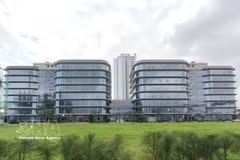
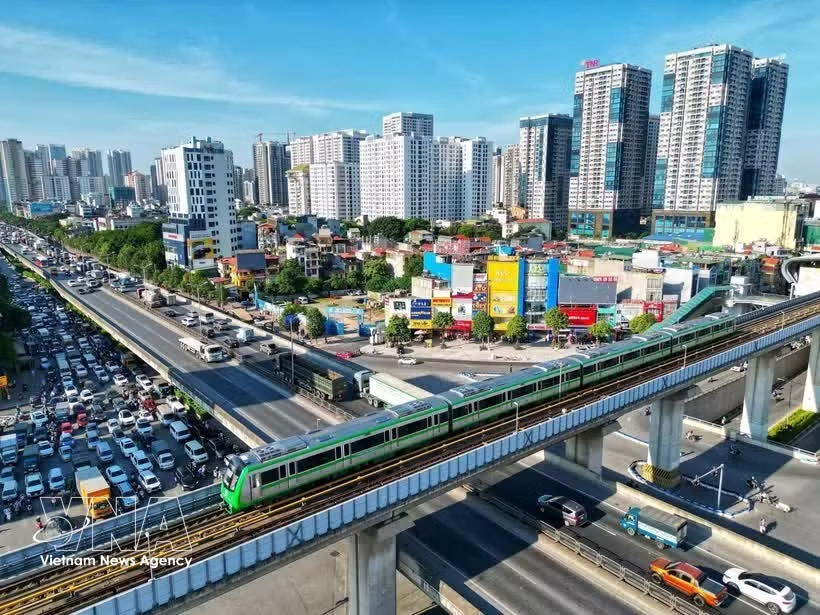
A corner of Hanoi (Photo: VNA)

Hanoi (VNA) – Hanoi's total state budget revenue in the first nine months of 2026 was estimated at nearly 567.6 trillion VND (21.8 billion USD), or 87.3% of the full-year target and up 5.9% from a year earlier.

Local budget expenditure was estimated at 170.760 trillion VND, up 86.8%, with development spending rising 2.8-fold year-on-year.

Domestic revenue remained the largest contributor to the city's total, at an estimated 528.66 trillion VND, or 86.7% of the annual target and up 4.6% year-on-year, according to a report on Hanoi's socio-economic performance in the third quarter and first nine months released by the Hanoi Statistics Office.

Export-import revenue reached over 33.82 trillion VND, or 92.4% of the target and up 26.7%, while crude oil revenue was about 2.5 trillion VND, or 71.4% of the target and up 18.8%.

Among domestic sources, revenue from the non-state industrial, commercial and service sector totaled 133.99 trillion VND, 94.1% of the annual target and up 29.9%. Foreign-invested enterprises contributed nearly 34.35 trillion VND, or 81.4% of the target and up 33.9%. State-owned enterprises generated 63.38 trillion VND, or 75.9% of the target and up 1.1%.

Some revenue streams already topped their full-year targets. Land-use fees totaled 85.04 trillion VND, 2.6% above the annual estimate and up 2.1% year-on-year. Dividends and after-tax profits hit 105.96 trillion VND, 5.2% above the target, even as they fell 13.7% from a year earlier.

Strong gains in some areas were offset by declines elsewhere. Personal income tax revenue was 44.46 trillion VND, 64% of the annual target and down 8%. Registration fees totaled 5.82 trillion VND, or 57.1% of the target and down 3.2%, while land and water surface lease revenue was 11.93 trillion VND, or 79.5% of the target and down 5.5%. Fees and charges brought in 24.52 trillion VND, or 81.7% of the target and up 24.9%.

Total local budget spending in the nine months stood at 72.3% of the annual estimate. Development investment reached 111.69 trillion VND, or 88.6% of the target and 2.8 times the level of the same period in 2025. Regular expenditure was 58.95 trillion VND, or 73.4% of the target and up 13.3%.

Within regular expenditure, spending on education, training and vocational education totaled 20.42 trillion VND, or 74.1% of the target and up 15.1%. Social security spending hit 8.34 trillion VND, or 78.7% of the target and up 57.7%, while spending on health, population and family affairs was 3.46 trillion VND, or 79.7% of the target and up 23%.

For the rest of the year, Hanoi plans to rely on public investment as a direct driver of economic growth. The city will review remaining capital allocation plans and pinpoint projects able to disburse funds and generate construction output in the fourth quarter, with priority to transport projects, urban railways, bridges, technical infrastructure and drainage systems.

The city will also work to clear obstacles to key projects, including site clearance, resettlement, relocation of technical infrastructure, construction materials and procedures./.​

VNA

See more

Part of Khanh Hoa province in central Vietnam (Photo: VNA)

Malaysian economist upbeat about Vietnam’s growth outlook

Among ASEAN’s “Fabulous Five”, namely Vietnam, Malaysia, Indonesia, Thailand and the Philippines, Vietnam demonstrates how industrial depth and effective investment can underpin rapid growth, Shan Saeed said, noting strong investment momentum.

Automobile production at the Honda Vietnam factory in Vinh Phuc ward, Phu Tho (Photo: VNA)

Vietnam’s auto market accelerates amid growing electrification trend

According to data released by PwC in late September, total vehicle sales across the six ASEAN-6 markets, namely Vietnam, Indonesia, Thailand, Malaysia, the Philippines and Singapore, reached about 1.755 million units in the first half of 2026, up 11% year on year. Vietnam recorded the highest sales growth in the group at 31.1%, followed by Indonesia at 15.9% and Thailand at 15.1%.

The headquarters of the Vietnam International Financial Centre in Da Nang (Photo: VNA))

VIFC-DN gradually establishes position on global financial centre map

According to Dang Dinh Duc, Standing Vice Chairman of the VIFC-DN Executive Agency, the ranking marks an important milestone, reflecting the foundations that VIFC-DN and Da Nang authorities are gradually building to connect with international capital flows, institutions and markets.

Quy Nhon Port, located in Quy Nhon Bay of Gia Lai province, offers highly favourable conditions for vessel anchoring and cargo handling throughout the year. (Photo: VNA)

Vietnam Logistics Forum 2026 to be held in early November

The Vietnam Logistics Forum 2026 will take place on November 6-7 in Gia Lai province, bringing together management agencies, local authorities, associations, experts and businesses to identify opportunities and challenges and discuss logistics development solutions suited to the new period.

VCCI Chairman Ho Sy Hung speaks at the Vietnam Corporate Sustainability Forum (VCSF) 2026 in Hanoi on October 5, 2026. (Photo: VNA)

Vietnam’s corporate sustainability forum calls for new growth paradigm

Breakthrough growth and sustainable development should be pursued as a shared journey in which the State creates an enabling environment, localities support businesses, enterprises take the pioneering role, science and technology provide momentum, and society as a whole participates.

Khanh Hoa province is rolling out infrastructure projects for the Van Phong Economic Zone. (Photo: VNA)

Khanh Hoa targets green, smart marine economy

The province aims for average annual GRDP growth of 11-12% during 2026-2030, with the digital economy accounting for 35% of GRDP and total factor productivity contributing more than 55% to growth. Labour productivity is expected to rise by an average of 11% annually.

Comb honey produced using Le Loc Quan’s interlocking-frame technique is well regarded for its quality and popular in the Korean market (Photo: VNA)

Scientific initiatives add value to Vietnamese farm produce

In 2026, the Vietnam Farmers’ Union (VFU) Central Committee honoured 42 “Scientists for Farmers” and presented 24 “Farmers’ technical innovation” awards for initiatives developed from practical production needs. The recognised works demonstrate the growing role of science and technology in improving production efficiency, increasing the value of farm produce and helping farmers access new markets.

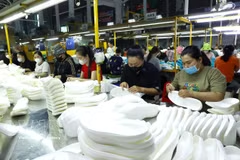
Shoe sole production at Kepai Co., Ltd. (a Japanese-invested enterprise) in Tan Kim Industrial Park (Tay Ninh) (Photo: VNA)

Tay Ninh expands industrial space to attract investment

To date, Tay Ninh has 3,234 domestic investment projects with total registered capital of nearly 800 trillion VND and 2,152 FDI projects with total registered capital exceeding 27 billion USD, ranking seventh nationwide in FDI attraction.

The Thu Thiem peninsula, an area positioned as the core of Vietnam's international financial centre. (Photo: VNA)

Vietnam revises scheme to improve sovereign credit rating by 2030

Under the decision, Vietnam aims to become a developing country with modern industry and upper-middle income by 2030, while building a competitive and effective governance system and a dynamic economy driven by science, technology, innovation and digital transformation.

Rooftop solar power system at Kizuna JV Joint Stock Company in Tan Kim Industrial Park (Can Giuoc commune, Tay Ninh). (Photo: VNA)

Rooftop solar power development falls short of target: deputy minister

Deputy Minister of Industry and Trade Truong Thanh Hoai noted that rooftop solar power has several advantages, including short construction time, limited land requirements and reduced transmission losses. The Government has therefore promoted its development amid rapidly rising electricity demand, projected to increase by around 10% annually.

Intensive shrimp farming zone of Vietnam Clean Seafood JS Company. (Photo: VNA)

Agriculture, forestry, fishery sector continues to underpin economy

The performance reflected relatively broad-based growth, with fisheries, livestock farming and perennial crops emerging as key drivers. These areas helped the sector continue to underpin the economy, safeguard food security and contribute to exports, Dau Ngoc Hung, head of the NSO’s agriculture, forestry and fishery statistics division, said at a press conference in Hanoi on October 3.

Shoppers at the Vietnamese goods section of Co.opmart Ly Thuong Kiet supermarket in Ho Chi Minh City. (Photo: VNA)

Vietnam’s CPI rises 4.52% in first nine months of 2026

Speaking at a press conference in Hanoi on October 3, NSO Director Nguyen Thi Huong said the CPI in September rose 0.62% from the previous month, mainly due to higher domestic fuel prices following global energy price movements and tuition fee increases at some universities and private schools for the new academic year.