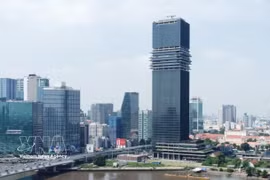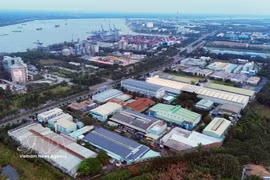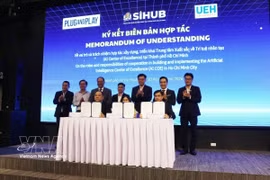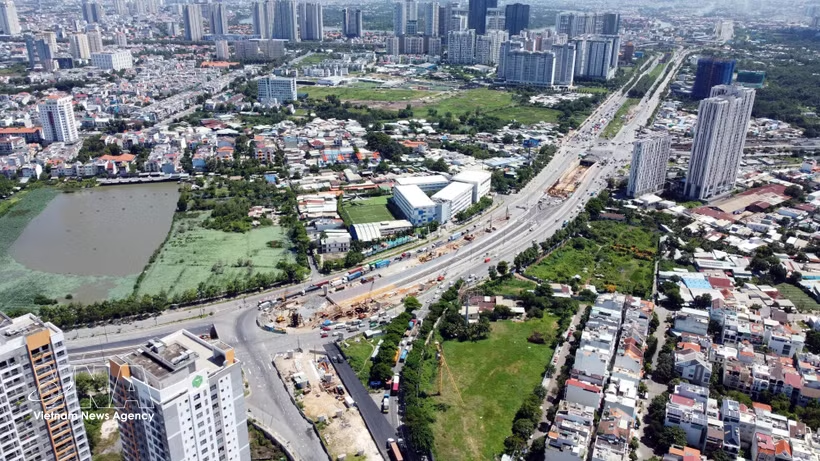
Ho Chi Minh City (VNA) – The merger of Ho Chi Minh City, Binh Duong province and Ba Ria-Vung Tau province has created a much larger development space, opening up opportunities to restructure the economy, strengthen regional connectivity and generate new growth drivers.
Beyond expanding markets, resources and production space, the integration of the three areas allows the city to leverage their complementary strengths in industry, services, logistics, energy and seaports.
MA Nguyen Thi Van from the Southern Institute of Social Sciences (SISS) said Ho Chi Minh City should be viewed not simply as an expanded urban area but as a multi-polar economic structure, with centres performing different functions within an interconnected production – services – logistics system.
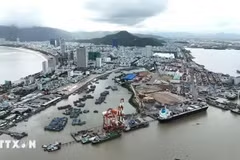
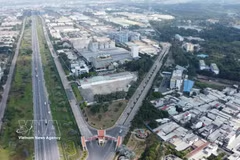
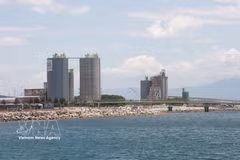
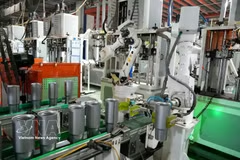
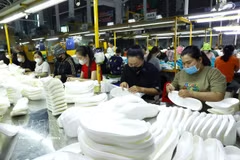
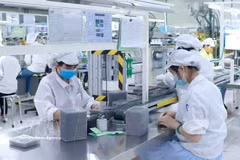
The former Ho Chi Minh City boasts strengths in finance, business services, science –d technology, and research and development (R&D); the former Binh Duong province is strong at processing, manufacturing and supporting industries; while the former Ba Ria-Vung Tau province has advantages in energy, chemicals, metallurgy, seaports and logistics.
Combining these strengths could help form a multi-polar economic structure in which different areas perform complementary functions and connect more closely with one another.
As a result, the city could develop value chains spanning research, innovation, finance and design through to manufacturing, logistics and exports, while connecting production centres with seaports and logistics services.
However, MA Pham Thi Dieu Linh of the Ho Chi Minh City College of Foreign Economic Relations cautioned that a larger economic space will not automatically translate into higher productivity or value added.
The key question, she said, is whether the merger can create a new economic structure with higher quality and efficiency rather than simply combining resources to expand the scale of the economy.
MA Nguyen Thi Phuong Yen from the Southern Institute of Social Sciences said the merger also marks a qualitative shift in the city's economic development orientation.
The southern metropolis is promoting digital and green transformation, the knowledge-based economy and innovation. In industry, the focus is shifting towards higher-value-added segments, restructuring key industries and reducing dependence on traditional labour-intensive sectors.
In services, greater attention is being paid to quality improvement and high-end services, creating room for finance, banking, insurance and other key sectors to expand and upgrade.
Connectivity key to new growth
The expanded space gives Ho Chi Minh City greater potential to connect R&D, manufacturing, energy, logistics and finance. However, these advantages can only be fully realised through stronger linkages among development areas.
Van said the city needs a unified planning and development strategy that clearly defines the functions of each development pole. Inter-regional infrastructure and logistics networks are essential to turn spatial advantages into value-chain advantages.
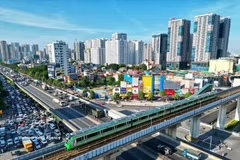
Priority should also be given to completing roads, expressways and ring roads linking production areas with the Cai Mep – Thi Vai port complex, alongside developing freight rail, inland waterway transport, dry ports and logistics centres.
Shorter transport times and lower logistics costs will strengthen connectivity among production capacities and help build a more integrated production – logistics network, she added.
The city should also shift from attracting FDI based mainly on quantity to focusing on quality and stronger linkages with domestic businesses. Priorities include developing domestic supplier networks, improving the technological and management capacity of local enterprises, and establishing databases on their supply capabilities.
For large-scale FDI projects, linkages with domestic enterprises and potential for technology transfer could be included among evaluation criteria.
The new economic structure will also require high-quality human resources in high-tech industries, logistics, finance, R&D and professional services. Training should therefore be aligned more closely with business needs and value chains, with stronger cooperation between educational institutions and enterprises.
Expanding development space is only the starting point, Van said, pointing out that the key challenge is to reorganise resources within a unified system through consistent planning, data, investment mechanisms and support policies.
By effectively linking capital, technology, production, energy, seaports and logistics, Ho Chi Minh City can turn its larger economic space into higher productivity and value added, strengthening its competitiveness and participation in regional and global value chains./.