China becomes Vietnam’s second-largest rice export market

China’s import value accounted for 17.4% of Vietnam’s total export volume over the eight-month period.

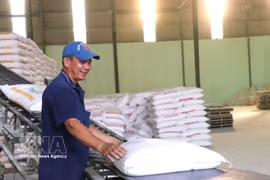
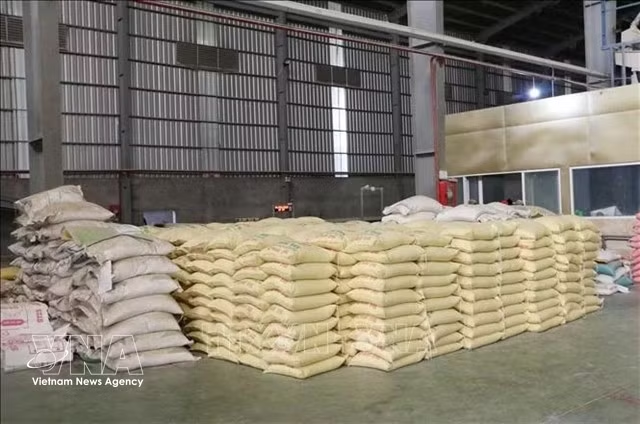
The Philippines remains the largest buyer of Vietnamese rice, accounting for a 40.9% market share. (Photo: VNA)

Hanoi (VNS/ VNA) – China has emerged as Vietnam’s second-largest rice export market after spending nearly 505 million USD to import over one million tonnes of Vietnamese rice in the first eight months of 2026, according to the Ministry of Agriculture and Environment.

During the same period last year, China imported just over 565,000 tonnes, valued at 286.7 million USD. With the surge, China rose from fourth place during the same period in 2025 to the second position, just behind the Philippines.

China’s import value accounted for 17.4% of Vietnam’s total export volume over the eight-month period.

The Ministry of Agriculture and Environment reported a sharp rise in demand for broken rice from China, primarily for use in animal feed production.

According to the ministry, during the first eight months of 2026, Vietnam's rice exports to Iraq also surged 98.9-fold compared to the same period last year. However, the export value to this market remains modest, totaling just under 14 million USD.

The Philippines remains the largest buyer of Vietnamese rice, accounting for a 40.9% market share.

In its assessment of supply, demand, trade, and prices for the 2026–2027 crop year, the ministry noted that the recovery of exports to Iraq indicates untapped potential for market diversification – an opportunity that should be exploited more proactively and sustainably during the final months of the year.

The ministry observed an increased concentration on the Philippine and Chinese markets, which account for over 64% of total exports, offers a short-term advantage, but also poses the risk of over-reliance on a few specific markets. Therefore, the ministry advocates for a gradual diversification of export destinations.

According to estimates by the Vietnam Food Association, after shipping 377,400 tonnes of rice in September, Vietnam is projected to export 400,000 tonnes in October, followed by approximately 220,000 tonnes in November and 268,300 tonnes in December.

Total rice exports for 2026 are forecast to reach nearly 7.74 million tonnes with a value of approximately 3.94 billion USD. This represents a 4% decline in value compared to 2025, driven by low average export prices during the early months of the year.

If the export volume reaches nearly 7.74 million tonnes, Vietnam is expected to retain its position as the world's second-largest rice exporter, trailing only India.

The outlook for rice export prices in the final months of the year is supported by several factors.

The global rice supply-demand balance for the 2026–2027 crop year is projected to shift into a deficit, while global rice trade could reach record levels.

The Philippines recently confirmed it would not impose an import ban in 2026 and would continue importing to boost reserves. This is welcome news, as Vietnam currently accounts for the majority of the country's total rice imports.

The Chinese market has seen a surge in import volumes, opening up significant opportunities for raw rice, broken rice, and glutinous rice.

In addition, certified high-quality, low-emission rice is fetching prices exceeding 1,000 USD per tonne in markets such as Japan, the EU, and Australia, underscoring the potential to enhance the value of Vietnamese rice.

Finally, global supply could also be affected by El Niño, monsoon conditions in India, and the planting area for the country’s Kharif rice crop./.
VNA

See more

Vietnam exports about 1.4 million tonnes of coffee worth 6.54 billion USD in the first nine months of 2026 (Photo: VNA)

Vietnam seeks to boost value, expand markets for coffee sector

Acording to VICOFA, Vietnam needs to focus on exporting green coffee beans that meet EUDR criteria, particularly as compliance levels among some other producing countries remain low. At the same time, it should develop specialty and organic coffee lines as well as deeply processed products to serve the premium segment in Europe.

Part of Khanh Hoa province in central Vietnam (Photo: VNA)

Malaysian economist upbeat about Vietnam’s growth outlook

Among ASEAN’s “Fabulous Five”, namely Vietnam, Malaysia, Indonesia, Thailand and the Philippines, Vietnam demonstrates how industrial depth and effective investment can underpin rapid growth, Shan Saeed said, noting strong investment momentum.

Automobile production at the Honda Vietnam factory in Vinh Phuc ward, Phu Tho (Photo: VNA)

Vietnam’s auto market accelerates amid growing electrification trend

According to data released by PwC in late September, total vehicle sales across the six ASEAN-6 markets, namely Vietnam, Indonesia, Thailand, Malaysia, the Philippines and Singapore, reached about 1.755 million units in the first half of 2026, up 11% year on year. Vietnam recorded the highest sales growth in the group at 31.1%, followed by Indonesia at 15.9% and Thailand at 15.1%.

The headquarters of the Vietnam International Financial Centre in Da Nang (Photo: VNA))

VIFC-DN gradually establishes position on global financial centre map

According to Dang Dinh Duc, Standing Vice Chairman of the VIFC-DN Executive Agency, the ranking marks an important milestone, reflecting the foundations that VIFC-DN and Da Nang authorities are gradually building to connect with international capital flows, institutions and markets.

Quy Nhon Port, located in Quy Nhon Bay of Gia Lai province, offers highly favourable conditions for vessel anchoring and cargo handling throughout the year. (Photo: VNA)

Vietnam Logistics Forum 2026 to be held in early November

The Vietnam Logistics Forum 2026 will take place on November 6-7 in Gia Lai province, bringing together management agencies, local authorities, associations, experts and businesses to identify opportunities and challenges and discuss logistics development solutions suited to the new period.

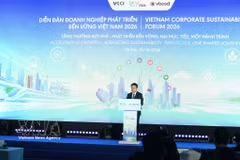
VCCI Chairman Ho Sy Hung speaks at the Vietnam Corporate Sustainability Forum (VCSF) 2026 in Hanoi on October 5, 2026. (Photo: VNA)

Vietnam’s corporate sustainability forum calls for new growth paradigm

Breakthrough growth and sustainable development should be pursued as a shared journey in which the State creates an enabling environment, localities support businesses, enterprises take the pioneering role, science and technology provide momentum, and society as a whole participates.

Khanh Hoa province is rolling out infrastructure projects for the Van Phong Economic Zone. (Photo: VNA)

Khanh Hoa targets green, smart marine economy

The province aims for average annual GRDP growth of 11-12% during 2026-2030, with the digital economy accounting for 35% of GRDP and total factor productivity contributing more than 55% to growth. Labour productivity is expected to rise by an average of 11% annually.

Comb honey produced using Le Loc Quan’s interlocking-frame technique is well regarded for its quality and popular in the Korean market (Photo: VNA)

Scientific initiatives add value to Vietnamese farm produce

In 2026, the Vietnam Farmers’ Union (VFU) Central Committee honoured 42 “Scientists for Farmers” and presented 24 “Farmers’ technical innovation” awards for initiatives developed from practical production needs. The recognised works demonstrate the growing role of science and technology in improving production efficiency, increasing the value of farm produce and helping farmers access new markets.

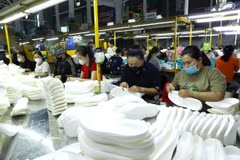
Shoe sole production at Kepai Co., Ltd. (a Japanese-invested enterprise) in Tan Kim Industrial Park (Tay Ninh) (Photo: VNA)

Tay Ninh expands industrial space to attract investment

To date, Tay Ninh has 3,234 domestic investment projects with total registered capital of nearly 800 trillion VND and 2,152 FDI projects with total registered capital exceeding 27 billion USD, ranking seventh nationwide in FDI attraction.

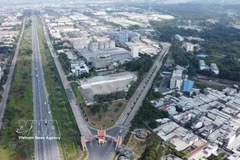
The Thu Thiem peninsula, an area positioned as the core of Vietnam's international financial centre. (Photo: VNA)

Vietnam revises scheme to improve sovereign credit rating by 2030

Under the decision, Vietnam aims to become a developing country with modern industry and upper-middle income by 2030, while building a competitive and effective governance system and a dynamic economy driven by science, technology, innovation and digital transformation.

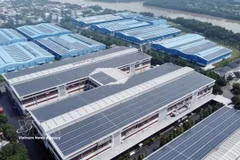
Rooftop solar power system at Kizuna JV Joint Stock Company in Tan Kim Industrial Park (Can Giuoc commune, Tay Ninh). (Photo: VNA)

Rooftop solar power development falls short of target: deputy minister

Deputy Minister of Industry and Trade Truong Thanh Hoai noted that rooftop solar power has several advantages, including short construction time, limited land requirements and reduced transmission losses. The Government has therefore promoted its development amid rapidly rising electricity demand, projected to increase by around 10% annually.